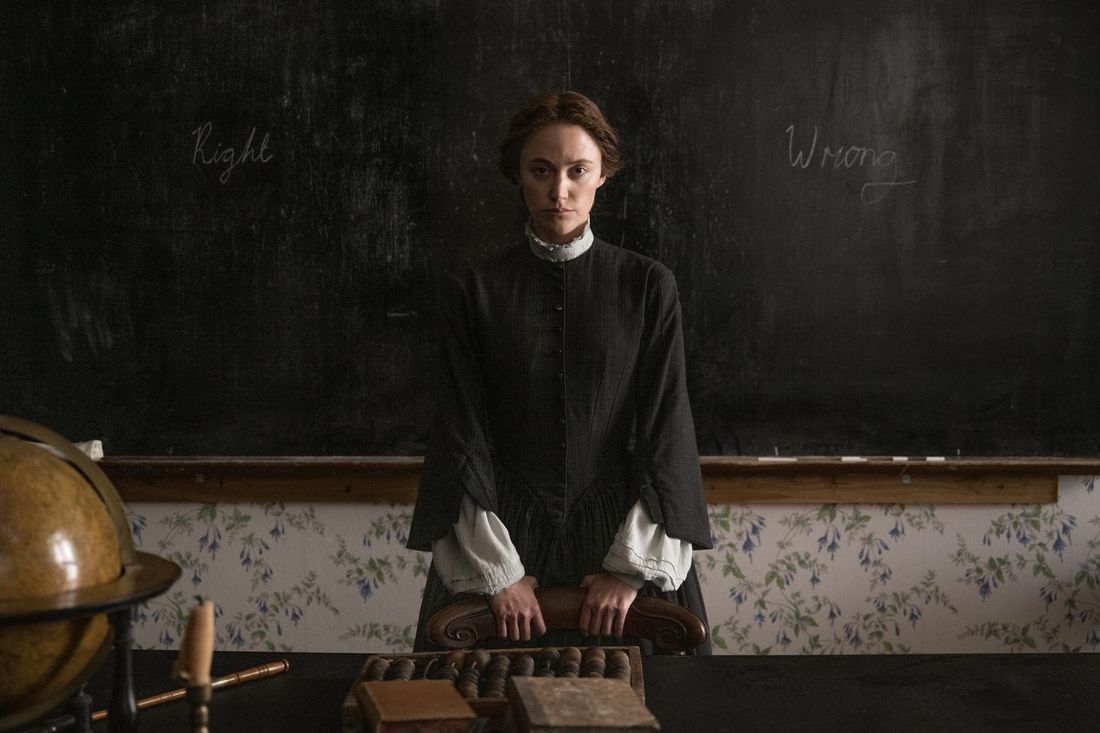
Maika Monroe is known for playing characters haunted by dangerous men, like in films such as Longlegs, It Follows, and Watcher. Now, she’s finally taking on a role where she gets to be the one causing trouble. In Victorian Psycho, which is debuting at the Cannes Film Festival, Monroe plays Winifred Notty, a governess who arrives at a spooky mansion in 1858 to teach two children (Jacobi Jupe and Evie Templeton). Initially, Winifred seems cheerful and eager to please the homeowners (Jason Isaacs and Ruth Wilson), but it quickly becomes apparent that she’s completely unhinged – and remarkably proud of it.
I’m really intrigued by Victorian Psycho, which comes from the novel of the same name by Virginia Feito – she actually wrote the screenplay too! It’s directed by Zachary Wigon, who did Sanctuary. From what I’ve heard, it’s totally over-the-top and energetic. Apparently, Emma Corrin, who plays the lead, was drawing inspiration from actors like Jack Nicholson and even… Ted Bundy! The role involves some seriously dark stuff – think swallowing ears, gruesome acts within a grand manor, and, well, it gets pretty intense. I recently had the chance to chat with Corrin and Wigon before the film’s Cannes debut. We talked about their experience premiering It Follows at Cannes back in 2015, filming in what they described as a genuinely haunted castle, and the surprisingly influential research they did – watching YouTube interviews with serial killers to get into the right headspace.
I was just looking at old photos of you from the premiere of ‘It Follows’ back in 2015, Maika. Maika Monroe: Oh my gosh, I’ve seen those pictures too! They’re… something. I remember buying an Anthropologie skirt – it wasn’t a great look, but I loved it at the time. It was a fun era.
What are your recollections of that period?
Monroe: It felt incredibly strange. We filmed It Follows with virtually no budget. David Robert Mitchell had previously made a very small film for around $100,000.
Zachary Wigon: So good. The Myth of the American Sleepover. I love that movie.
It was amazing. I was just starting out in my career, and I never imagined that this small, independent horror film would actually premiere at Cannes. It’s a moment I’ll never forget.
Have you shot They Follow yet?
Monroe: No, we go in two months. I’m so excited.
Is Jay alright?
Monroe: She’s… she’s doing okay. That’s all I can really say. She’s present and doing well.
So, I was chatting with Wigon, and it turns out this is his first time at the festival, which is pretty wild considering he’s been following it for years. He told me the lineup announcement is a huge event for him – he pores over every review and photo. It’s clearly been a lifelong dream; he’s been wanting to make movies since he was a kid, and this time of year, mid-May, has been a ritual for him for as long as he can remember. It’s one of those things he genuinely looks forward to every single year.
Cate Blanchett recently pointed out that this film is one of the few American productions at the festival, suggesting Hollywood is hesitant to take risks. Do you, as someone working within the industry, agree with that assessment? Monroe responded that she feels fortunate to be involved in projects like this one, and a few others she’s working on. However, she also acknowledged that many scripts and films being made feel uninspired, leaving her wondering why they’re being made in the first place. She expressed hope that this isn’t a permanent trend.
I’m really grateful to Anton, the studio that made this film, for believing in the project. I’ve found that when a movie blends genres, it often gives filmmakers more freedom to create something unique – that’s been true for this film and for my previous work, Sanctuary.
What was your reaction upon getting this script, Maika?
As an actor, I read countless scripts, and this one immediately stood out as something different and exciting. I also knew the role would be a real challenge, and honestly, it was a little intimidating.
I hadn’t taken on a role quite like this before, so that was a little scary. Usually, my characters are more reserved and subtle, but this one was very expressive and larger than life. I wanted to keep the performance realistic, but also push it to the extreme, which was new for me. We did a lot of rehearsals, which helped immensely. By the time we started filming, I felt really comfortable with the character. It was just figuring out how she moved, her expressions, and adding the British accent and the historical setting that were all different from what I’m used to.
Wigon: Working with babies, working with animals.
I’ll really miss playing Monroe. It was the most fun I’ve ever had in a role, and I felt incredibly free while playing her.
Someone asked Zachary what movie featuring Maika led him to cast her in this role. Zachary (Wigon) responded that it’s interesting to discuss It Follows because he considers both It Follows and Longlegs to be among his favorite horror films made after Cure.
Monroe: Cure is so good.
Wigon explained that Maika possesses a captivating inner depth that immediately makes you wonder what she’s thinking. She’s skilled at portraying that internal thought process, creating a sense of mystery behind her expressions. He felt this quality would be ideal for a serial killer character, as we’re naturally fascinated by the minds of such individuals in real life. He also discovered she admired Jack Nicholson, which was a great fit since the character they were developing was inspired by Jack Torrance.
I read you prepared for this role by watching footage of Ted Bundy. Can you tell me which clips specifically?
Monroe: Yes, that’s right! Or… was it Ted?
I saw this video of a forensic psychologist who would stop the interview every 20 seconds to point out subtle cues. He’d say things like, ‘Notice how his lip twitched – what he’s saying doesn’t match what he’s thinking.’ He was really breaking down every little movement and gesture.
I’ll never forget the video you showed me of him in prison. Someone asked him a basic question – like, ‘Who are you?’ – and you could see all these different emotions flash across his face. He was laughing, then angry, it was crazy! That’s when I knew, that was it!
Wigon described the experience as feeling like a machine adjusting to a living creature, or even something not of this world. He explained that Winifred seemed almost like an alien inhabiting a human body – that’s something they discussed at length.
Playing a character similar to Bundy was challenging. Did it affect you emotionally?
Monroe: It was an intense experience, but also really enjoyable. All the preparation allowed me to fully commit to the role, which was liberating. I don’t think I’ve ever felt that much freedom while acting.
What makes you keep returning to the horror genre?
Monroe: I find horror really captivating. Over the last decade or so, there’s been a resurgence of amazing filmmakers drawn to it because it offers a lot of creative freedom. You can truly explore new ideas and push boundaries. I feel fortunate to be working during a new era of horror – think films like It Follows, The Witch, and The Babadook – which are beautifully crafted with stunning visuals and soundtracks. These projects offer the most compelling roles and collaborations with the most innovative directors.
Should we be adding more female characters who exhibit psychopathic traits to the list of iconic figures?
Wigon explains that what intrigued him about the character was how Victorian England severely restricted women’s lives. He and Virginia discussed the bizarre beliefs of the time—like the idea that exercise could cause a woman’s uterus to fall out. He found it compelling to explore the link between this kind of repression and mental instability, noting that denying someone the ability to express themselves can be incredibly damaging.
Monroe described a fascinating perspective – a lack of certain emotions, like fear, which gave a sense of complete freedom. This feeling strongly motivated her to take on the role, something she doesn’t always experience when considering a part.
The interviewer complimented Monroe on scenes where her character was harsh with young Hamnet, asking how she balanced being convincing without frightening the child actor. Monroe responded by explaining that Jacobi, the actor who played Hamnet, was eleven years old during filming, despite appearing much older. She was impressed because he was already a seasoned writer, working on his fifth novel even during breaks from shooting.
So, is he writing a novel?
Monroe: He’s been writing in notebooks – this is actually his fifth book. He wants to feel like an adult, and it really feels like you’re talking to one when he writes.
Wigon is a very perceptive actor. He consistently asked insightful questions during rehearsals. There’s a moment where his character, Winifred, asks why people lose their faith, and Wigon wondered about the motivation behind that line. He asked me why Winifred would ask such a question, and I simply said he was curious about the theme. Jacobi, however, had a brilliant suggestion – that Winifred asks the question because he feels his own parents have lost their way spiritually. It was a much deeper interpretation than mine, and I immediately told him to go with it.
So, I got the lowdown on his novel from Monroe, and wow! It’s science fiction, really detailed, and he was walking me through all the characters – I was completely captivated, honestly. He’s a seriously talented writer, but Monroe did mention he might not want details shared, so that’s all I can say for now!
Who would win in a fight between Longlegs and Winifred?
Monroe: Wow, definitely Winifred. Longlegs would try his best, but I think she’s smarter and would ultimately win.
Wigon: I have to mull that further. Both of those characters are pretty vicious.
I heard the castle where you filmed was haunted. Did you experience anything unusual?
Wigon: Well, Randall – who is currently Lord Dunsany and owns Dunsany Castle – told me about it. It’s a massive place, around 30,000 square feet. He said one night he was upstairs and saw a woman he didn’t recognize walk down the hall, enter his office, and close the door. When he went to check, she was gone.
I always kept my backpack with me, and at the end of each day, after working outside, I had to quickly run inside the castle to get it before heading home. It was a huge, old, and dark castle, and I was usually the only one there, so I’d just dash in, grab my bag, and leave.
Monroe: I would not want to be in there alone.
Read More
- Off Campus Season 1 Soundtrack Guide
- DoorDash responds after customer uses AI to make food look bad and get a refund
- Jon Bernthal Explains Why Marvel Let Him Make The Darkest Punisher Story Ever
- Ethereum Eyes Break Above $2,420 as Rally Hangs in the Balance
- 10 Most Universally Beloved Sci-Fi Movie Villains, Ranked
- All Golden Ball Locations in Yakuza Kiwami 3 & Dark Ties
- Gold Rate Forecast
- 8 Movie Trilogies That Are More Rewatchable Than The Lord of the Rings
- XRP’s New Credit Hub: A Tale of Tokens and Trust
- The Strongest Battlegrounds codes (May 2026)
2026-05-22 00:57