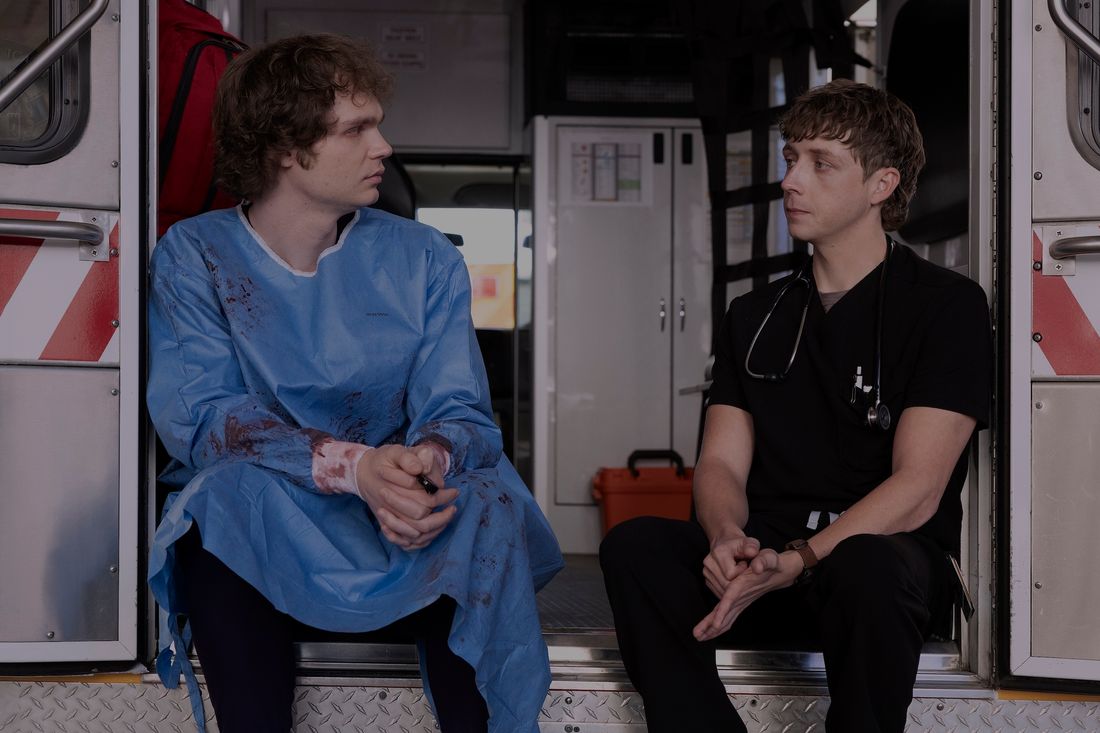
The first season of The Pitt showed us a team of doctors who were both incredibly skilled and genuinely caring. They weren’t perfect – they made mistakes and sometimes let personal biases slip in – but they always tried to improve. Season two introduces James Ogilvie (Lucas Iverson), a medical student who immediately makes a poor impression. He comes across as arrogant and overly eager to prove himself, quickly frustrating his colleagues. It’s difficult to sympathize with someone who seems to see patients as tasks to complete rather than people in need, especially when he constantly claims he’s naturally gifted at his job.
Throughout the second season, Ogilvie starts to show more of his compassionate side, largely because of guidance from Drs. McKay and Whitaker. The death of Mr. Green, a teacher who reminded Ogilvie of his father, deeply affects him and forces him to confront the emotional realities of working in an emergency room. While he’s skilled technically, the show questions whether that’s enough for this demanding job. As Iverson explains, not all doctors begin with natural empathy. The real challenge is figuring out how to teach humanity to someone who already has the medical knowledge.
Honestly, my first impression of Ogilvie was… rough! I totally crumbled after the audition. The notes said I didn’t read the room well, was smart, but liked to show it. Then, at my fitting, everyone was already saying I was a jerk! They kept mentioning this big rivalry with someone named Javadi, and I had no clue who he was. Luckily, John Wells gave me a key piece of direction early on. I was worried I was playing Ogilvie too much of a jerk, and he told me that was exactly what I needed to do. He said something that really stuck with me – I was almost afraid to talk about it until now – that to really connect with people, you have to push yourself way, way out there first. It was like, ‘Give yourself the biggest fall possible to see if you can land on your feet.’
Have you ever pushed things too far? We actually reshot a scene so I could play a more unpleasant character. But in the end, we didn’t end up using those new shots.
What drives that kind of behavior? It comes down to prioritizing self-preservation and a strong desire to succeed. It’s a mindset of needing to do what’s best for yourself, even if it means others lose out. For example, in a competitive situation like applying for a limited number of residency positions, someone might feel they have to act in a way that benefits them, believing it’s necessary to achieve their goals and create the life they envision.
How did your feelings about the character change throughout the season? He definitely becomes more understanding.
It’s interesting because the direction of Ogilvie’s story shifted halfway through. Initially, and in the scene I used for my audition, he was supposed to burn out and give up. There was even a tense scene planned with Robby. The original idea was that someone who should have thrived in a place like the Pitt would be crushed by it and unable to cope. But as the season progressed, the writers gave him more depth and heart, which is when his empathy started to show. It felt like we were figuring things out as we went – if we wanted to reveal that there was some good in someone like Ogilvie, how could we add that in mid-season? It was a really fun challenge, and I think they did a great job.
Among a team of caring doctors, Ogilvie often represents a different perspective – he embodies the kind of unconscious biases that can exist in healthcare. The show aims for realism, not just in its medical details, but also in the types of people it portrays. Many viewers have contacted us saying they’ve encountered doctors like Ogilvie, or nurses who’ve worked with someone similar, and even some have identified as the Ogilvie. This raises a difficult question: now that we’ve shown this type of person exists, what do we do with them? Is there a path to redemption or growth for someone who holds these biases? Should they be ostracized, or can they still be good doctors? And what responsibility do they have to address their own prejudices?
Now that people really dislike my character, Ogilvie, it’s been strange getting recognized as ‘that guy.’ I didn’t expect him to become such a target for negativity – I thought he’d just get a few minor criticisms. But it feels like there’s a real online backlash against him! Luckily, everyone I’ve met in person has been really kind. I checked online comments early in the season, but quickly realized it wasn’t a good place for me. I’ve peeked a few times after major episodes, but it’s starting to seem like the public’s opinion might be shifting a little.
He’s a fascinating mix of qualities. For example, he speaks Farsi and appreciates James Baldwin – it’s an unexpected combination. I’ve noticed he makes an effort to pronounce people’s names correctly, like saying ‘Dr. Mohan’ instead of the shortened version everyone else uses. He even learned some Farsi to make people feel more comfortable. While it might sometimes seem like he’s trying too hard to please, he is genuinely trying to connect with people in their own language, and his intentions are good. He can be both generous and emotionally reserved, which is a bit of a contradiction.
We trimmed a few lines from the end of the scene where he gives the Baldwin book to the teacher. Originally, he explained it was his father’s favorite and hoped the teacher, as a fellow English teacher, would enjoy it. That part of the story is now gone. The book itself is clearly well-read and shows a lot of wear, suggesting he’s read it multiple times, maybe trying to better understand his own father. Offering it to someone who reminds him of his dad, and wanting to connect on a personal level—more like a son seeking connection than a doctor making a professional gesture—reveals a lot about his character. Ultimately, he’s searching for a meaningful connection and understanding.
When the patient, Austin Green, passed away, Ogilvie was deeply shaken. How did you approach filming that scene? It felt like a turning point, fulfilling the prophecy that he was becoming fully human. In that moment, he wasn’t just mourning Mr. Green – they had formed a connection – but also the future he envisioned for himself. He was overwhelmed by a kind of spiritual paralysis, his sense of self completely tied to this loss. He questioned not only his abilities as a doctor, wondering if he’d made a mistake, but also his capacity to cope with repeated loss. It’s about confronting death, and it’s particularly devastating because this was one of his first days in his dream job, to realize this kind of pain is commonplace was terrifying for him.
Throughout the day, his harshness and seeming lack of empathy seem to be a way of shielding himself. He avoids emotional connection, likely because he anticipates negative outcomes. He faced criticism from colleagues after a patient died – referring to it bluntly. Apparently, dark humor and dismissive attitudes are common in the emergency room, and he participated in that, especially after briefly working with a severely alcoholic patient. It’s not surprising to him that this happened. When he sees others grieving, he’s shocked not by the loss, but by their willingness to feel so deeply. He hadn’t understood that emotional connection was a part of being a doctor. Now, with Mr. Green, he’s finally experiencing that connection firsthand.
The final scene with Ogilvie and Whitaker in the ambulance bay is a perfect ending. It really resonated with me, because when someone says they want to quit something, what they often mean is they need a reason to continue. It’s not about losing passion, but about the current pain being overwhelming and needing help to cope. Ogilvie is facing that same struggle – a crisis of identity. He’s looking for validation and understanding, something to help him decide if he can keep going. His suggestion of working with children seems like a desperate reach. It’s clear he’d rather give up entirely than face that. I think he chooses pediatrics because he subconsciously believes children are less likely to die, and it’s all about avoiding the grief that comes with loss.
Whitaker unexpectedly finds Ogilvie in a vulnerable moment. Initially embarrassed, he tries to keep it to himself, but eventually has to confide in Whitaker. Thankfully, Whitaker is understanding, and seems to recognize a bit of his own past in Ogilvie’s situation – mirroring a conversation he had with Robby in the first season about finding emotional balance.
Joining the show when it was so popular was really intimidating at first. I started to feel comfortable, but then all the award buzz began, and I got nervous all over again – it felt surreal that my first job was the big one! Luckily, everyone on set was incredibly kind and supportive. Noah and I often spent mornings journaling together in the family room, having really open and honest conversations about our fathers, our careers, and our lives. He was always patient with my basic questions, like trying to understand how the camera worked. It was a really special experience.
And I have to talk about the ‘poop cannon’! Whitaker was famously covered in fluids during the first season, and now it seems that ‘honor’ has been passed on to you. Everyone was saying that. Noah even had a video of the dummy they used for testing – it was getting blasted with the cannon and actually moved from the force of it. He kept watching it, laughing so hard he was in tears, and kept saying, ‘That’s going to be you!’
I was incredibly nervous that day on set. The director, Damian Marcano, told us we’d do as many takes as needed, but there wouldn’t be any rehearsals – he just said, “Get ready, and don’t mess up!” It felt like we were kids about to face something scary. We’d talked through the scene and jokingly practiced it without actually using the effect, and then the writer, Simran Baidwan – she’s fantastic – told me I looked like I was being shot and to relax, that it wouldn’t be so bad. It definitely was. The first time we did it, the force of it covered my face, and unfortunately, some…well, some waste ended up in my mouth. Luckily, it didn’t taste like anything! Our makeup artist even took a picture of the specks on my face, and now we have a little “wall of Lucas” next to the “wall of Gerran” from season one. And after all that, we didn’t even use that take!
What’s ahead for Ogilvie? The writers made a bold choice with his storyline. Instead of a typical redemption, they’ve shown his descent into destruction. He’s vulnerable and gets repeatedly hurt, leading to the collapse of his ideals and his view of medicine. He’s overwhelmed by the suffering he sees in the emergency department. This season focuses on the idea of compassionate people reaching their limits – we’ve already seen it with Langdon and Samira, and now it’s happening to Robby. It seems like having a big heart is almost a requirement for this kind of breakdown.
This isn’t about saying Ogilvie isn’t capable or should give up. It just feels like he’s processed a lot of his personal goals and is now ready to fully commit to this work. I truly hope he continues, as it sends a powerful message: even after experiencing heartbreak or closing yourself off, there’s always a way forward. He’s starting from a really strong place, with a clear understanding of what this job demands.
Read More
- Netflix’s Little House On The Prairie Reboot: Release Date, Cast & Everything We Know
- Off Campus Season 1 Soundtrack Guide
- YouTuber arrested after viral AI bodycam videos spark real police complaints
- Silver Rate Forecast
- Prime Video’s New R-Rated Spy Thriller Is Officially No.1 On Streaming Despite Poor Reviews
- Brent Oil Forecast
- Peaky Blinders: The Immortal Man’s Tommy Shelby Is a Better Father Than Michael Corleone
- Gold Rate Forecast
- EUR ZAR PREDICTION
- Bulgakov’s Take: Koreans Bet the Farm on Chips, Crypto, and Chaos
2026-04-07 21:56