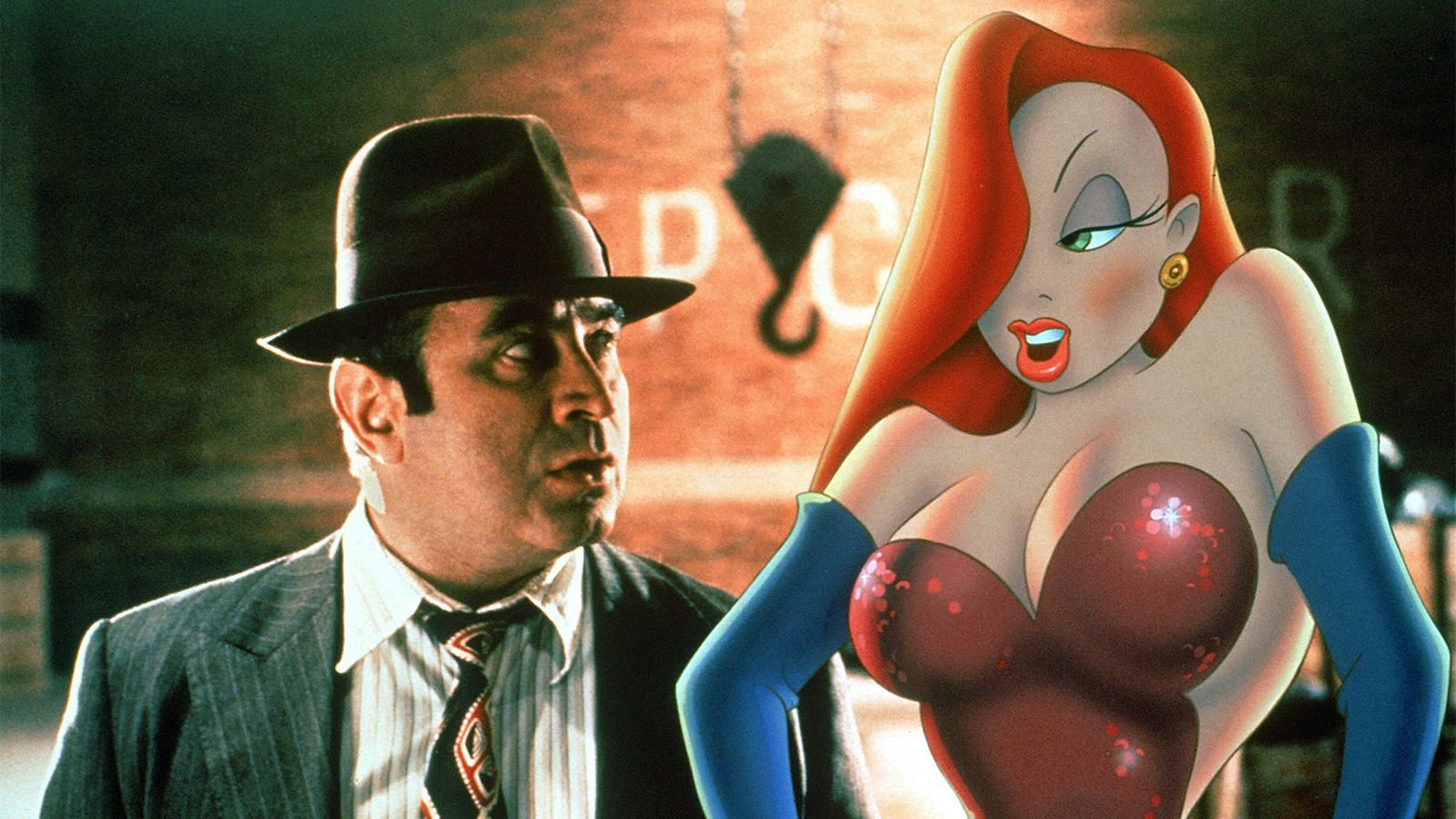
Who Framed Roger Rabbit is a unique blend of live-action and animation, taking place in a 1947 Hollywood where humans and cartoon characters live alongside each other. The film follows detective Eddie Valiant as he investigates the murder of Marvin Acme, a cartoon producer. He’s trying to clear Roger Rabbit’s name, as Roger is suspected of killing Acme due to a complicated relationship involving Jessica Rabbit.
Following Rain Man, Who Framed Roger Rabbit was another record-breakingly expensive film and a multiple Academy Award winner. The movie is famous for featuring over 100 cameos from classic cartoon characters, including Bugs Bunny, Bambi, and Betty Boop. While Betty Boop, popular since the 1930s, is often considered the first animated sex symbol, Jessica Rabbit quickly became just as well-known. Voiced by Kathleen Turner, Jessica Rabbit is now the standard for cartoon bombshells, but she’s also a strong, independent character and a significant figure within the asexual community.
It’s Not Easy Being Jessica Rabbit
In the book Who Censored Roger Rabbit, Jessica Rabbit is depicted as a rising actress who started as a comic strip character. She’s initially presented as someone who uses her attractiveness to get what she wants and is separated from her husband, Roger. However, the film version of Jessica is more complex. While still glamorous, the movie adds layers to her personality, revealing her intelligence, strong morals, and genuine love for Roger.
Jessica Rabbit is a timeless and unforgettable pinup character who has charmed viewers for decades with her alluring voice, striking looks, and unwavering love for Roger Rabbit. Animator Richard Williams and director Richard Zemeckis have called her the “ultimate male fantasy,” drawing inspiration from classic actresses like Rita Hayworth, Veronica Lake, and Lauren Bacall. Though designed to embody the ideal woman, Jessica Rabbit defies expectations by refusing to be seen as a typical ‘femme fatale.’ Unlike those characters who use seduction to manipulate others, Jessica playfully flips the trope on its head with her genuine love, loyalty, and fierce protection of Roger.
Jessica Rabbit’s creation was heavily influenced by Marilyn Monroe, another famous symbol of attraction. Interestingly, Monroe herself wrote about not being interested in sex, which has led to debate among researchers about whether she identified as asexual. Because both women are known for their highly sexualized images yet are believed to have lacked personal sexual desire, the asexual community has embraced them as icons representing asexuality.
She’s Not Bad, She’s Just Drawn That Way
Jessica’s performance clearly attracts unwanted attention from men, but she isn’t simply a victim. She’s aware of her own sexuality and how it affects the audience, and she actively uses that power to control the situation and turn the tables on those who try to objectify her. She anticipates their intentions and uses her sensuality to her benefit, essentially taking control before they can take advantage of her.
As a critic, I’ve always been fascinated by Jessica Rabbit, and the film cleverly subverts expectations around her character. She openly expresses her discomfort with being seen only as a sex symbol, making it clear she doesn’t enjoy the constant oversexualization. It’s a powerful statement – she feels trapped by her appearance, famously stating she ‘wasn’t made to be cute,’ but rather created a certain way. What’s particularly brilliant is how the film pushes back against the assumption that attractiveness equals a desire for romance or attention. It reminds me a lot of real-life figures like Yasmin Benoit, an asexual aromantic model who’s even cosplayed as Jessica, actively challenging the idea that women enhance their appearance solely to attract others. It’s a surprisingly modern and insightful commentary on societal pressures and expectations.
Asexuality is often misunderstood. It’s generally defined as experiencing little to no sexual attraction, and it’s actually a spectrum – sometimes called ‘aspec’ – that also includes different types of romantic attraction. The character of Jessica Rabbit offers a surprisingly complex portrayal of asexuality. Despite being presented as a sex symbol, her identity as asexual isn’t cancelled out. Some people find it confusing that she embodies both, but she challenges the idea that asexual people need to fit a certain look. Jessica Rabbit perfectly demonstrates that how someone appears has nothing to do with their sexuality. As an asexual icon, she shows that anyone can be on the spectrum and that asexuality doesn’t conform to typical stereotypes.
Is Jessica Rabbit a Toon In Name Alone?
This movie from the 1980s is unique because it successfully combines the dark, serious style of Film Noir with the over-the-top humor of classic cartoons. While some might see Jessica Rabbit as more human, she clearly has cartoon-like qualities and a playful, comedic side – plus, she has a completely unrealistic physique.
Besides storing items in an otherworldly space within her clothing, she also playfully blows kisses. This adds to her cartoon-like personality, which is further highlighted by her exaggerated reactions, like a surprised ‘double take,’ when Judge Doom reveals Dip – the only substance that can harm cartoon characters.
As a critic, I’ve always found Jessica Rabbit fascinating. While her cartoonish qualities aren’t as over-the-top as some characters, they are there, and it got me thinking. The way cartoons often behave – taking everything literally, prioritizing a good laugh, and constantly exaggerating – suggests Jessica’s extreme seductiveness might not be a choice. She might feel compelled to act that way, even if she doesn’t consciously want to. It’s actually pretty ironic, then, that the one thing Disney wouldn’t let her do today is be… well, Jessica Rabbit. They’d find her ‘too provocative’ for modern standards, which is a bit rich considering her entire persona is built on playful exaggeration.
Roger and Jessica Rabbit are Toontown’s Power Couple
Okay, so it sounds weird, but at its heart, Jessica Rabbit’s devotion to Roger is pretty straightforward – he makes her genuinely happy. Everyone else in Toontown assumes she’s being unfaithful, but honestly, she doesn’t give anyone else the time of day. She truly loves Roger for who he is, and she’ll go to extreme lengths to protect him, even if it means resorting to a little domestic violence – like, say, knocking Roger unconscious with a frying pan to keep him safe! It’s a surprisingly sweet, if slightly chaotic, dynamic.
A common misunderstanding about asexuality is that asexual people can’t have deep, loving relationships. But just because someone doesn’t experience sexual attraction doesn’t mean they can’t feel romantic love. Many asexual individuals do experience romantic attraction, and Jessica and Roger Rabbit are a great example. They clearly love each other, even without a sexual or physical connection. This further supports the idea that Jessica is asexual, especially since Roger is also considered to be on the asexual spectrum.
Throughout much of the film, it seems like Jessica is having an affair, which leads Roger to be suspected of murder. However, Roger insists she’s innocent and declares his unwavering love for her. Interestingly, a recent podcast explored how Jessica Rabbit can still be considered an asexual icon despite being married to Roger. While rabbits are often associated with high sex drives, the argument is made that Roger himself isn’t particularly sexual. The podcast suggests that we often assume characters are sexual simply because of societal expectations, and this doesn’t necessarily mean Jessica isn’t asexual.
The movie frequently highlights the odd pairing of Jessica Rabbit and Roger Rabbit, playing into the common trope of an attractive woman with an unconventional husband. However, from the perspective of the cartoon characters within the film, Roger is the more desirable partner. Characters like Betty Boop are shown to be charmed by him, seeing Jessica as the one who got lucky. To them, Roger is a successful and funny actor – a cartoon equivalent to someone like Goofy. The film consistently challenges what viewers expect, so it’s possible the filmmakers intentionally made the most visually appealing cartoon character not interested in romance.
Patty Cake, Patty Cake, Jessica’s Man
The setup for the conflict in Who Framed Roger Rabbit begins when Jessica Rabbit is seen playfully interacting with Marvin Acme, the head of Acme Corporation, leading to accusations of infidelity. Later, it’s revealed that Roger’s boss, M.K. Maroon, forced Jessica to do this as a way to blackmail a rival studio, threatening Roger’s job if she refused. Although this interaction is presented as something scandalous, the analogy doesn’t really fit the situation.
Valiant seems genuinely puzzled while photographing Jessica and Acme. Given his past experience with cartoon characters, he’d likely recognize actual sexual activity. Therefore, what he’s witnessing isn’t meant to be sexual; it’s a deliberately misleading joke played for the viewers’ amusement.
Roger overreacts to the news, but it’s established that cartoons are meant to be funny, suggesting he’d respond in whatever way he believes will get the biggest laugh, even if no one actually finds it humorous. If something genuinely brings joy to both Roger and Jessica, he assumes someone must have forced her to participate. Their lack of interest in sex is straightforward – there are no subtle hints or hidden meanings; they’d simply prefer wholesome activities like playing patty cake or baking a carrot cake.
Some argue that cartoon characters don’t experience sexual attraction, but the character Baby Herman suggests otherwise. Despite appearing as a baby, he’s portrayed as a middle-aged womanizer with a strong libido. He embodies a problematic, old-fashioned masculine stereotype through his suggestive behavior and objectification of women. This suggests that Jessica and Roger Rabbit’s apparent lack of sexual desire is specific to them, and not a general trait of toons.
Jessica Rabbit is a surprisingly well-developed asexual character who doesn’t get the recognition she deserves. Despite being seen as hypersexualized, she’s actually a nuanced and groundbreaking example of asexual representation in an 80s comedy – and her story still resonates today.
Found an error? Send it so it can be corrected.
Read More
- Netflix’s Little House On The Prairie Reboot: Release Date, Cast & Everything We Know
- Off Campus Season 1 Soundtrack Guide
- Silver Rate Forecast
- Prime Video’s New R-Rated Spy Thriller Is Officially No.1 On Streaming Despite Poor Reviews
- Gold Rate Forecast
- Brent Oil Forecast
- EUR ZAR PREDICTION
- Amazon Primes new GenAI cartoon looks like K-Pop Demon Hunters with aliens
- Inkford Hermitage Chest Locations In HSR (Honkai: Star Rail)
- KPop Demon Hunters Meets Avatar: The Last Airbender In Netflix’s 3-Part Fantasy Series
2026-04-06 19:10