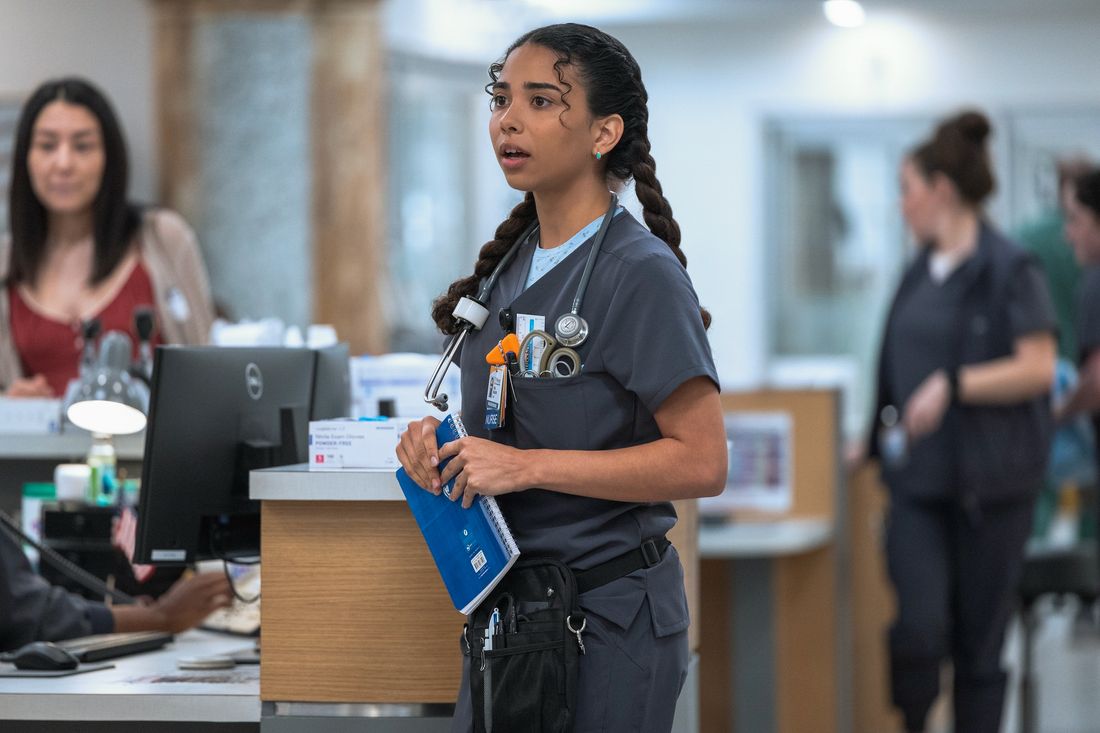
New nursing graduate Emma Nolan starts her first shift at the hospital on a particularly busy Fourth of July, understandably nervous but eager to help. She quickly realizes the emergency room is even more overwhelming than she imagined, facing a constant stream of unusual and disturbing cases – from a man with maggots in his wound to another suffering an overdose and a burn treated with honey. Beyond the physical challenges, Emma struggles with the emotional weight of witnessing so much pain and trauma, particularly while assisting with a sexual assault examination. Just when she’s trying to process everything, an unstable patient attacks her, leading to a hospital-wide alert and setting the stage for further drama.
There are several striking similarities between the character Emma and the actress who portrays her, going beyond just growing up in the Midwest. Just as Emma starts a demanding job immediately after nursing school, the actress graduated from Juilliard directly into a high-profile production. The support and direction she received from a co-star mirror the mentorship Dana provides to Emma on the show. And, like Emma’s quick recovery from a difficult situation, the actress wasn’t particularly shaken by the intensity of an attack scene, drawing on her training – she jokes that Shakespeare can be quite intense as well.
Similar to Emma, who grew up in Sault Ste. Marie, Michigan, you also have Midwestern roots. I’m originally from the French Caribbean – I was born in France and spent my childhood moving between France, Guadeloupe, and Wisconsin. I went to school from kindergarten through twelfth grade in Wisconsin.
I’m also from the Midwest, originally Michigan. I can definitely hear a midwestern accent in your voice – I used to have one myself. I’ve mostly adjusted how I speak over time, but when I visit Wisconsin, my accent comes back really strong, and it’s a little embarrassing. I end up sounding like a stereotypical suburban mom!
So, ‘The Pitt’ is your first time appearing on screen? Well, I was working on a small independent film beforehand, but this feels like my official debut. I trained at Juilliard, and in our final year, we perform scenes for industry professionals in both New York and Los Angeles. It was during a showcase in L.A. that Cathy Sandrich Gelfond, a casting director, saw me and thought I’d be a good fit for the role of Emma. She sent me the scripts for both Emma and Joy, and after reading the character descriptions, I immediately felt connected to Emma, a girl from Sault Ste. Marie. As someone who grew up in the Midwest, I understood her background.
I initially wondered if the character, Emma Nolan, seemed like she wasn’t a person of color, especially since she’s from the Upper Peninsula of Michigan, an area where I don’t know many people of color. Then I realized I was dismissing my own background – I was one of only two Black students in my class and I’m from Wisconsin. Why was I excluding myself from that demographic? That’s when I decided to audition. I felt I could portray the experience of a high schooler who tries to do too much, always wanting to help others before herself.
What was it like jumping into a popular show like this?
Honestly, I was exhausted after graduating from Juilliard. It’s a very intense school, and I was worried about finding work. Getting this role right before graduating was a huge opportunity. My family was much more excited than I was – I was in shock and couldn’t fully grasp how life-changing being on The Pitt would be. On set, I kept my head down, focused on doing the scenes and truly representing Emma. It’s only now, with the show out, that I realize how incredible it all is.
Did you have to go through a training bootcamp like the other actors?
We had a one-day bootcamp. The nurses had a refresher, as they did two weeks of training last year. Emma needed more theoretical knowledge than hands-on practice. Even nurses fresh out of school haven’t often practiced CPR on a real person – this show provided that experience. But the hardest part for me was the emotional side. During filming, medical professionals often told me to hide my reactions more. I didn’t think I was showing much emotion, but when I looked at the monitor, I realized that even just listening, I naturally express empathy. I learned that people don’t want to be pitied or misunderstood, so maintaining a professional demeanor is crucial.
The hardest scenes to film were those involving Louie’s passing, especially because it also meant saying goodbye to Ernest, who’s a beloved presence on set and brings so much energy. It was a very emotional experience for Emma to witness the support of the entire cast and crew—the ‘Pitt’ community—during those scenes. Noah Wyle advised us during the final episode of season six not to force tears, but to find the genuine emotion. It was challenging because you truly felt the loss of the character, and it was hard not to cry while performing those scenes.
I was really moved by the scene where Dana shows Emma how to prepare a body for viewing – leaving one hand free for family to hold. Later, when everyone says goodbye to Louie, Emma gently takes his hand. It reminded me of my own difficult experience seeing a loved one in an open casket. Emma realizes that Louie is well-known at the hospital, but tragically, no family is coming to claim him. Given Emma’s own upbringing – growing up with her grandmother and a somewhat fractured family – she seems to understand his loneliness. Seeing Louie, who has suffered so much loss, creates a sense of connection for her. In offering him comfort, she also finds a sense of belonging, almost as if she’s discovering a family within the hospital staff.
The storyline dealing with sexual assault is among the most impactful of the season. A significant amount of research went into portraying it accurately, including visits to facilities like the Stuart House in Santa Monica, which works with UCLA’s emergency department on these cases. The production team spent half a day with a real SANE nurse, learning about her work and procedures, and she even consulted on set to ensure authenticity. It was important to show the sensitivity of the process and properly isolate the forensic aspects.
Throughout the season, the actor worked closely with Katherine LaNasa, describing her as incredibly energetic and a joy to work with. They developed a strong dynamic quickly, and the actor was thrilled when LaNasa won an Emmy. LaNasa consistently brought insightful questions to the role, particularly about the emotional toll on the nurse character, pushing the actor to delve deeper. On set, amidst difficult scenes, LaNasa would often dance to lighten the mood, reminding everyone of the importance of levity during long shoots. This helped them both process the intense material and reset.
In the episode “5 p.m.,” the actor’s character is put in a headlock by a patient. Having previously performed Shakespeare, including roles in Macbeth and King Lear, the actor found this scene cathartic, allowing them to channel personal experiences through the character and release negativity.
It seemed like this was all planned out in detail, didn’t it? Absolutely. We practiced it very slowly, discussing every little detail – even parts you don’t see on screen. I felt completely safe because I was working with experienced professionals.
I was still feeling the effects of the headlock even though it was all part of the fight choreography – your body really remembers those things. I knew I was safe, and working with Travis Van Winkle was great. He consistently checked to make sure I was okay. The fight choreographer was also helpful, but Travis had a lot of experience with fight scenes, which made me feel much more comfortable. Interestingly, the choreographer kept telling me to fight more, so near the end, Travis encouraged me to really go for it and break free from the safe headlock. Watching those scenes now, I still have a strong physical reaction to it.
Also in that episode, when two ICE agents brought an undocumented patient into the ER, Emma questioned whether they should treat her, and Robby pointed out they just needed to provide care. I noticed some people were skeptical of Emma’s reaction, but it seemed realistic to me that she might not immediately know that emergency care is a right for all patients.
I actually first learned about anonymous care for undocumented people from watching Grey’s Anatomy, so it felt meaningful to portray that on screen. There’s a lot happening for Emma in that scene, so let’s be understanding! She may have heard about patient rights before, but she’s from Sault Ste. Marie, which doesn’t have a large immigrant population. I think sometimes information doesn’t really sink in until you’re faced with a situation firsthand.
Some viewers seem to hold non-white characters to a higher standard, forgetting that everyone has their own flaws and perspectives. This character really resonates with my own high school experience. Being a person of color, especially growing up in a predominantly white environment, can create a lot of internal struggles. It’s about not knowing how to fully accept yourself and navigating harmful situations without realizing they’re unhealthy. For me, moving to New York helped me discover who I truly was, and I hope the same happens for Emma. Being in a new environment like Pittsburgh could broaden her horizons. Her upbringing with a white grandmother likely meant she didn’t receive the guidance she needed.
Emma is understandably nervous and shy on her first day, but she’s surprisingly willing to tackle difficult tasks and insists on staying after a difficult event. This shows she’s stronger than she appears. She’s comfortable being vulnerable, and Dana creates a safe space for her to express her nervousness while also demonstrating her work ethic. I’m reminded of the hardworking people from the Midwest, like those I know from Wisconsin, who are willing to put their heads down and work hard. Emma has always been resilient, and she chooses to remain optimistic as a way to cope.
I’m excited to see what the future holds for Emma. I want viewers to be constantly wondering if she’ll stay true to herself or start to change and become more like Dana. Will she become cynical? I’d love to explore that internal conflict and see how she evolves. It would also be interesting to show her navigating a traumatic situation, highlighting the chaos and challenges that nurses face.
People often misjudge Emma. We should explore her past to reveal her hidden strength and show that her reserved demeanor is a deliberate act, not a sign of innocence or weakness.
Read More
- Netflix’s Little House On The Prairie Reboot: Release Date, Cast & Everything We Know
- Off Campus Season 1 Soundtrack Guide
- YouTuber arrested after viral AI bodycam videos spark real police complaints
- Silver Rate Forecast
- Prime Video’s New R-Rated Spy Thriller Is Officially No.1 On Streaming Despite Poor Reviews
- Brent Oil Forecast
- Gold Rate Forecast
- Bulgakov’s Take: Koreans Bet the Farm on Chips, Crypto, and Chaos
- Peaky Blinders: The Immortal Man’s Tommy Shelby Is a Better Father Than Michael Corleone
- EUR ZAR PREDICTION
2026-03-31 22:56