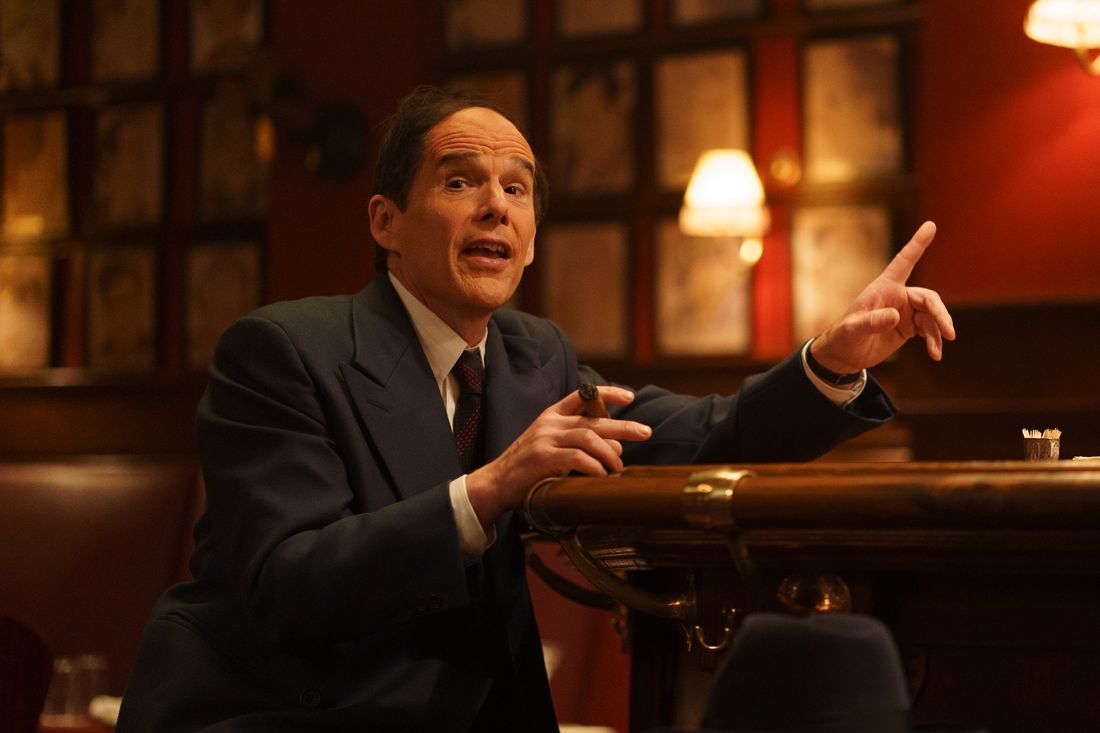
Robert Kaplow’s Oscar nomination for Blue Moon came as a big surprise to many. Most predictions only included a nomination for Ethan Hawke’s acting, and Kaplow isn’t a typical Hollywood insider. He spent three decades teaching high school while also writing comedic songs for NPR’s Morning Edition. He previously wrote the book Me and Orson Welles, which was turned into a 2008 film, but he didn’t receive writing credit for that screenplay. This makes Blue Moon his first official screenwriting credit, and now he’s an Academy Award nominee.
The film Blue Moon tells the story of Lorenz Hart, a talented lyricist who wrote hit musicals like Pal Joey with his partner Richard Rodgers. However, the movie focuses on a single night after their greatest successes, when Rodgers has moved on to collaborate with Oscar Hammerstein II on a new musical, Oklahoma! This new partnership would become the most famous in musical theater history. The film depicts Hart, a gay, troubled alcoholic, grappling with being left behind as the world shifts toward more optimistic entertainment during wartime. He spends the opening night of Oklahoma! drowning his sorrows, complaining to a bartender, and longing for a young woman he can’t have. Despite being a sad story, Blue Moon is surprisingly funny and witty, thanks to a script packed with jokes. The writer aimed to capture Hart’s voice through his lyrics, which are known for being smart, playful, and subtly melancholic, even when they’re humorous.
The idea for Blue Moon actually came from a moment I experienced in my twenties. I was trying to become a songwriter and ended up writing comedic pieces for NPR’s Morning Edition. While researching at the New York Library of the Performing Arts in the mid-1970s, I listened to a three-hour interview with Richard Rodgers. I remember being struck by how dismissively he spoke about his writing partner, Hart. There was a coldness in his voice that hinted at deeper, hidden emotions. It felt like he was protecting himself, keeping things strictly professional. That moment stayed with me, and I knew I wanted to explore it in my writing someday.
For years, I wrote fiction about different subjects, but I kept being drawn to the story of Lorenz Hart, feeling like he had so much to say. I started writing it down in a notebook, and it ended up filling 71 pages with his voice. Then, while talking to director Richard Linklater – who’d previously adapted my novel, Me and Orson Welles – I mentioned I was working on a piece about Hart’s final days. He asked to read it, and that simple request is what led to this conversation.
After hearing that interview and before writing the script, I did a lot of research into songwriters. I read biographies of people like Rodgers, Hart, and Sondheim, almost collecting material without realizing it. Your brain somehow stores things for later use. Nowadays, if you were writing about Sondheim, there’s tons of interview footage to study his way of speaking. But with Hart, it’s different. He’s a much more mysterious figure. My biggest challenge was creating a voice for him that was lighthearted and amusing, but hinted at a deeper sadness – a longing for love that he felt he’d never achieve.
Lorenz Hart subtly explores themes related to gay identity. Considering the time – 1943 – and the character’s background as a 47-year-old Jewish man living with his mother, any suggestion of same-sex attraction had to be implied rather than explicitly stated, though it becomes clearer by the film’s conclusion. This portrayal of gayness differs from modern depictions, which often emphasize pride and openness.
He consistently presents himself with a deep sense of self-hatred, particularly evident in his demeanor from 1943. In his work, Blue Moon, this shame and self-loathing subtly seep into everything he discusses.
When creating this work, I considered how much the audience would already know about the subject. Many people aren’t aware that Richard Rodgers collaborated with Lorenz Hart before he teamed up with Oscar Hammerstein. I wanted to bring Hart’s contributions to light. Rodgers and Hart worked together for 25 years – half of Rodgers’ life – and their relationship was complex, a mix of affection and frustration. The film begins with Hart’s collapse, followed by a simulated radio obituary from 1943. This opening, suggested by Richard Linklater, quickly establishes who Hart was for viewers who may not be familiar with him, providing necessary background information in about 40 seconds.
Honestly, watching it felt more like a play than a movie – it’s so focused and takes place almost entirely in one location. I kept asking myself, ‘What makes this a film?’ I intentionally leaned into that theatrical feel because the story revolves around songwriters and producers. But stage plays are usually big and broad, with actors really projecting to reach everyone in the audience. This story is much more personal and contained. It reminded me of an Ingmar Bergman film – something like Scenes From a Marriage with a small cast. You wouldn’t walk away from that and think, ‘This would be better as a play,’ just because it only features a few characters, right?
There’s this incredible scene in Blue Moon with Ethan Hawke and Margaret Qualley, and it takes place entirely in a coatroom – for fourteen minutes! Honestly, most directors would have panicked and tried to find ways to make it more visually dynamic, like moving the camera around. But Linklater just kept it focused on the characters and their conversation. What really gets to me is how close the camera is to their faces. When Margaret Qualley finally tells Ethan’s character, “Of course I love you, Larry, but just not that way,” you can see the struggle in her eyes. She’s clearly heartbroken saying it, and you feel like she’s desperately trying to soften the blow because she really does care about him.
Ethan Hawke’s performance feels surprisingly natural compared to typical stage acting, even bordering on wonderfully strange. It’s the kind of role that could easily be overdone by another actor, but here it works. On stage, it might be too much, but he pulls it off.
You’ll be seeing this play performed in theaters nationwide soon. The film version cleverly handles the actor Ethan Hawke’s height – sometimes emphasizing it, but often allowing the audience to forget it. On stage, the height difference is a constant visual element. However, the movie focuses on what Hawke’s character is saying and doing, rather than making his height or identity the central focus of sympathy.
When approaching the show, we knew Oklahoma! was incredibly popular – possibly Rodgers and Hammerstein’s biggest success. They followed it up with other famous musicals like Carousel, South Pacific, and The Sound of Music. Lorenz Hart famously disliked the sweetness of Oklahoma!, and it’s funny to imagine how much more he might have disliked The Sound of Music – he might have even sided with the villains just to stop the constant singing!
During World War II, in 1943, Oklahoma! resonated with audiences, offering a welcome escape. However, this bothers Richard Rodgers—the show is overly sentimental and romanticizes a past that never truly existed. It features idyllic scenes of farm life, like churning butter and singing about beautiful mornings. While undeniably lovely, these elements weren’t suited to Rodgers’s own artistic style. He was initially asked to adapt the story, but thankfully he declined – the result would have been disastrous.
Beyond being a beloved classic, Oklahoma! was groundbreaking for musical theater. It helped evolve the art form by integrating songs directly into the story and having characters sing in a way that felt authentic to them and moved the plot forward. This approach is something Rodgers and Hammerstein collaborator Oscar Hammerstein II excelled at, surpassing Lorenz Hart in this regard. Hart was more focused on entertaining audiences, while Hammerstein was a true musical storyteller. In fact, Mary Rodgers noted that Pal Joey hasn’t fully succeeded as a musical because its songs don’t actively contribute to the narrative. Hammerstein was a dramatist who used music, while Hart was primarily a skilled lyricist and comedian.
You know, as a movie buff, I’ve always wondered if Arthur Hart realized Oklahoma! was just a better, more impactful piece of drama than anything he’d done. I think he did, deep down. He’d never admit it outright, of course. But when he jokes to Rodgers about it running longer than Abie’s Irish Rose, it’s clear he gets how special it is. And later, as the rave reviews pour in – especially that huge one in the New York Times – he’s surprisingly gracious. He even tells Rodgers he’ll put “Quite clearly approaches perfection” on the marquee! It’s amazing, considering it’s a show he didn’t create and one that, realistically, signaled the end of his own career.
In a sense, the show effectively ended the careers of everyone involved except for Rodgers and Hammerstein. It set such a high standard that composers like Frank Loesser, known for Guys and Dolls and How to Succeed in Business Without Really Trying, felt compelled to match its quality, specifically by writing similarly strong character-driven songs.
Even the prolific Cole Porter seems less impressive when you consider how many of his musicals relied on older songs – tunes he’d written previously and simply repurposed. After 1943, he only really had one major hit, Kiss Me Kate. And even in that show, a memorable song like “Brush Up Your Shakespeare,” sung by the gangsters, feels like it could fit into any musical – it wasn’t specifically written for the story.
There’s a certain brightness and cleverness to these lighter, more playful songs that feels more carefree and spirited than the classic, more serious musicals written by Rodgers and Hammerstein. It’s a bit of a surprise, actually. It shouldn’t really make sense, but the work of a comedic playwright like Noël Coward is just different. It’s full of irony and playfulness, and it’s sexier in a more humorous way than anything Oscar Hammerstein ever wrote. He created beautiful songs like “Some Enchanted Evening,” but they always feel a bit constrained by traditional values. While many of Rodgers and Hammerstein’s shows have remained popular over the years, the actual stage productions of Rodgers and Hart’s work haven’t had the same staying power – though their songs certainly have. People just don’t perform those old musicals anymore.
Rodgers and Hammerstein musicals are generally cheerful and tell complete, satisfying stories with a clear beginning, middle, and end, often including a sad side story. South Pacific is considered one of their best because the story was written by Josh Logan, who was a stronger writer than Oscar Hammerstein. Logan’s experience in the war gave the dialogue a realistic feel, making South Pacific a more powerful and gritty musical.
Rodgers and Hammerstein musicals are strong enough to support modern reinterpretations, as seen in the 2019 production of Oklahoma! which emphasized the darker side of the American West. I doubt earlier Rodgers and Hart shows like Pal Joey or Babes in Arms could handle that kind of treatment. They’re different. You can enjoy a funny, satirical work like the Marx Brothers’ Duck Soup – it’s both a parody and a musical – and Rodgers and Hart have a similar playful energy. They’re lighthearted and silly, and there’s definitely an audience for that kind of entertainment. It’s the same audience that enjoys something like Little Shop of Horrors – you’re meant to be entertained, not to take it too seriously.
Do you feel America suffered a loss when Lorenz Hart passed away? Absolutely. I believe musical theatre lost a great talent. The witty, satirical lyrics Hart wrote in the 1930s wouldn’t have resonated during the 1940s with the war happening. However, if he’d lived longer, his style would have fit right in with the resurgence of satire in the early 1960s. Consider A Funny Thing Happened on the Way to the Forum – Hart could have written that show, and it likely would have been just as hilarious as the version Sondheim created.
As a huge film enthusiast, and a Sondheim admirer, I just had to include him in a cameo in ‘Blue Moon’! It felt perfect because he was practically Oscar Hammerstein’s son in spirit – they were neighbors in Doylestown, you see. And the story about him seeing ‘Carousel’ for the first time is amazing. He apparently spent the whole night crying onto Dorothy Rodgers’s fur coat, which she was not happy about! It’s such a funny, charming anecdote. I loved the idea of having Hart ask someone what they thought of his work, and then having that ‘someone’ be Sondheim, representing his actual opinion. He was a bit critical in his book, ‘Finishing the Hat,’ but the whole thing just felt too good to pass up.
He could be really critical, and I think that came from Sondheim feeling like his mentor wasn’t always appreciated the way Lorenz Hart was. It felt like he was fiercely defending his mentor, almost saying, ‘No, he was the brilliant one, and Hart wasn’t as polished.’ Honestly, I couldn’t help but reflect that same intensity back at young Sondheim himself – that same sharp edge.
Honestly, one of my favorite parts was seeing those two gay characters playfully bicker with each other – it was hilarious! And I just loved when Hammerstein walked in on their conversation with Margaret Qualley. His line, “I hope I’m not interrupting anything too weighty,” and Hart’s snappy response, “Weighty affairs will just have to wait,” was brilliant. It’s so cool to realize Sondheim actually remembered that moment and used it in “Comedy Tonight” twenty years later!
Someone asked if I worried about breaking the fourth wall with my little winks to the camera. I didn’t think they were distracting enough to pull people out of the movie. Richard Linklater actually said he wished Stephen Sondheim had lived longer so he could have shown him the script. He believed Sondheim would have really enjoyed it and found it humorous.
The idea that Hart may have sparked a line in Sondheim’s work or inspired E.B. White’s Stuart Little essentially cements Hart’s place in history. It’s a way of highlighting his influence, even if the connection isn’t definitively proven. While researching, I wanted to understand Yale University in 1943, so I bought the yearbook from that year on eBay. I flipped through the drama section and discovered George Roy Hill, who later directed Butch Cassidy and The Sting, was a prominent member of the drama club. He was even Elizabeth’s date to a party! Hart advised him, “Don’t focus on love stories, tell stories about friendship.” Hill apparently took that advice to heart, and I’m finding all this quite fascinating.
People always ask if Elizabeth is based on a real person, and the answer is no, but she started with something real for me. I stumbled across these amazing letters – twelve carbon copies of letters she wrote to a guy named Hart. I don’t have Hart’s side of the conversation, sadly – those letters are probably long gone, maybe even in a landfill somewhere! But reading Elizabeth’s letters, you get a real sense of a friendship between them. They even went to a lake house together, though I have no idea if they were alone or what happened while they were there. She mentions a terrible 20th birthday with someone she liked, but she never actually says what went wrong, which always stuck with me.
I enjoyed creating a narrative for her that subtly highlighted the themes in Hart’s story. She’s sharing a story of unreturned love concerning her boyfriend from Yale, but Hart interprets it as a story about his own unrequited love. When she asks, “Do you know what it’s like to love someone and receive nothing back?” Hart responds with a line from Casablanca – “Nobody ever loved me that much.” I find it interesting how they seem to be having a conversation, yet completely missing each other’s point.
I chose to have him fall for a woman because I had the source material – the letters – and I felt it heightened the tragedy. It’s a more difficult situation, and the audience instantly understands that. It takes the character until the scene in the coatroom to finally accept that she only sees him as a friend and someone to confide in, and that will never change.
We needed to address the character’s alcoholism because it’s a key reason for his strained relationship with Rodgers. Many people who’ve struggled with addiction present it as something they’ve overcome, but that’s rarely the case. For this character, alcohol is a coping mechanism, a way to numb the pain. The scene portrays a moment where his professional failures and personal struggles collide, driving him to drink. The bartender offering them both a drink at the end felt fitting – at that point, he has nothing left to lose and won’t be attending the party he mentioned earlier.
What do you personally think of Oklahoma!?
I like the songs a great deal.
Honestly, the music is really lovely – one great song follows another. But I actually find the show itself a bit cheesy and embarrassing.
I noticed the movie doesn’t really highlight that line, and I was curious if his view is similar to yours. When he calls the line ‘The corn is as high as an elephant’s eye’ the worst in American songwriting, I actually agree. While it fits the rhythm and makes sense, imagining an elephant in an Oklahoma cornfield feels… strange. It suggests the songwriter wasn’t very attuned to imagery. Still, I enjoy the songs and get lost in the story when I watch Oklahoma!
You appreciate Rodgers’s musical talent, even if you’re not always a fan of his lyrics. The lyrics don’t really bother me, though. As a musician myself, I find Rodgers’s music incredibly exciting. I actually wrote him two fan letters back in the 1970s, and he surprisingly responded both times! I’ve framed those letters and have them hanging in my office. He wasn’t very busy then, so he had the time to reply. I just wanted to tell him how much his music meant to me, and I’m happy I did.
The film is set in a time when both Richard Rodgers and the nation have moved on from the style of work previously associated with Lorenz Hart. It’s the early 1950s, and societal focus is shifting towards the traditional nuclear family. Rodgers now embodies this ideal: he’s married with children, successful, and presents a respectable image. In contrast, Hart continues his late-night lifestyle, and Rodgers finds this increasingly distasteful.
He sees Hart as a flawed person. While Hart has his issues, I’d still choose to spend time with him – I think he’d be really fun. I hoped the movie would make viewers feel like watching it was a challenging experience, but one they wouldn’t forget, as if they’d shared a memorable time with him.
I’ve heard about Richard Linklater’s film adaptation of Merrily We Roll Along, which he’s shooting over twenty years, but I’m not involved. From what I understand, he’s already filmed around a third of it.
So, I got to go to the Oscars nominee luncheon, thanks to Sony flying me out. It was amazing to meet so many respected directors, like Ethan Hawke and Paul Thomas Anderson. Paul Thomas Anderson actually came up to me and said he was a fan of my film, Blue Moon, which was pretty surreal! Ethan and I joked about how the nomination certificate might be the only reward we get. It was a really fun, and slightly humbling, experience.
Will I be attending the premiere and walking the red carpet? I already experienced something similar at the awards luncheon – it felt incredibly awkward and out of place, like I didn’t belong.
Honestly, the gift bags they give out are amazing! I’m really excited – they’re flying me in on Saturday for the show, which is on Sunday, and then sending me back home on Monday. It’s going to be a quick trip, but totally worth it as a movie fan!
Read More
- Off Campus Season 1 Soundtrack Guide
- Chainsaw Man Volume 24’s Cover Art Reveals a Brand-New Denji
- Dragon Quest II HD-2D Remake: Where to get the Magic Key
- DoorDash responds after customer uses AI to make food look bad and get a refund
- HSR Banner Schedule (Honkai Star Rail)
- How to Get to the Undercoast in Esoteric Ebb
- Euphoria Season 3’s New R-Rated Sydney Sweeney Scene Proves The Show Is Trolling Us
- Hideo Kojima says Metal Gear Solid 2 became the future he hoped would not happen
- Gold Rate Forecast
- All Golden Ball Locations in Yakuza Kiwami 3 & Dark Ties
2026-03-14 16:00