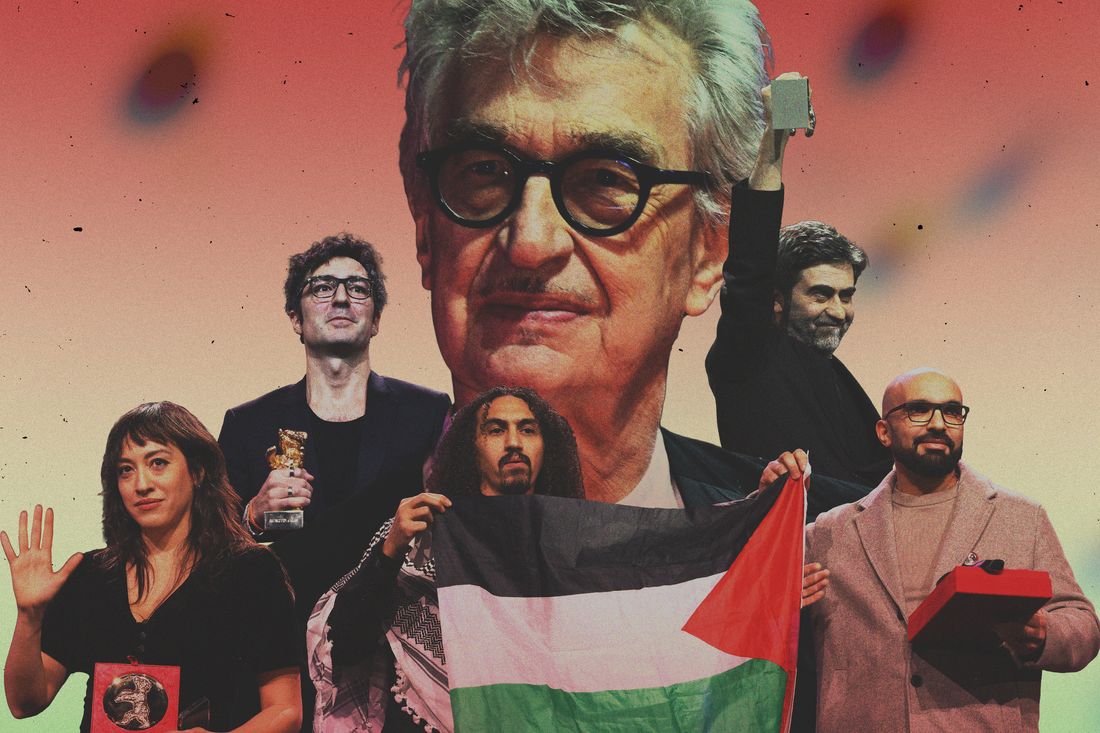
This year’s Berlin Film Festival sparked debate about the role of politics in film. The discussion began when the festival’s president, Wim Wenders, stated that filmmakers offer a different perspective than politicians. This led to widespread disagreement throughout the 11-day event. Now, the German government is reviewing its support for the festival, and the Minister of State for Culture has called an emergency meeting about its management. As a result, it’s likely that the festival director, Tricia Tuttle, will be removed from her job.
It’s strange to even debate whether politics have a place at film festivals, especially considering Berlin’s long history as the most politically engaged of the major international events. This year’s festival reinforced that reputation: the top prize, the Golden Bear, went to İlker Çatak’s Yellow Letters, a film about a couple whose lives are disrupted by the Turkish government due to their beliefs. The second highest award, the Grand Jury Prize, was given to Emin Alper’s Salvation, a drama exploring the escalating violence and mistrust between two Kurdish families.
During the closing ceremony, Abdallah Al-Khatib, a Syrian-Palestinian director who won the Perspectives award for his film Chronicles from the Siege, made a powerful statement. He held up a Palestinian flag while accepting the award and vowed to remember those who supported them, as well as those who opposed their right to a dignified life or remained silent. Addressing the German government, Al-Khatib, who is a refugee in Germany and had been cautioned about his speech, directly accused them of being complicit in the events in Gaza, stating, “You are partners in the genocide in Gaza by Israel.” He added that he believed they were aware of the truth but chose to ignore it.
Earlier, Lebanese director Marie-Rose Osta, who won best short film for Someday a Child, spoke about the bombing of Lebanon and Palestine. She stated, “No child should have to be extraordinarily strong just to survive a genocide fueled by vetoes and a breakdown in international law.” She added that if her Golden Bear award meant anything, it should signify that the lives of Lebanese and Palestinian children are not something to be compromised.
The closing ceremony felt unusually political, and seemed to be a reaction to comments made by director Wim Wenders about Palestine. He had awkwardly tried to change the subject after another jury member gave an uncomfortable answer. The original question was pointed: it asked about the festival’s ties to the German government and why it strongly supported Ukraine and Iran, but remained quiet about the situation in Gaza, particularly regarding human rights. It’s a challenging question, and perhaps not one best answered by a film festival jury.
Honestly, this whole scandal felt… expected. It’s the kind of thing you’d think someone leading a jury would be ready for. It actually happened last year at Venice, when the jury president, Alexander Payne, just said he was there to talk about movies when asked about Gaza. It’s getting so routine now, it’s almost funny – they should just add it to the official festival schedule! Like, ’12pm: Welcome from the Director. 1pm: Jury President says something controversial. 2pm: Snacks.’
Wim Wenders’ comments in Berlin sparked a series of problems. This included novelist Arundhati Roy cancelling her trip to the festival, where a restored version of her 1989 short film, In Which Annie Give It Those Ones, was scheduled to be shown. Several prominent figures and past festival attendees also signed an open letter protesting what they viewed as the festival’s stifling of discussions about Gaza. Shortly after, many of the same people signed another letter, this time to support festival director Tiffani Tuttle against reports that she might be fired.
On February 14th, Tuttle released a detailed statement addressing the disagreement, explaining that films can explore power dynamics in everyday life or directly address broader political issues – it’s a conscious choice for filmmakers. She followed up on February 18th, responding to an open letter and correcting what she believed were false and anonymous claims about the festival. The situation was particularly frustrating because everyone seemed to be reacting to different aspects of the issue, yet it all became part of the same ongoing debate. Now, Tuttle is facing criticism from all sides for seemingly conflicting reasons. While some have criticized her and the festival for remaining silent on the situation in Gaza, the potential reason for her removal is the opposite: German politicians were upset by the pro-Palestinian views expressed at the closing ceremony. It’s ironic, but mostly just a disheartening and troubling situation.
Film festivals are often tied to government funding and support – you can see this in the numerous official appearances at events. In Germany, strict laws regarding speech, particularly concerning criticism of Israel, add another layer of complexity. These laws stem from Germany’s historical responsibility for the Holocaust and limit what officials can say publicly. This likely explains why Germany’s Environment Minister walked out during a filmmaker’s acceptance speech. It also probably contributed to a strange scene at the festival’s closing ceremony, where the Cultural Minister applauded both Israeli and Palestinian directors after they accepted an award, but then issued a statement claiming she only intended to applaud the Israeli director’s speech.
Consider the films selected and awarded. A film festival genuinely trying to avoid politics wouldn’t have included titles like No Other Land or Chronicles from the Siege. Nor would it have showcased Jason Osder and William Lafi Youmans’s documentary Who Killed Alex Odeh?, which investigates the 1985 murder of a Palestinian-American activist, as a main competition entry this year. This highlights a core challenge for film festivals today: they must balance relationships with government funders and authorities while still offering a platform for politically charged films to reach international audiences. (It’s worth remembering that the Venice jury, led by Payne, previously awarded its Grand Jury Prize to The Voice of Hind Rajab.) While Wenders can publicly state a desire to avoid political themes, he acknowledges that all films are inherently political – especially those that present themselves as pure entertainment, as he himself has said, a point many noted after his initial statements at the Berlin festival.
At the festival’s closing event, Wenders elaborated on his thoughts, explaining that “Cinema speaks to our empathy, while social media focuses on getting things done.” He believes that films have a lasting power that the internet’s quick pace doesn’t offer, but social media can reach audiences films can’t. He stressed that these shouldn’t be seen as rivals, but as partners. I was deeply touched by his words, though I suspect others, already taking sides, might have found them frustrating.
It’s difficult to discuss this situation without repeating the same fragmented quotes that initially caused the problem. One reason the controversy continued was likely because the Berlin Film Festival, while showcasing many great films, didn’t have enough major, attention-grabbing movies to shift the focus. (At festivals like Cannes, controversies rarely last long because a new celebrity or provocative film quickly dominates the headlines, distracting the media.) However, this is also a natural consequence of Berlin’s commitment to bolder, more experimental and politically-charged films. It’s not a festival that predicts Oscar winners or launches big-budget blockbusters. Instead, it’s a platform for films like Chronicles from the Siege and No Other Land, and Rafael Manuel’s Filipiñana, a visually striking drama set on a Manila golf course that subtly explores themes of capitalism and exploitation. I originally saw Filipiñana at Sundance, where it felt somewhat out of place, but in Berlin, it felt perfectly suited to the festival’s atmosphere.
The two top prizes at the Berlin Film Festival were awarded to films by Turkish directors, and they offer a compelling look at how personal struggles and political issues are often intertwined. Yellow Letters centers on Derya and Aziz, a married couple who are successful theater performers in Ankara, attracting large audiences and prominent guests. Their lives are turned upside down when they become targets of the state following an anonymous accusation of political activity. Aziz and other academics are suspended from their jobs, and Derya’s play is shut down. Facing financial hardship, the couple and their strong-willed teenage daughter, Ezgi, are forced to move to Istanbul to live with Aziz’s mother and find a new school for Ezgi.
The characters in this film are thoughtful and expressive, freely sharing their feelings and often getting lost in deep thought. However, this openness gradually reveals itself as a way to avoid dealing with the real impact of their situation. Yellow Letters begins as a political thriller but evolves into a story about marriage and family. As Derya and Aziz struggle to survive, raise a family, and cope with social stigma, their relationship begins to fall apart. Like other strong political films, such as The Secret Agent and It Was Just an Accident, Yellow Letters demonstrates how politics can damage personal relationships and everyday life. The film subtly shows how authoritarianism creeps into our interactions through small moments – a dismissive comment, a casual accusation, a minor embarrassment – which ultimately build to become unbearable.
Director Çatak, known for his Oscar-nominated film The Teachers’ Lounge, presents a nuanced story where no one is simply right or wrong. What could easily be seen as a selfish pursuit – a couple’s search for the best private school for their daughter – is complicated by the realities of their lives. When Aziz takes on driving a taxi to manage their finances, he initially feels a bit ashamed, but quickly adapts with a practical attitude. However, the film doesn’t shy away from examining his privilege. A chance encounter with an old colleague, who runs a small, politically charged theater, reveals that Aziz had already begun to make compromises in his artistic principles when he moved towards more mainstream work. The film suggests that principles aren’t simply black and white, and integrity isn’t a fixed state. Instead, politics, art, and beliefs exist on a spectrum, a point beautifully illustrated in the film’s final moments.
A unique element of the film Yellow Letters is its portrayal of German cities standing in for Turkish ones – the film literally states “Berlin as Ankara” and “Hamburg as Istanbul.” This is a thought-provoking idea that audiences may understand in various ways. Some might see it as representing the feeling of being exiled, or a reflection of the film’s potentially sensitive political themes. However, the Turkish actors involved quickly clarified this wasn’t the intention. As actor Namal explained at a press conference, the film could absolutely be made in Turkey; choosing Germany was simply a practical decision for production purposes. In fact, Yellow Letters already has a distributor and release date set in Turkey.
Watching this Turkish political drama unfold in Germany really struck me. It made me realize this kind of story isn’t limited to one country – it could happen anywhere, and sadly, it has happened before. The show subtly reminds you of Germany’s own history, a clear warning about the dangers of letting authoritarianism take hold. There’s a powerful moment when Aziz walks into what’s supposed to be a courtroom in Ankara, but the background is dominated by the year ‘1933’ carved into a wall. That year doesn’t mean much in Turkish history, but it’s unforgettable for Germans – it’s when Hitler and the Nazis came to power. It’s clear the director, Çatak, is making deliberate choices with every shot, and it’s fascinating to think about what those choices are trying to tell us.
Emin Alper’s film, Salvation, takes a very different approach than some other recent works. While some filmmakers build tension through realistic details, Alper uses the style of myths and allegories to tell a story that still feels relevant today. The film is set in a mountainous area of Turkey, where two Kurdish groups, the Hazerans and the Bezaris, have long been suspicious of each other. The Hazerans, who live in the highlands, are known for their strength and their willingness to support the government against guerilla fighters – though the film never actually shows these fighters, adding a subtly philosophical layer. Below them, on the plains, live the Bezaris, farmers who the Hazerans view as privileged and cowardly. As conflict grows between the two groups, a Hazeran leader named Ferit attempts to maintain peace, but his authority is challenged by his resentful brother, Mesut, who suspects his pregnant wife of infidelity – she once worked for the Bezaris. Like many stories, personal drama and political conflict become intertwined.
While modern objects like cellphones and refrigerators occasionally appear, the film Salvation unfolds in a grand, almost timeless setting. Think torchlit meetings, shadowy figures in caves, and eerie visions. The director skillfully uses the mountainous landscape and ancient ruins where the Hazeran people live to create a tense and primal atmosphere, as if deep-seated emotions are about to erupt. Characters, believing their ancestors are speaking to them through dreams, chase ghostly figures through dark streets. The film hints at supernatural forces without confirming them, and as the story builds to its heartbreaking end, it increasingly feels like a horror film. The fact that all this is happening amidst the Turkish military’s operations against hidden enemies suggests that these visions and paranoia are widespread, affecting everyone in society like a contagious disease.
Although seemingly different on the surface, Alper’s dramatic style shares similarities with Çatak’s approach of broadening his focus from Turkey to Germany. The films’ stark settings, raw emotions, and storytelling that feels like a fable all help Salvation resonate beyond a specific location in Turkey. Alper, who is also a historian, highlighted this universal connection in his moving acceptance speech, reaching out to people in Palestine, Iran, and the Kurdish regions, as well as Turkish political prisoners like Istanbul’s mayor, Ekrem İmamoğlu. He powerfully stated that the worst loneliness comes from feeling uncared for and forgotten, and that the purpose of their work was to break that silence and remind those suffering that they are not alone. The festival, which initially claimed to separate cinema from politics, ultimately showed how deeply connected the two are, and the resulting controversy only reinforces that point.
Read More
- Netflix’s Little House On The Prairie Reboot: Release Date, Cast & Everything We Know
- Off Campus Season 1 Soundtrack Guide
- Silver Rate Forecast
- Prime Video’s New R-Rated Spy Thriller Is Officially No.1 On Streaming Despite Poor Reviews
- Gold Rate Forecast
- Brent Oil Forecast
- EUR ZAR PREDICTION
- Infinity Nikki Candlelight Reverie Challenge and Rewards Guide
- KPop Demon Hunters Meets Avatar: The Last Airbender In Netflix’s 3-Part Fantasy Series
- 币安人生 PREDICTION. 币安人生 cryptocurrency
2026-02-26 22:57