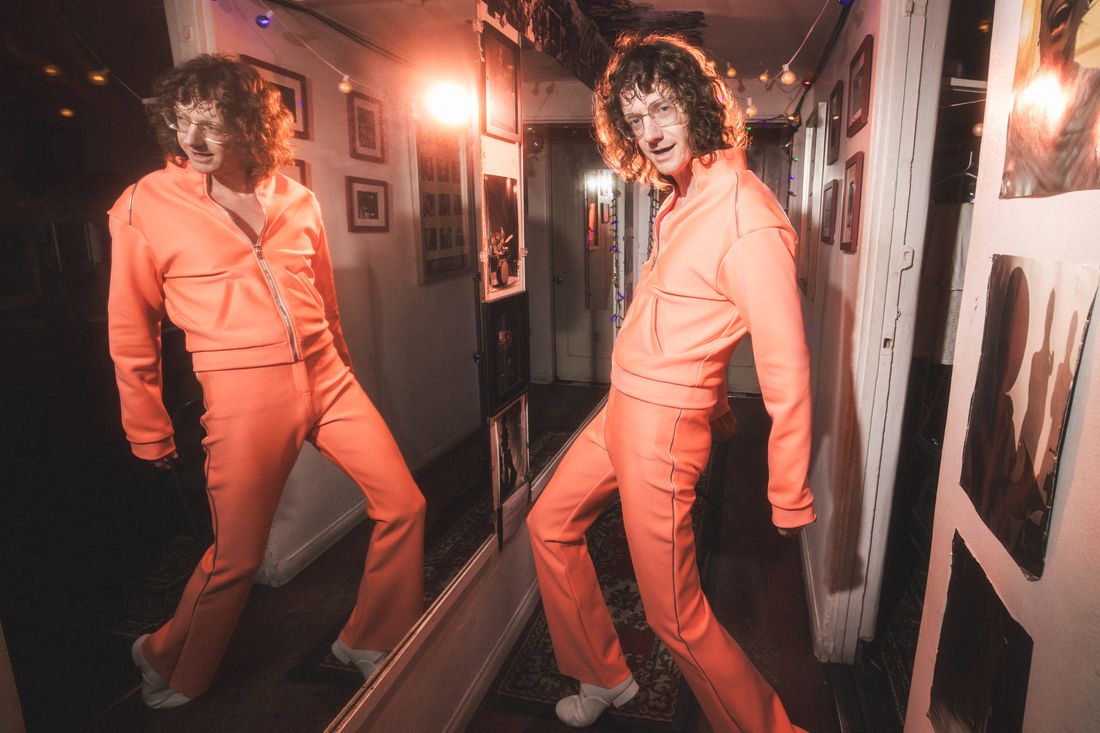
Comedian Chris Fleming pulled up to my hotel in a ridiculously small, pale green car – it looked more like a joke than a real vehicle. It’s a Nissan Figaro, a rare convertible styled after cars from the 1950s, complete with shiny chrome, small round headlights, and a steering wheel on the right side. At six-foot-two, Fleming barely fits inside; his knees practically touch his chest when he drives, and his curly hair brushes against the car’s roof. He looked like he’d stepped out of a Richard Scarry book, like Lowly Worm driving around town in his little apple car.
I’ve been hearing so many wild things about Nate Fleming – people online call him everything from a Muppet to a prophet! It’s honestly fascinating. I was really curious how someone who knows his work would put it into words, so I asked Conan O’Brien, who produced Fleming’s new special, Live at the Palace. His first attempt? A six-foot dandelion on cocaine bursting out of the ground! Seriously. And he kept trying to explain it! Eventually, he settled on comparing Fleming to the gloopy stuff inside a lava lamp. It’s a weirdly perfect description, honestly. It captures that unpredictable, slightly chaotic energy he has.
Fleming’s comedy is incredibly detailed and fast-paced, filled with quirky observations and unusual performance art elements. His jokes often start with a strange premise – like his idea of “girlos,” a type of woman distinct from “girlies.” He builds on this by imagining what defines a girlo – perhaps someone who might have been gay if born after 1995, which he jokingly calls “the Sapphic Meridian.” Now, he says, a girlo is someone who knows she isn’t gay because she once had a crush on Colin Firth. From there, the joke spirals off into unexpected directions. He might call Firth a meat substitute or a celebrity poorly imagined by lesbians. This kind of celebrity-focused, surprisingly biting observation is a hallmark of Fleming’s style – it’s not necessarily malicious, but it’s often brilliantly cutting.
Fleming’s performance quickly becomes incredibly physical. He races around the stage, playfully acting out exaggerated flirting styles, comparing them to the stability of redwood trees. He gets carried away with ideas, straying so far from his starting point that the original joke becomes almost forgotten. The focus shifts, and he starts making fun of himself, pointing out that he doesn’t fit neatly into traditional ideas of masculinity or femininity. He feels like an outsider, “washed up onshore,” and dramatically throws himself onto the stage, writhing like a strange creature from the sea. One commenter on a video of the performance praised the camera operator, saying they deserved an award for keeping up with Fleming’s chaotic movements, comparing him to a “daddy-long-legs in a toddler tumbling class.”
After years of creating quirky, independent projects like his web series Gayle (2012-2015), the YouTube special Showpig (2018), and a never-made TV pilot, comedian Fleming is finally getting wider recognition with Live at the Palace. He admits he once expected to be more famous by now, but he intentionally avoided the path of building a fanbase through casual, personal content. He strongly resists conforming to corporate expectations, saying he dislikes “company men” above all else. It’s taken 15 years of dedicated work to reach this point – enough to land an HBO special, play theaters, and even impulsively buy a classic Nissan Figaro (for around $30,000!). He admits the car purchase was premature, hoping a Red Robin commercial deal would come through, but unfortunately, it didn’t.
As we drove around Pasadena, I compared the experience to Jerry Seinfeld’s ‘Comedians in Cars Getting Coffee.’ Fleming burst out laughing, but also seemed genuinely upset. ‘That’s a big problem!’ he exclaimed. ‘If that’s the vibe it’s giving off, damn it!’ That’s what happens with a car that demands attention. People notice it, want to know what it’s about, and are eager to get a closer look—even wanting to meet the driver to understand how they fit into the picture. I asked Fleming if he was generally into cars, if it was a hobby of his. ‘Oh God, no,’ he replied. ‘It’s purely about the look.’ He loves his Figaro because it’s unusual, a delightful surprise to see on the road—an impractical car driven by someone who stands out. But he’s uncomfortable with the attention it draws, the way it begs the question, ‘What kind of person drives this?’ He prefers to remain mysterious. ‘It’s easier to be seen as an enigma,’ he explained.
Growing up in Stow, Massachusetts, Chris Fleming was a very shy child, but he curiously signed his kindergarten papers “Chris the Comedian,” a name he couldn’t explain. He was naturally drawn to physical comedy and dance. His mother remembers taking him to his sister Katie’s dance class when he was very young, and he was so eager to join in that he danced along the side until she had to pull him onto her lap – he was heartbroken when she made him stop. Even in preschool, he showed a flair for performance, enthusiastically playing a silent Farmer McGregor in a production of Peter Rabbit, improvising and hamming it up. He also loved playing dress-up with his sister and female cousins, even taking on the role of Scary Spice when they pretended to be the Spice Girls. As he got older, he became fascinated with performances like Michael Flatley’s Lord of the Dance and Yanni’s Live at the Acropolis. During his high school years, he obsessively listened to Eagle-Eye Cherry’s “Save Tonight” for nine months straight, much to his sister’s annoyance.
Katie explains that their mother taught them the importance of kindness and honesty, but also that making people laugh is incredibly powerful. She says, “If something is funny enough, people tend to overlook a lot.” Katie and her brother, Chris, were born to parents who were pharmacists in their forties. They were raised with a unique mix of humor and the reserved, somewhat self-aware culture of New England Catholics. Chris always liked to test limits. For example, he made a deal with his high school band teacher: he’d join the jazz band for one semester, but only if he could perform an extended drum solo during the song “St. Thomas.” The catch? He’d never played the drums before. A recording Chris later shared shows the band playing, then suddenly being overtaken by a chaotic burst of drumming, complete with enthusiastic cowbell strikes, to the delight of the audience.
Fleming’s mother saw his comedic potential and, when he was sixteen, drove him to his first open mic night in Merrimack, New Hampshire. He recalls her telling him, “If you want to be like Robin Williams, you have to try stand-up.” He initially resisted, thinking, I don’t want to do stand-up! It seems boring, and I don’t even enjoy watching it! He actually wanted to be in movies and found stand-up tedious. While he admired Williams’s stand-up – particularly the special Live at the Palace, which was inspired by Williams’s An Evening at the Met – Fleming was more drawn to Williams’s acting. Nevertheless, at his mother’s urging, he performed at the open mic, delivering a carefully prepared set of characters all connected by the shared experience of having recently seen a deer.
I always find it fascinating learning how people ended up doing what they do. For me, it’s movies, but for Sam Fleming, it was a bit of a winding road. He graduated from Skidmore College in 2009 with a theater degree – almost a dance minor, just one credit short! – but honestly, he didn’t have a clue how to turn his passion for comedy into a real career. He’d been working since he was practically a kid, starting with a job his dad got him at a country club when he was twelve. Over the years, he did everything – ski instructor, door-to-door sales, barista, even worked at a dry cleaner. College summers meant heading to New York City. One summer, he interned at an ad company and ended up with a ridiculous amount of Starbucks gift card money – originally meant for a Heidi Klum commercial shoot, they just gave it to the interns! We called it ‘Klumbucks’ and had a blast. Another summer he tried to focus on stand-up, but he actually loved his job at the Ann Taylor Loft in Times Square. He was surprisingly good at styling police officers! They trained them to help customers by gently touching their shoulders and talking to them in the mirror, and he says he still remembers how to do it!
After graduating from college, Fleming moved back home and worked as a substitute teacher. This experience made him realize how sheltered and supported he’d been growing up – he describes it as living in a “bubble.” He knew he needed to seriously focus on building a career as a performer. That’s when his character, Gayle, emerged. While living at home, he started performing at Boston’s Comedy Studio, developing Gayle Waters-Waters – a middle-aged woman inspired by his mother. Gayle’s act involved power-walking and gossiping about neighborhood life, obsessing over details like Christmas cards, and rigidly enforcing a “shoes-off” policy in her house. Fellow comedian Gary Gulman, who met Fleming at a Comedy Studio show, was immediately impressed by Fleming’s confidence onstage, especially considering he didn’t fit the typical mold of Boston stand-up comedians. Gulman recalls that Fleming seemed genuinely comfortable with himself, and it was clear his material wouldn’t focus on trends like dating apps or current political figures.
Fleming often drives a specific loop around Pasadena when he’s working through ideas – a habit he’s developed over years of living in the area. It involves lots of sugar and talking things out as he circles town. He moved to Los Angeles in 2010 and, while working as an SAT tutor and caregiver, created the web series Gayle from 2012 to 2015 to support himself. Gayle gained a following, particularly a video called “Company Is Coming,” which showed Gayle preparing for guests. The series focused on Gayle’s constant worrying and gossiping with her close friend and rival, Bonnie, played by Fleming’s mother, Nancy. Nancy happily portrayed a version of herself, even joining Fleming when he later adapted Gayle into a stage show. Fleming’s sister describes Gayle as a playful take on some of their mother’s strong personality traits, but Nancy enjoyed being a part of it. As Nancy puts it, even when her son playfully pokes fun, she always feels loved and valued.
https://youtube.com/watch?v=watch?v=GBwELzvnrQg
Fleming’s portrayal of Gayle brought him recognition, but also led to ongoing questions about his own gender and sexuality. He’s consistently avoided labels, expressing himself through gender-fluid clothing choices—he even jokingly recalled wearing a sundress to a Super Bowl party during a period he described as his most androgynous. However, he now questions whether the success of Gayle inadvertently complicated things. He clarifies that the humor wasn’t about cross-dressing, and he intentionally wore a small bra to avoid emphasizing breasts, aiming for a more ambiguous look. He wonders if that early performance has contributed to the frequent inquiries about his identity, but he doesn’t feel compelled to offer explanations. He points out that a similar role played by a British comedian would likely be understood simply as a man playing a woman.
He doesn’t see his stage persona as deliberately playing with gender, but he admits to embracing a kind of openness and flexibility. He jokes in his special, Live at the Palace, that a previous performance led to a nationwide guessing game about his pronouns. However, he never clarifies what those pronouns are. He explains, “To truly understand the world and yourself, you have to be open to everything.” He’s accepted that people are free to refer to him however they choose. His fans constantly update his Wikipedia page with different pronouns, which he compares to a changing seasonal menu, but he says it’s not something he controls. It’s a practical outlook as much as a personal one. He believes that when people can see you as almost anything – gay, straight, male, female, nonbinary, asexual, even something completely different – it gives you “total freedom to talk about any topic you want.”
By 2015, comedian Chris Fleming was losing his passion for stand-up and facing creative challenges. He’d stopped performing his popular Gayle character and didn’t want to play venues like the Comedy Store, believing they required performers to compromise their artistic integrity. He found it difficult to get stage time in Los Angeles and avoided shows like Last Comic Standing because he feared they would sensationalize his act. He’d initially hoped to join the cast of Saturday Night Live, but never even made it to a screen test after performing for Lorne Michaels.
What reignited his love for stand-up was rediscovering elements of the Gayle character within himself. While he’s moved away from relying on recurring characters, his current performances as himself are more energetic and unrestrained. Gayle had allowed him to explore exaggerated physical comedy, and he realized this wasn’t an act – it was a part of who he was. “I’ve found a way to access this wild, unrestrained side of myself, which is really helpful,” Fleming explains. “Growing up, we weren’t allowed to express anger or be showy, but onstage, you can do anything without it being seen as vanity. That’s the freedom of the job.”
While driving around Pasadena in his car, I asked Fleming about his experiences performing at more traditional comedy clubs. He explained that he’s intentionally avoided those venues throughout his career, believing he wouldn’t be accepted. He’s found that when he’s opened for mainstream comedians like Nikki Glaser, audiences aren’t sure how to react to his unique, energetic style – comparing his look to Weird Al and his stage presence to My Little Pony. A 2023 opening gig for the band Guster didn’t go as planned. According to Guster’s lead singer, Ryan Miller, Fleming’s humor is very specific and requires the audience to be prepared for a particular kind of performance. He described Fleming as not being a broadly appealing act – not like a chain restaurant where everyone can find something they like – but a niche experience, which, Miller points out, is exactly what Fleming wants; he doesn’t want to be something generic.
Fleming stopped on Arroyo Boulevard to show me his favorite parking lot – a large overflow area for the Rose Bowl, surrounded by the San Gabriel Mountains, and it really is beautiful. I wondered if it would help him reach a wider audience if he embraced some simple labels to describe himself. He admitted that trying to avoid being easily categorized might actually hinder his career growth. I pointed out that labels can help people understand new things, but he reacted strongly. He said the word ‘anchor’ made him feel trapped, like being caged – specifically, a cage you’d find when meeting sharks.
Fleming offered to give me a tour of his small cabin on Lake Arrowhead, about an hour and a half from Los Angeles. He found it online, on Zillow, and bought it on a sudden impulse, much like he did with the Figaro. This time, instead of the Figaro, he picked me up in a bright orange Bronco Sport. He played pop music in the car, making sure I listened to his current favorite, Hilary Duff’s “Roommates,” even though he playfully cringes at one of the lyrics. We stopped for boba tea on the way, and he always orders green tea with passionfruit – so much so that his favorite shop in Pasadena has a label on the passionfruit container that says “Chris Fleming Fuel.” Fleming used to enjoy partying, but he’s been sober for two years now, and he’s replaced that habit with a surprisingly large boba habit.
Since buying the cabin in 2024, Fleming hasn’t made many changes. It features a large, two-story window overlooking the hills, along with a keyboard, sofa, and crates for his three rescue dogs—Daysy, Erik, and Luchie (two pit mixes and a miniature poodle)—when they visit. He also has a house in Pasadena, but he finds the mountain setting reminiscent of his childhood summers in New Hampshire and prefers it as a place to concentrate on his work.
Fleming’s recent success isn’t just about leaning into his energetic stage persona; it’s also about how consistently he creates new material. While many comedians now rely on short, viral clips of audience interactions on Instagram, Fleming avoids that approach, saying he doesn’t want to constantly question audience members. Instead, he edits his own videos, drawing from his live shows and regular performances at Largo in Los Angeles. Though it’s time-consuming, he enjoys the control and the ability to refine a joke through careful editing and captions. His videos aren’t just simple recordings; he uses close-ups to emphasize expressions and employs unique fonts to enhance his jokes. He particularly likes dramatic, horror-style fonts and uses Papyrus sparingly for effect, like when performing his “girlos” bit and pretending to be Jane Goodall reacting to an interview with Alex Cooper from the Call Her Daddy podcast.
https://youtube.com/watch?v=watch?v=q7PGeQb4L4k
Comedian Nate Fleming describes his performances as simply reporting what he experiences. “It doesn’t feel creative, it feels reported,” he explains, while sitting on a cabin porch overlooking a pine forest. He worries that once a joke feels perfected, it loses its spontaneity, and he doesn’t want to just recreate old material. Director Bill Benz, while preparing for the Live at the Palace special, discovered Fleming was constantly evolving his act. Benz initially studied footage of a performance from about a year prior, but when Fleming previewed the hour he planned to film just months later, half of it was new. A month after that, another half was different, leading Benz to realize the special would have to be filmed as a documentary. On the day of the shoot, Fleming improvised even more material. As a result, the crew was instructed to approach the filming like a wildlife documentary, rather than a traditional live comedy performance, with very little pre-planning beyond a few multimedia cues.
Fleming excels at picking celebrities to joke about, often choosing well-liked, mainstream figures. His latest special features material on Paul Dano, Zach Braff, Lin-Manuel Miranda, and Terry Gross, whom he’s joked about for years. Gross says she’s amused by a bit imagining her cleaning a gun before interviews, jokingly wondering how Fleming knew. A major appeal of Fleming’s work is his celebrity commentary, which feels like insightful, slightly mischievous gossip that often hits close to home. Comedian Hannah Einbinder explains that Fleming can freely criticize established figures because he’s independent and doesn’t owe anyone anything. Sometimes his humor is pointedly critical, like his impersonation of Kareem Rahma. Other times, it’s about his own relationship with fame. For example, he jokes about accidentally sending Lin-Manuel Miranda an unedited, lengthy video of himself. Miranda confirmed the incident, even sharing screenshots as proof, explaining it happened after he commented on one of Fleming’s Instagram posts. Miranda describes Fleming as a “cultural anthropologist” who captures feelings and experiences we haven’t quite found the words for yet.
Comedian Chris Fleming doesn’t buy into the idea that being genuine is risky or costly, a concept often highlighted by Tina Fey. He openly admits his jokes are usually based on real people he knows, often requiring apologies. He anticipates this will happen with celebrities too, like Zach Braff, whom he jokes about in his special and will likely have to apologize to on Jimmy Kimmel. He jokes that his life feels like a constant apology tour, and awkward encounters are inevitable. However, Fleming believes it’s better to get a laugh out of these situations. His friend, Caleb Hearon, thinks Fleming doesn’t worry about social consequences or celebrity interactions, finding it endearing. In fact, Hearon points out that Fleming could be very successful – he could easily have a lucrative podcast – but chooses not to pursue that path.
Fleming really dislikes the idea of having his own podcast and sharing details about his personal life with the public. He reluctantly does appearances when he feels they’re necessary for his career. He’s critical of many podcasters, calling them insincere, and often feels uncomfortable as a guest, like he’s in trouble. Even podcasts he enjoys feel like work. On Mike Birbiglia’s 2024 podcast, Working It Out, Birbiglia pressed Fleming about a childhood habit of running away from his mother, questioning why he hadn’t shared this story in his stand-up. Fleming avoided answering, explaining that overly personal questions make him defensive and uncomfortable, like he’s under examination. He doesn’t want to reduce his life story to a few childhood memories and cringes at the idea of excessive self-revelation, which he jokingly calls “Ira Glass poisoning.”
So, Fleming gave me the tour of his cabin up at Lake Arrowhead, and made us both tofu tacos – seriously, a cool guy. We chatted about what he’s been reading, mostly plays, and bonded over our shared love of horror. But then he started talking about all the injuries he gets doing his own stunts! It’s wild – he doesn’t really train or treat his body like an athlete, so he’s constantly bruised, pulls muscles, and messes up his back. He actually chipped his front tooth during filming – smacked his face on a stool between takes! He’s still debating whether to get it fixed or just keep the chip as a battle scar, which I kinda think is awesome.
He doesn’t talk about his home in Pasadena, but during our drive, he pointed out a quiet, suburban neighborhood with lots of trees where he’d like to live. He’s seeing someone, but he keeps the details of that relationship private. He also prefers to keep personal matters, like his parents getting older, to himself. He clearly enjoys being noticed – he works incredibly hard, shares a lot online, and drives flashy cars – but he doesn’t want his audience to feel like they truly know him. He thinks overly personal, confessional comedy is awkward and self-indulgent, and he acknowledges that sharing a vulnerable story feels very different from telling a joke. He believes all interpretations of his persona are valid, as long as they’re based on what he chooses to share. While exploring his cabin, I found a scattering of notes on his desk, written in large marker. One said “Girlos,” another “Colin Firth,” and another jokingly referred to “Husband Dan and 6 (3) little psychopaths.” There was also a sketch of a child with a ride-on suitcase, which I recognized as a note for a joke he’d posted online. I got the feeling he’d deliberately left them out for me to see.
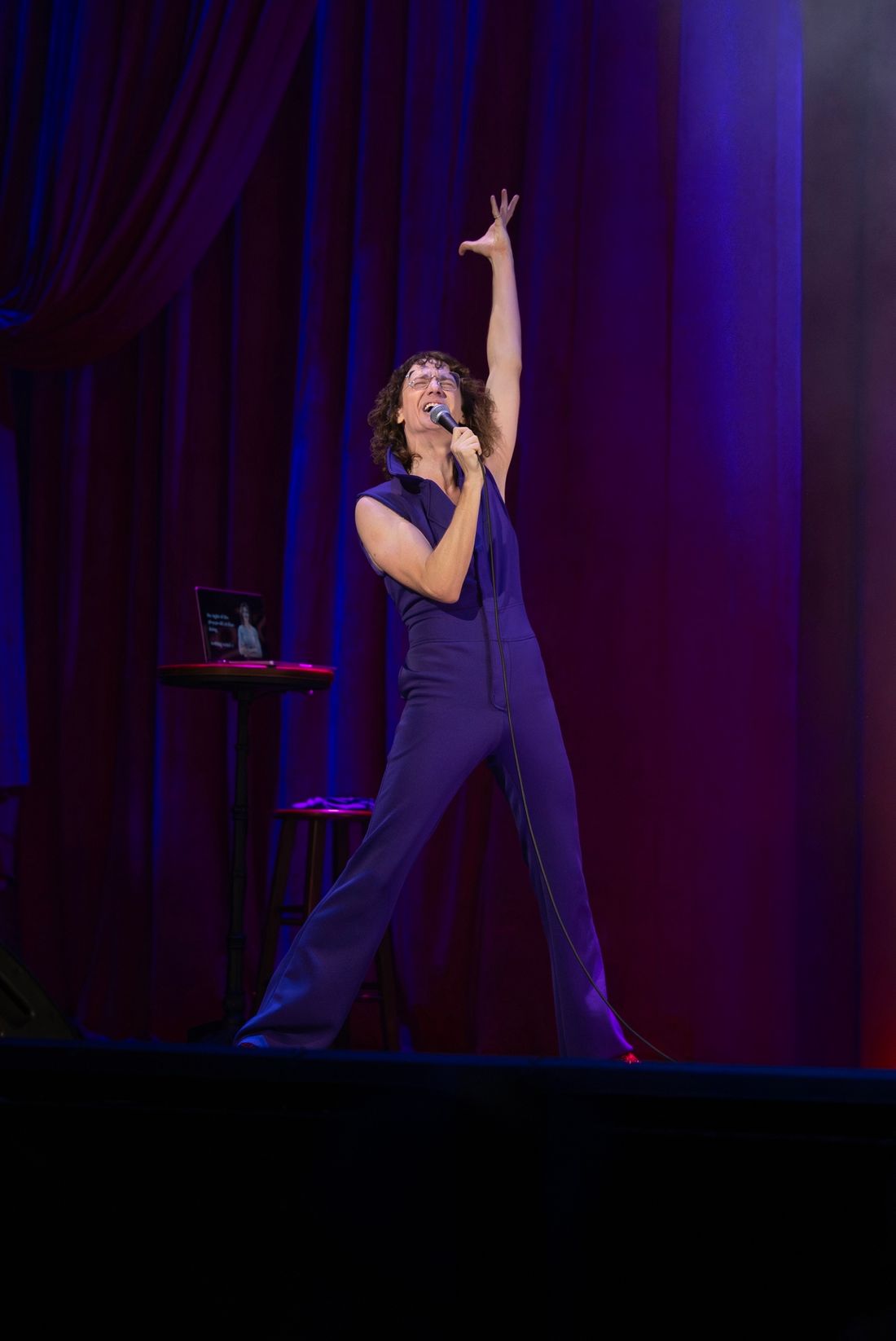
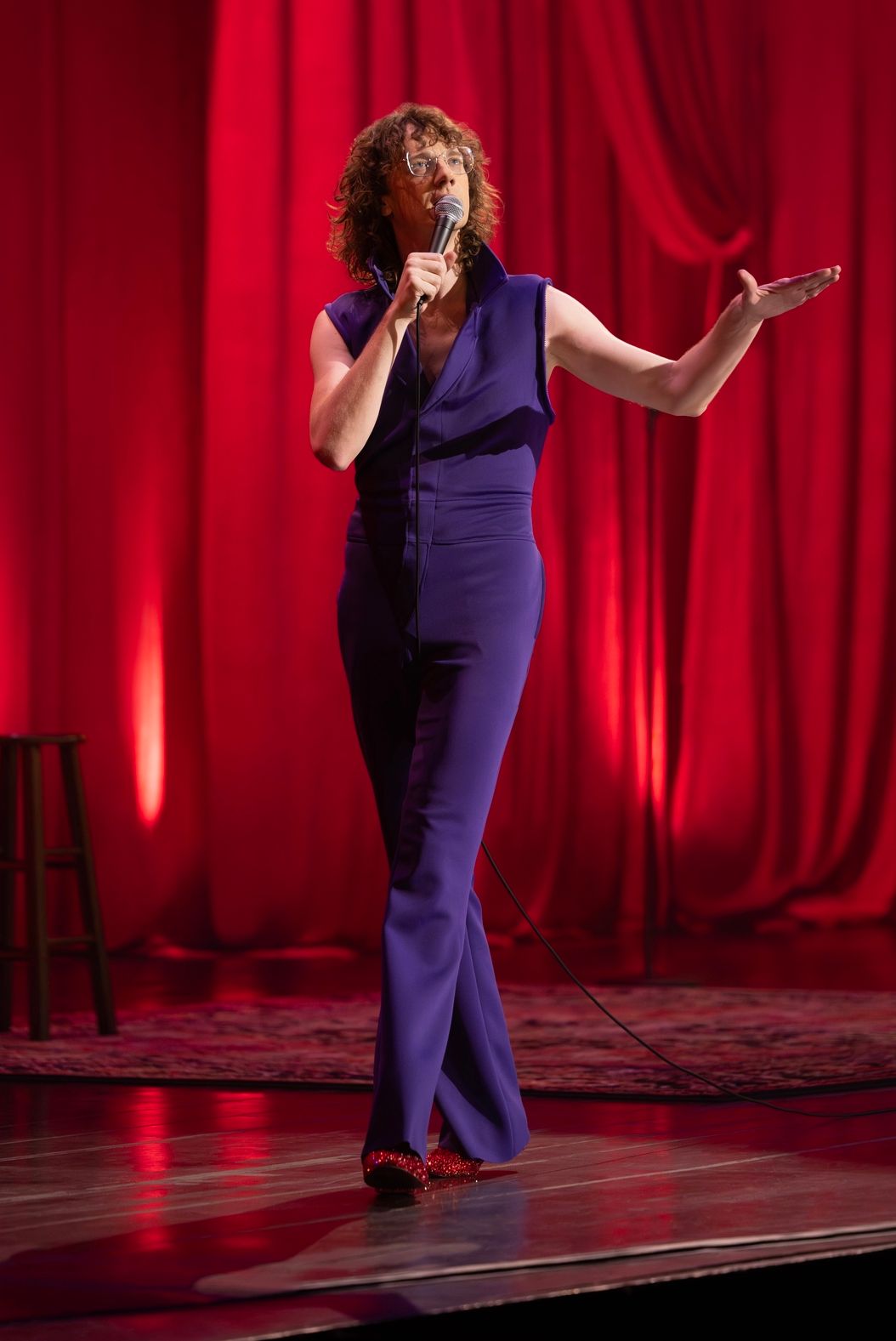
Fleming’s new special, Live at the Palace, successfully captures what it’s like to see him perform live. It’s a more straightforward show than his previous special, and that’s a good thing. While Fleming enjoys blending comedy with other art forms, his performances are often strongest when they focus on his energetic stage presence. This special is a polished presentation, filmed in a beautiful theater with rich red velvet and ornate gold details. He’s also been working with fashion designer Tony Sartino, known for creating clothes for stars like Prince and Elton John. Sartino noticed Fleming’s style in older videos was a bit chaotic, saying, “He was mixing masculine and feminine pieces, and it seemed like he needed help bringing it all together.” For this special, Sartino designed a purple jumpsuit—inspired by Prince—that allows for freedom of movement, features zip-off sleeves for a playful touch, and includes a small jeweled butterfly on the back.
The performance wasn’t overly refined, which actually worked in its favor. Benz, who was monitoring the video feed from directly under the stage, described Fleming’s energetic performance as feeling like a bombing raid due to the vibrations. About halfway through, Fleming launched into a bit about Oreos, a topic Benz hadn’t heard him cover before. He playfully pretended to examine ice cream toppings, then described Oreos as “maimed” and looking like a message from a cartel or the result of a witch’s grinding. A woman in the audience burst out laughing as Fleming imagined how a celebrity like Judi Dench might be exploited for a quick buck, demonstrating with frantic hand movements. He embodied a villainous Nabisco executive, giving a potential Oreo licensee permission to misuse the brand. He acted out a teenager carelessly crushing Oreos. Crucially, he never became the Oreo itself, because that would have made the joke too sympathetic. After finishing the bit, Fleming briefly left the stage, then returned to add a final thought: the same dialogue could easily apply to the agent representing Eugene Levy and their approach to commercial work.
Read More
- Netflix’s Little House On The Prairie Reboot: Release Date, Cast & Everything We Know
- Off Campus Season 1 Soundtrack Guide
- Silver Rate Forecast
- Gold Rate Forecast
- Prime Video’s New R-Rated Spy Thriller Is Officially No.1 On Streaming Despite Poor Reviews
- Brent Oil Forecast
- EUR ZAR PREDICTION
- Infinity Nikki Candlelight Reverie Challenge and Rewards Guide
- Amazon Primes new GenAI cartoon looks like K-Pop Demon Hunters with aliens
- KPop Demon Hunters Meets Avatar: The Last Airbender In Netflix’s 3-Part Fantasy Series
2026-02-26 19:00