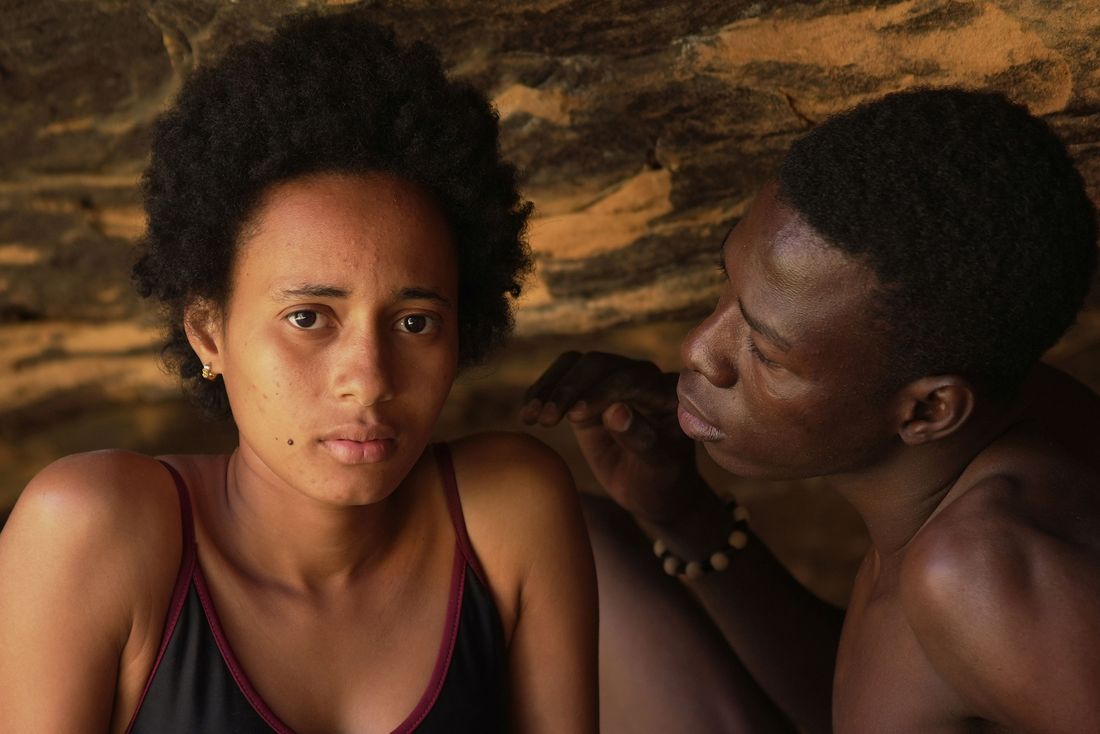
Mahamat-Saleh Haroun’s film, Soumsoum, the Night of the Stars, is a beautifully shot and subtly magical coming-of-age story. It premiered at the Berlin Film Festival and feels like a modern myth. The film evokes the work of Pier Paolo Pasolini and Haroun’s own impressive previous films. Though not widely known in the U.S., Haroun is a significant international filmmaker – his A Dry Season won a prize at Venice, and A Screaming Man at Cannes. His 2021 film, Lingui, the Sacred Bonds, a powerful story about a mother and daughter facing difficult circumstances, was particularly acclaimed. Like Lingui, Soumsoum focuses on women challenging traditional societal norms. However, while Lingui was fast-paced and urgent, Soumsoum takes a more dreamlike and open-ended approach.
Teenager Kellou (Maïmouna Miawama) simply states, “I see things, and they happen,” when explaining the difficulties in her life to her father, Garba (Eriq Ebouaney). For Kellou, this isn’t a gift, but more like a burden. Already an outcast because her mother died during her birth – a fact that marks her as “born of blood” – she prefers solitude, wandering the caves and rocky landscape of the remote Ennedi Plateau in northeastern Chad. She has a boyfriend who cares for her, but their relationship seems doomed due to the village’s disapproval. After being attacked and injured, Kellou is taken in by Aya (Achouackh Abakar Souleymane, known for her role in Lingui), another social outcast. Aya is a midwife who delivered Kellou years ago and is now blamed by the village for a string of recent deaths.
As a film lover, I was immediately struck by Haroun’s storytelling ability – it feels so effortless. The movie opens with these beautiful shots of Kellou swimming and wandering through this incredible landscape, and at first, she just is – peaceful and completely at ease. But then, subtly, you start to sense her worries bubbling up. Haroun handles her visions in a really direct way – like these stark images of five men reaching for her, or a woman lying injured. It’s all presented so simply that it feels like the line between reality and something…otherworldly is incredibly thin.
People are wary of both Kellou and Aya, suspecting curses or witchcraft. Interestingly, Aya claims to speak with spirits and hints at other abilities, leading us to wonder if she truly is a witch. But the film isn’t concerned with proving or disproving such beliefs. Instead, it explores how we choose to deal with things we don’t understand. While there are a few subtle visual effects towards the end, the film relies more on suggestion than spectacle. The director, Haroun, keeps the focus firmly on the real world – on the characters, the environment, and the details that make it feel authentic.
At its heart, this story is about how people exert control over their lives. In the village, the supernatural is viewed as a negative force, bringing hardship and fear. But for Aya, it represents liberation and connection. She explains to Kellou that the visible and invisible worlds are linked, urging him to view all living things with kindness. The film then shows landscapes that seem to come alive – caves resembling faces, rocks shaped like people – suggesting a belief system where everything is connected and respected. This contrasts sharply with the isolation and suspicion that define Kellou and Aya’s experiences.
Despite its mystical elements, Soumsoum feels grounded in reality thanks to its relatable characters. This simplicity is actually what makes the film’s supernatural moments so effective. Director Haroun’s straightforward style is surprisingly powerful, subtly introducing magic into everyday scenes. For example, a scene of Kellou and Aya under a starry night sky feels expansive and wondrous, and even a simple visual effect, like a dissolve between the two characters, feels like a genuine miracle. Ultimately, this unassuming film is what makes it so memorable.
Read More
- Netflix’s Little House On The Prairie Reboot: Release Date, Cast & Everything We Know
- Off Campus Season 1 Soundtrack Guide
- YouTuber arrested after viral AI bodycam videos spark real police complaints
- Silver Rate Forecast
- Prime Video’s New R-Rated Spy Thriller Is Officially No.1 On Streaming Despite Poor Reviews
- Brent Oil Forecast
- Bulgakov’s Take: Koreans Bet the Farm on Chips, Crypto, and Chaos
- EUR ZAR PREDICTION
- Peaky Blinders: The Immortal Man’s Tommy Shelby Is a Better Father Than Michael Corleone
- Gold Rate Forecast
2026-02-21 16:54