
It’s tough to stay on top of your favorite game these days. Between long update notes, lengthy video guides, and endless online discussions, it’s easy to get overwhelmed with information. How do you find the key details that really matter? That’s where summarizing comes in handy. It’s not about writing formal reports; it’s about quickly finding the important information you need right away. This skill allows you to understand new game changes quickly, explain strategies to friends clearly, and spend more time playing and less time reading.
Key Takeaways
- Summarizing is a gamer’s superpower: It’s the fastest way to filter out fluff from guides, patch notes, and discussions, helping you understand the meta, make better in-game decisions, and save your valuable time for actually playing.
- Focus on facts, not fluff: A great summary pulls out only the essential gameplay mechanics and strategies. Rephrase these key points in your own words to confirm you understand them, and be ruthless about cutting anything that isn’t critical to success.
- Be clear, concise, and credible: Structure your summary with the most important information at the top for quick scanning, and always give credit by citing your sources to build trust and show respect for the original creator’s work.
What is a Gaming Summary?
A gaming summary is like a fast, helpful guide to a game. It quickly covers the most important things – how the game works, what the story is about, and its best features. Whether you’re reading a full review, a guide to a new challenge, or looking at how to create a character, a good summary simplifies everything and gives you the key details in just a few minutes. It’s meant to give you what you need to know without a lot of extra reading.
Instead of wading through long, detailed guides – like one listing every weapon in Warzone – a summary would focus on the most effective current weapon setups and explain why they’re successful. Similarly, if you’re unsure about a new expansion like Diablo 4’s Vessel of Hatred, a summary can quickly tell you about the new classes and content, helping you decide if it’s worth playing. The goal is to give you the essential information quickly, so you can spend more time gaming and less time reading.
Why Gamers Need Quick Info
When you’re gaming, you don’t have time to read lengthy guides. You need quick, useful information to make smart choices during gameplay. Being able to summarize information – to quickly find the most important ideas and ignore the rest – is a valuable skill. This helps you understand new strategies, decide if a new item is worth earning, or choose which character to play. Getting to the point quickly improves your game and makes it more enjoyable.
How to Break Down Complex Game Mechanics
Large, complex systems, like detailed skill trees or crafting systems, can seem daunting. The key to understanding them is to break them down into smaller, easier-to-handle parts. Don’t try to learn everything at once – focus on one piece at a time. For instance, you could start with a character’s basic abilities, then move on to their passive skills, and finally see how equipment works with everything else. This helps you understand how everything connects without getting bogged down in details. It’s about identifying the most important concepts and building your knowledge step by step.
Why Should Gamers Learn to Summarize?
It’s easy to cringe at the word “summarize” and remember high school English, but being able to quickly understand and relay information is incredibly useful for gamers. With constant updates, long online discussions, and lengthy video guides, knowing how to get straight to the point is a huge advantage. It’s not about writing formal reports—it’s about saving time, quickly grasping the current game strategies, and becoming a valued member of the gaming community.
Being able to summarize information effectively helps you quickly identify the most important details and ignore unnecessary fluff. For example, you can easily determine if a new weapon setup in Warzone is worth trying, grasp the main points of a discussion about the latest Diablo 4 season, or explain complicated game rules to others without boring them. It’s about processing information quickly so you can spend more time playing and less time reading. Ultimately, this skill makes you a more knowledgeable player and allows you to contribute thoughtfully to any conversation.
Cut Through the Noise in Gaming Communities
Online gaming communities like forums and Discord are often busy and disorganized. It’s easy for conversations to go off-topic, arguments to start, and important information to get lost. That’s where summarizing skills come in. Being able to quickly understand the main points of a discussion and ignore what’s not important is really helpful. If you can mentally summarize a long conversation – whether it’s about a problem with the game, a discussion of strategy, or feedback on something new – you can quickly understand what’s being discussed. This lets you contribute clear, focused comments that are more valuable and appreciated by others.
Decode Patch Notes and Updates Faster
We’ve all faced it: a huge game update with incredibly long patch notes. Instead of reading every small change, you can use summaries to quickly find the most important information. A good summary shrinks a long text down to its core points, letting you easily see what’s new. This helps you quickly identify major changes to characters or items, discover new features, and get back to playing. It’s a great way to stay competitive and adjust your strategy before others do.
Build Your Cred in Gaming Discussions
Want to be the go-to person for advice among your friends? Knowing how to summarize information is a huge help. When you can effectively summarize, you actually improve your understanding of what you’re reading by finding the most important parts and explaining them in your own way. It’s about truly understanding something, not just repeating it. If you can clearly explain why a particular Honkai: Star Rail team works well, or break down how people are reacting to a new trailer, you’ll become a trusted source. People will value your opinions and insights in any conversation.
How to Identify Key Points in Gaming Content
To write a good summary, you first need to be able to quickly identify the most important information. It’s similar to finding valuable items in a video game – you need to separate what’s useful from what’s not. When reading a guide or online post, focus on extracting the key details that will actually help you succeed. This skill helps you ignore unnecessary information and get straight to the point, whether you’re learning something new or trying to understand current trends.
Find the Main Ideas in Game Guides
Game guides are often packed with extra details like background stories and developer insights. When using them, focus on finding the main strategy first. What’s the most important takeaway? Is it how to start a game, how to defeat a boss, or the best way to play a character? Don’t get bogged down in unnecessary information—look for the core ideas. For example, a helpful guide about equipment in a game like Warzone will quickly show you the best attachments and settings – that’s the key information you need.
Separate Must-Do Strategies from Optional Tips
Not all gaming advice is equally important. It’s key to tell the difference between things you have to do and things that just make you a little better. A “must-do” is essential – like avoiding an attack that will instantly defeat you. An “optional tip” is something small, like adjusting your position for a tiny damage boost. These can help you improve at a higher level, but aren’t necessary just to finish the game. When reading a guide, try to separate the advice into “need to do” and “nice to do” categories. This way, you can focus on learning the most important things first.
Figure Out What Information Matters Most
As a gamer, I’ve learned that the best way to quickly understand something – like a game update or a new character – is to focus on what actually matters for gameplay. Forget the lengthy descriptions and cool stories for a second. I try to zero in on how things work: what are the key abilities, what are the main goals, and how do the mechanics change things? Take Diablo 4 gear, for example. The flavor text is fun to read, but what really matters are the stats and special bonuses. If you get good at picking out those core mechanics, you can create summaries that other players will actually find useful – and that’s a skill worth having!
What Makes a Gaming Summary Great?
A helpful game description simply explains what a game is about, but a great one makes you feel like you understand it instantly. It’s the difference between a boring list of features and a glimpse into what it’s actually like to play. To write that kind of description, focus on three things: how the game is played, the important details (without unnecessary information), and the overall feeling it creates. When you do that well, you’ll give other players the information they need to decide if the game is right for them.
Nail the Key Gameplay Elements
A good game summary focuses on what makes playing it fun and unique. Consider the main goals, special features, and how the game works differently from others. Is it about collecting items, solving challenges, or becoming skilled at fighting? Highlighting these key parts helps people quickly understand what the game is all about. For instance, when describing a new Warzone season, focus on changes to the map, new weapons, and how the best strategies have evolved. The goal is to show what the game feels like and why someone should play it.
Be Accurate, But Keep It Brief
As a gamer, I always appreciate summaries that get straight to the point! When I’m looking at a game summary, I want the important stuff, not a long story. That’s what I try to do when I summarize gameplay. Basically, cut out all the extra details and focus on what really matters. For example, if I’m talking about a new item in Diablo 4, I wouldn’t list every single stat. Instead, I’d say something like, “This boosts your fire resistance and critical hit chance.” It’s about giving people the key info they need to quickly figure out if something is useful – that’s what the gaming community really wants!
Give Your Audience the Right Context
It’s really important to give players some background information about a game. This helps them understand the world it takes place in, what kind of game it is, and the overall feeling it’s going for – all of which can grab their attention. A good description doesn’t just explain how the game works, but also where it takes place and what it’s like to play. For example, knowing that Palworld has a dark sense of humor immediately gives you an idea of the experience you’ll have. This overall theme helps players figure out if the game is something they’d enjoy.
How to Create a Killer Gaming Summary
Want to quickly understand long game updates and guides? Learning to summarize is a valuable skill for any gamer. It’s about more than just shortening text – it’s about finding the most important details so you can get back to playing with your friends. Think of it like making your own easy-to-use guide for any game. Whether you need to explain a new challenge to your team or just want to remember the best way to play, a good summary can really help. Let’s go through how to create clear, concise, and helpful summaries.
Read Gaming Content Like a Pro
To effectively summarize something, first make sure you understand it. When reading, especially guides or developer blogs, focus on finding the main ideas and don’t get bogged down in unnecessary details. Instead of just quickly reading, actively search for the central message.
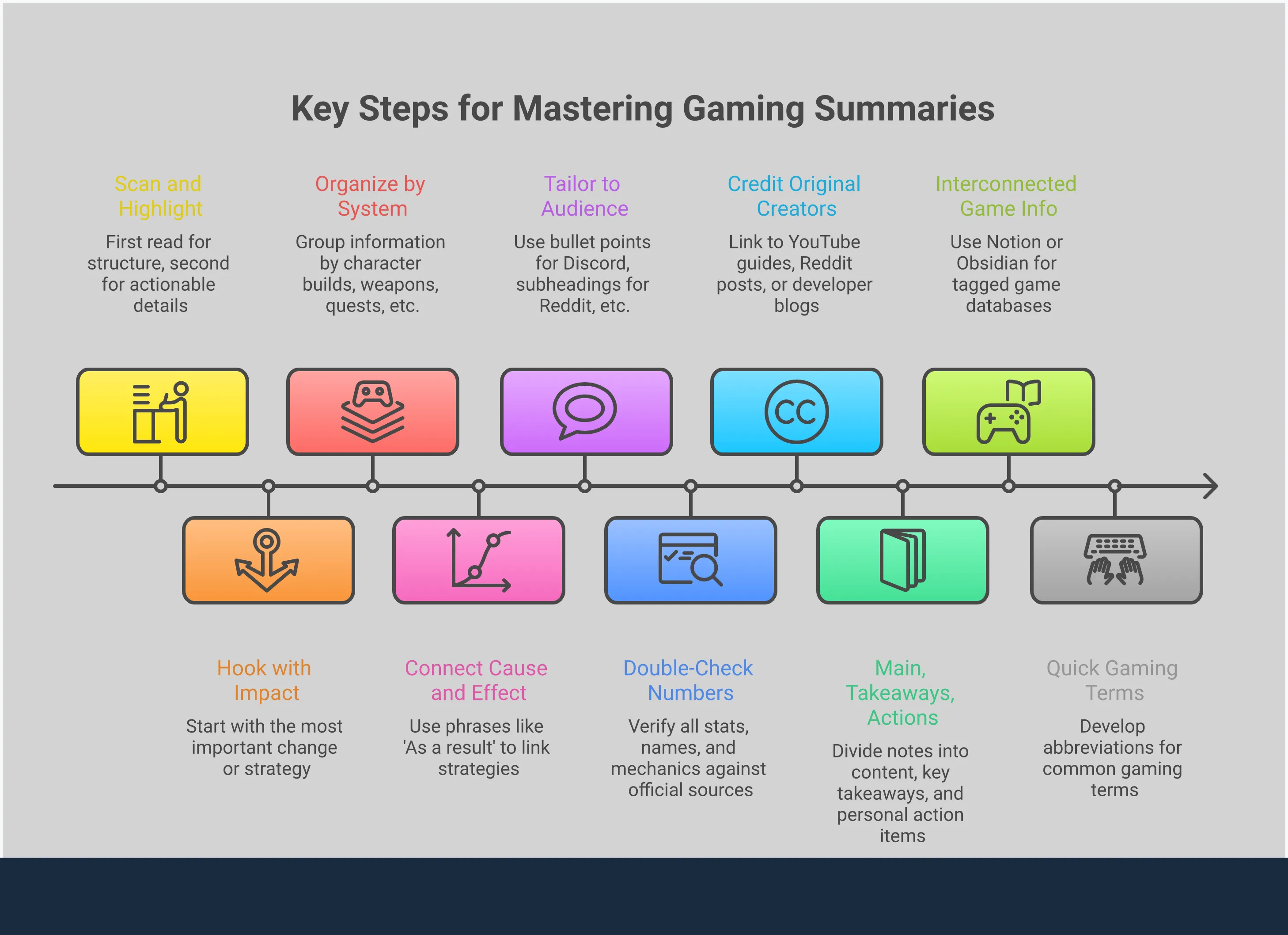
First, read the content once to understand the main idea. Then, read it again, this time highlighting the most important information. Focus on details that directly affect how you play – like new stats in Warzone, important quest steps, or a boss’s weaknesses. This helps you ignore unnecessary background details and focus on what you need to win.
Break Down Complex Information
Gaming guides and updates can be hard to understand because they often contain a lot of information. Trying to read a long, complicated explanation – like one about the skill tree in Diablo 4 – can be overwhelming. The best way to learn is to break the information down into smaller parts. Focus on the key ideas and how the guide is structured. Luckily, most helpful guides are already divided into sections, making it easier to follow along.
Imagine you’re exploring a video game dungeon. You wouldn’t try to understand the whole thing at once, but tackle it room by room. When summarizing something complex, like a guide to defeating a boss, do the same. Divide it into sections based on different stages or phases. What does the boss do in the first phase? What new challenges appear later on? By understanding each section separately, you can then create a clear and concise summary of the whole thing.
Rephrase Info Without Losing Key Details
A good summary doesn’t just copy phrases from the original text. It means explaining the information in your own words, which shows you truly understand it. An effective summary should be significantly shorter than the original, focusing only on the most important details.
Instead of listing every detail about new gear, focus on what it does. For example, instead of specific numbers, you could say a chest plate is great for absorbing damage and resisting fire. This gets the important information across quickly. The goal is to be concise and accurate – cut out unnecessary details, but don’t leave out anything that could significantly improve a player’s setup.
Cut the Fluff and Get to the Point
Time to be direct and concise! A great summary leaves out anything that isn’t essential. Focus on getting straight to the main point. As you review your draft, ask yourself if each detail is truly needed to understand the core idea. If not, remove it. That means cutting lengthy introductions, personal stories, and anything you’ve already said.
Don’t be afraid to reorganize information to make your summary clearer. If a key point is hidden within a longer paragraph, move it to the beginning. The aim is to create a concise and helpful summary that delivers the most important information quickly – think of it like a game trailer, where viewers want to see the best parts right away.
How to Structure Your Summary for Maximum Impact
Your summary should quickly grab your reader’s attention, like a fast-paced video game moment. A well-organized summary is key – a disorganized collection of facts, even if correct, won’t help anyone understand complex topics like a new Diablo 4 strategy or the current Warzone trends. Aim to present information so clearly that your reader effortlessly follows your train of thought without realizing they’re actively processing it.
A strong summary isn’t about sticking to a strict format—it’s about building a clear and logical progression of ideas. Start with your most important points to grab attention, then connect them in a way that feels natural. This helps busy gamers quickly find what they need, while also providing a complete and understandable overview for those who read everything. When you thoughtfully organize your writing, you create a summary that’s both convincing and helpful.
Hook Them with a Strong Opening
Your opening sentence is crucial – it needs to instantly hook your reader and make them want to learn more. Don’t just state the obvious; instead, create an introduction that really captures what your game or update is all about. For example, instead of saying “Here’s a summary of the new Palworld patch,” try something like “The latest Palworld update drastically changes base building and Pal management.” Notice how that second version sparks curiosity?
Start by immediately sharing your most important points. Your introduction should grab attention by showcasing your most interesting or significant information, giving people a compelling reason to keep listening or reading.
Put the Most Important Info First
Gamers need information quickly, so get straight to the point. When summarizing guides or loadouts, lead with the most important details. A good summary should only include the essential information. For example, when reviewing a game, start by stating its genre, how it’s played, and what sets it apart.
When creating a guide for a new Warzone loadout, begin by showcasing the weapon and its five essential attachments. After that, explain why the loadout is effective, its strengths and weaknesses, and how it performs against the current popular strategies. This method immediately provides value to your readers and respects their time.
Make Your Points Flow Smoothly
Effective summaries aren’t just collections of facts; they’re well-written pieces where ideas flow smoothly together. That’s where transition words are so helpful. Words and phrases like “Because of this,” “However,” and “This leads to” act like road signs for your reader, making it easy to follow your reasoning. Experts say these words help guide both you and your audience through the information logically.
When describing how to build a character, you can clearly connect ideas by showing how one thing leads to another. For example, you might say, “This skill boosts your chance to land a critical hit. Therefore, you should use equipment that maximizes critical damage.” This helps players understand why a strategy works and makes it more memorable.
Common Summarizing Mistakes to Avoid
Even experienced gamers sometimes struggle to summarize lengthy guides or updates. Writing clear summaries takes practice, just like any other skill. The aim should be to provide trustworthy information to your friends and community, avoiding the spread of inaccuracies. By avoiding common pitfalls, you can create summaries that are accurate, helpful, and concise, establishing yourself as a reliable source of information within your gaming community.
Sharing Opinions Instead of Facts
This is the biggest trap, and it’s so easy to fall into. Your summary should be a faithful report of the original content, not your personal take on it. The goal is to reflect the author’s ideas, not to insert your own analysis. For example, if you’re summarizing a guide to the best Warzone loadouts, your job is to state which attachments the guide recommends and why. It’s not the place to argue that a different optic is better. Save your hot takes for the discussion that follows. A summary presents the “what,” while your opinion is the “what I think about it.” Keep them separate to build trust with your audience.
Dropping Important Technical Details
When trying to be brief, it’s easy to accidentally leave out important details. In gaming, even small things can make a big difference. Forgetting a specific number, a necessary item, or a key step can ruin a guide or even give incorrect information. For example, if you’re explaining how to beat a tough boss, forgetting to mention a weakness could make your instructions useless. While it’s good to be concise, be careful not to skip over technical details that are essential for understanding. Always double-check: will leaving something out break the strategy? If so, keep it in.
Over-Simplifying Complex Strategies
It’s easy to oversimplify things when explaining a complex strategy. While your goal should be to make it easier to understand, you need to avoid losing the important details that make it work. For example, simply saying “avoid the red circles” when describing a boss fight isn’t helpful. A good explanation would include when to dodge, the pattern of the attacks, or where the safe spots are. When summarizing a guide, focus on the key ideas, but don’t remove so much information that the strategy becomes unclear or useless, leaving your audience more confused than before.
Getting Game Mechanics and Context Wrong
Making simple factual errors quickly destroys your trustworthiness. Whether you’re explaining game updates – like damage percentages – or a character’s skills, accuracy is key. While adding unnecessary details can weaken a summary, incorrect information is a far bigger problem. This is particularly important when covering unique features, such as the unusual death system in Palworld. Always double-check your facts – your audience relies on you to be correct.
How to Write Summaries That Actually Engage Readers
A good summary isn’t just about making something shorter—it’s about making it interesting! Imagine it as the best parts of a game guide, update notes, or developer message. You want to quickly deliver the most important information to other players without boring them. It’s about valuing their time and still showing them why the topic matters. Listing facts is easy, but a truly great summary gets people excited and ready to play. Let’s look at how to make your summaries stand out and actually get noticed.
Use Writing Tricks to Keep Them Hooked
Okay, so when I’m writing up a summary for a game update, I’ve learned it’s not enough to just list what changed. You gotta sell it, you know? I try to write like I’m talking to a friend, using strong, active language. Instead of saying something boring like ‘A new ability was added,’ I’ll say something like ‘This new patch just dropped a game-changing ability for this character!’ It just hits different, right? And I really try to match the tone of the game itself. If it’s a dark, gritty game like Diablo 4, I use words that feel like that world. Basically, I figure out the most important stuff and then present it with some energy to get people hyped!
Format for Different Gaming Platforms
Where you post your summary matters. A detailed breakdown that works for a blog post will get ignored on Discord, and a tweet-length summary will feel too shallow for a Reddit guide. You have to adapt your format to the platform. For quick updates on Discord or Twitter, lead with the single most important change and use bullet points for readability. On Reddit, you can be more conversational and break down your summary with subheadings and bold text to guide the reader’s eye. The idea is to rearrange the points and trim details to fit what users on that platform expect. Think about how memes and short-form content thrive in places like the Honkai: Star Rail community—your summary should match that fast-paced, visual energy.
Keep Readers Engaged from Start to Finish
Okay, so when I’m writing update summaries for games, I try to get right to the good stuff. I immediately tell everyone why this update matters to them – what one big change will actually affect how they play? I keep it super short and sweet, using quick sentences and paragraphs because nobody wants to wade through a huge block of text just to see if their favorite gun got changed. I aim for a quick info-dump, like a really good loadout guide – just the essential stuff to help you win. Basically, I want to save people time and give them exactly what they need, fast.
Why Citing Your Sources Matters
It might seem like extra effort, but always include links to your sources when you’re summarizing gaming guides, patch notes, or forum discussions. Linking back isn’t just for school papers—it’s essential for building trust and respect within the gaming community. Think of it as showing your research; it demonstrates you’ve done your homework and makes your summaries much more credible. This is how you establish yourself as a reliable source of information, rather than just another player sharing their thoughts.
Build Trust with Your Community
In gaming, building trust with your audience is crucial. Players want information they can rely on to improve their skills, stay updated on changes, or fully enjoy a game. Citing your sources shows you’ve done your research and aren’t just making things up. It’s a sign of respect for your audience’s time and proves you’re committed to providing accurate, well-supported content. This builds trust and helps you become known as a reliable source that other gamers can depend on.
Avoid Plagiarism in Your Content
Using someone else’s work without giving them credit is a surefire way to lose the trust of others. Whether it’s a detailed guide, careful analysis, or discovered information, claiming it as your own can really hurt your reputation. The simple solution? Always cite your sources. This shows respect for the original creator’s effort and protects you from accusations of plagiarism, while also maintaining your honesty and standing within the gaming community.
Give Credit Where It’s Due
Gamers often work together and share what they learn. When someone puts in a lot of effort – like testing strategies in Warzone or figuring out the story behind a Genshin Impact quest – it’s important to give them credit. It’s not just polite; it shows respect for their work. By mentioning where you got your information, you acknowledge their contribution and help others find useful resources. Being a good gamer means respecting creators and sharing credit, which builds a positive and supportive community.
Tools and Tricks for Better Summaries
Understanding how to write a good summary is helpful, but having the right tools and techniques can make it much simpler. Consider these your essential strategies for turning complicated game content into something clear, concise, and valuable. These aren’t just theories—they’re practical tips you can use immediately to better understand and share information about the games you enjoy.
Smart Note-Taking Methods for Gamers
To create a good summary, start with effective note-taking. Don’t just read or watch something – actively identify and write down the most important information. Focus on the core ideas and skip unnecessary details, making sure to connect the main points logically. For example, if you’re a gamer, note down crucial stats, quest steps, or ability combinations. Whether you prefer a digital app or a notebook, the process of writing forces you to determine what’s truly important – and that’s the essence of summarizing.
Organize Information by Game Systems
Video games are complicated, so your notes should be too – but in a good way! Don’t just write everything down as one big block of text. Instead, organize your notes like the game itself. For example, create separate sections for things like character development, crafting, player-versus-player combat, and the main story. If you’re taking notes on a game like Diablo 4, you could even organize them by character class or what you do after finishing the main story. This makes your notes easier to understand and helps you quickly find the information you need while playing.
Create Your Own Quick-Reference Guides
The main point of taking notes is to create something useful for yourself. A good summary takes a lot of information and boils it down to just the most important parts. You can then turn these organized notes into quick guides or personal cheat sheets – like a list of the best weapons in Warzone, a step-by-step guide for beating a tough enemy, or a list of where to find crafting materials. These guides are what you’ve been working towards – easy-to-use resources that help you quickly find the information you need and improve your gameplay.
Related Articles
- Deus Ex LFG: Connect with Other Augs in LFG Feature on Z League App
Frequently Asked Questions
A summary isn’t simply a shorter review. Reviews share opinions and tell you whether something is good or bad. Summaries, however, stick to the facts. They report key information – like a character’s skills or recommended weapon attachments – without offering any personal opinions on whether those things are any good or enjoyable.
Okay, so how long should my game summary be? Honestly, it depends on where I’m posting it. If I’m just quickly updating my friends on Discord, a few short sentences are perfect. But if I’m making a guide for Reddit or a forum, I can go into more detail and use headings to break things up. Basically, I try to keep it as short and sweet as possible, but still make sure everyone gets the important info they need to understand what’s going on.
Yes, these tips work perfectly for summarizing YouTube videos or live streams too! The basic idea is the same – just listen for the most important information instead of reading it. Notice how the video creator organizes their content; they usually state the main idea early on. Keep an eye out for timestamps, text on the screen, or anything the creator highlights. Writing down these key points will help you create a quick summary, saving your friends time by letting them get the gist without watching the whole thing.
The most frequent error when summarizing is unintentionally including your personal opinions. It’s tempting to add comments like, “This guide recommends this, but it’s not good,” but a summary should accurately reflect the original source, not your criticism of it. Focus on presenting the information truthfully, allowing others to draw their own conclusions. Share your thoughts and reactions separately, after you’ve posted the summary.
It feels like a lot of effort, doesn’t it? But creating resources like guides or notes actually saves you time later on. Instead of constantly looking up information, you’ll have everything you need right at your fingertips. It helps you quickly learn the best strategies, explain them to others, and spend less time reading updates and more time enjoying the game. Ultimately, it makes you a better and more efficient player.
Read More
- Netflix’s Little House On The Prairie Reboot: Release Date, Cast & Everything We Know
- Off Campus Season 1 Soundtrack Guide
- YouTuber arrested after viral AI bodycam videos spark real police complaints
- Silver Rate Forecast
- Prime Video’s New R-Rated Spy Thriller Is Officially No.1 On Streaming Despite Poor Reviews
- Brent Oil Forecast
- Gold Rate Forecast
- Bulgakov’s Take: Koreans Bet the Farm on Chips, Crypto, and Chaos
- EUR ZAR PREDICTION
- Peaky Blinders: The Immortal Man’s Tommy Shelby Is a Better Father Than Michael Corleone
2026-02-20 17:36