
We’ve all been there: someone asks about a game you love, and you struggle to explain what’s so great about it. You end up talking about details – crafting, side quests, a cool boss – but lose their interest. Being able to quickly capture the essence of a huge game like Diablo 4 or the wild fun of Palworld in just a sentence or two is a real talent. It’s the key to getting your friends to play with you and understand why you’re so hooked. This guide will teach you how to do just that – how to create a summary that instantly grabs attention and gets people excited.
Key Takeaways
- Capture the Vibe, Not Just the Facts: A great summary does more than list features; it conveys the core experience and emotional tone, giving someone a reason to care without spoiling the discovery.
- Find the Core Message First: Before writing, identify the central point of the game, review, or discussion. This focus ensures your summary is sharp and relevant, cutting straight to what matters most.
- Write for Your Audience, Not Just Yourself: Build trust with fellow gamers by avoiding confusing jargon, steering clear of spoilers, and keeping personal bias out of it. The goal is to inform clearly and objectively.
What Is a One-Sentence Summary?
Think of a one-sentence summary as a game’s elevator pitch. It’s a single, powerful sentence that cuts through the noise and tells you exactly what a game is all about—its core concept, main themes, and what you’ll actually be doing. It’s not just a description; it’s a hook designed to grab your attention immediately. For example, instead of a long paragraph about Palworld, you could say: “It’s Pokémon with guns, where you capture creatures to build, farm, and fight in a survival-crafting world.” See? You instantly get the vibe.
A good game summary is a short, catchy sentence that gives you the main idea. It’s often the first thing people see when deciding whether to try a game, so developers work hard to make it perfect. For players, being able to recognize and write these summaries is useful because it helps us find games we’ll enjoy and easily share our recommendations with others. It’s all about capturing what makes a game special in a clear and interesting way.
Why Summaries Matter in Gaming
With so many new games coming out every year on platforms like Steam, PlayStation, Xbox, and mobile, it can be tough to choose what to play. That’s where a good game summary really helps. It quickly gives you the basic idea of a game, so you can decide if it’s something you’ll actually enjoy. A helpful summary saves you time and money by preventing you from wasting hours on a game that isn’t a good fit – it can be the deciding factor between adding a game to your wishlist or skipping it altogether.
Summaries vs. Reviews: What’s the Difference?
It’s common to confuse summaries and reviews, but they do different things. A summary simply explains what a game is about – like the description on the game box, telling you the genre and basic premise. A review, however, shares someone’s opinion on whether the game is actually good. It covers things like gameplay, story, and graphics, and gives an overall impression. Essentially, summaries inform you, while reviews evaluate the game. You use a summary to see if a game interests you, and you read a review to help you decide if it’s worth buying.
Find the Main Idea in Gaming Content
When you’re looking at something like fan art, reading a review, or checking game updates, the key to summarizing it well is to identify the main idea. What’s the core message the creator or community is trying to convey? For example, when someone shares art, it’s rarely just the image itself. Often, like with the Mizora artwork, it’s about showing how much they’ve improved over time. Seeing that growth is inspiring, and that’s usually the most important part of what they’re communicating.
Being able to quickly understand the main point of gaming content is a crucial skill. It lets you easily figure out what matters most – whether it’s a big update to a game or how players are responding to new footage. Once you know the key message, you can explain it to others in a clear and simple way. It’s about understanding the reason behind the content, which gives you a much more thorough understanding than just looking at the surface. Now, let’s explore how to do this with different kinds of gaming content.
Find the Core Message in Game Reviews
Game reviews often go into detail, discussing things like visuals, sound, how the game plays, and the story. The most important part is the reviewer’s overall opinion and why they feel that way – are they impressed with the story, or frustrated by difficult controls? Try to find the main point, usually stated in the beginning or end. For example, someone sharing fan art might simply say they want to show off a fascinating character from Baldur’s Gate 3, highlighting their appreciation for the character’s design. Likewise, a review of the music in Diablo 4 might explain how it adds to the game’s spooky feeling.
Pinpoint Key Changes in Patch Notes
Game update notes can be hard to read because they’re often full of technical details. To quickly understand what’s important, skim for changes that will actually affect how you play. You can usually skip over small bug fixes and look for sections like “Class Balance,” “New Features,” or “Quality of Life Updates.” For example, a note saying, “Skill selection is now easier when creating a character” is important because it impacts all new players. By ignoring the complicated language, you can quickly see how the update will change the game, which is essential for creating effective setups or adjusting your tactics in competitive games.
Identify Themes in Community Discussions
Online communities, like forums and social media, are often filled with lively discussions. To understand what people are mainly talking about, look for ideas or feelings that keep coming up. For example, are players generally happy, upset, or puzzled by something new? One artist shared that they concentrate on improving one specific thing with each new attempt, focusing on detail this year. This shows a dedication to thoughtful progress. If many people are saying similar things, you’ve probably hit on a key theme. This approach helps you understand how the community feels about things like a new trailer, and what the overall mood is.
What Makes a Gaming Summary Great?
As a gamer, I always say a good game summary isn’t just a bunch of bullet points listing what you can do. It’s like the perfect game trailer, but in text! It should give you a feel for the game, what the big problem is, and make you actually want to play. For example, telling me “It’s a fantasy RPG with swords” is boring. But saying “You’re the last hope for a dying world, armed with a cursed blade that whispers forgotten secrets”? That’s amazing! One is just a fact, the other makes me want to jump in and experience it. A really great summary grabs you, paints a picture in your mind, and makes you desperate to find out what happens next. It’s how a game, an update, or even a cool fan theory gets your attention!
Key Components of an Effective Summary
An effective summary gets straight to the heart of the matter. It should clearly state the game’s genre, its central premise, and what makes it unique. What is the player’s main goal? Who are they playing as? What is the core conflict they need to solve? Just as an artist works to capture a character’s essence in a single portrait, a good summary captures the game’s soul in a few sentences. It isolates the most compelling elements—whether it’s a unique mechanic, a fascinating world, or a gripping narrative—and puts them front and center. This gives anyone, from a seasoned fan to a total newcomer, a solid foundation of what to expect.
Balance Detail with Brevity
One of the trickiest parts of writing a summary is finding the sweet spot between detail and brevity. You want to provide enough information to be meaningful, but not so much that you overwhelm or bore your reader. Avoid getting bogged down in listing every single feature, character, or minor plot point. Instead, focus on the highlights that define the experience. Think of it like an artist showing their six-month improvement; they don’t show every single sketch, just the key pieces that demonstrate their growth. Your summary should do the same by zeroing in on what truly matters, leaving the smaller discoveries for the player to enjoy themselves.
Capture the Emotional Impact
A truly effective game summary goes beyond just listing what the game is and focuses on how it feels. Does it create a sense of dread and suspense, or is it a fun, cheerful experience? Perhaps it’s a game that makes you think and rewards clever planning? The language you use should capture that core feeling, because that’s what truly resonates with people. Think of a great trailer – it evokes emotions and gets people excited. Your summary should do the same, giving readers a taste of the game’s atmosphere and a hint of the adventure to come.
How to Write Game Summaries: A Step-by-Step Guide
A great summary doesn’t just shorten something—it gets to the heart of it. Whether you’re explaining a complex game to a friend, sharing important updates with your team, or simply noting your thoughts on a review, being able to summarize effectively is a valuable skill. It helps you focus on the most important information and skip the unnecessary details.
Anyone can learn to summarize well, even without being a professional writer. It’s a straightforward process with three main steps: understand the material, identify the key information, and finish with a strong concluding thought. It’s like searching for treasure – you focus on the valuable items and leave the rest behind. Using this method will help you consistently create summaries that are clear, brief, and effective.
Step 1: Analyze the Source Material
To effectively summarize something, you first need to truly understand it. This requires active engagement – don’t just skim the surface! If you’re summarizing a game, play it. With articles or videos, watch or read attentively. Focus on the key elements – the rules, the plot, or the main point. As you go, take notes on what’s important and creates the overall impression. Even experts suggest deciding what you’re focusing on – the story, gameplay, or art – to help you sort through everything and create a clear summary.
Step 2: Extract the Key Information
After you understand the material well, start focusing on what’s most important. Separate the essential information from anything extra. Consider what someone really needs to know to understand the main idea. For example, if you’re summarizing an update for a game like Warzone, focus on big changes to weapons and maps – not every small bug fix. A helpful technique is to identify the main points within each part of the content. If it’s a game, think about major quests or sections. If it’s an article, look at each paragraph. This helps you create a concise and focused summary by only including the most important details.
Step 3: Craft Your Final Sentence
Your final sentence should be memorable – the key point you want your reader to remember. It should effectively summarize the main idea or overall feeling of what you’ve presented. For example, after discussing the new season of Diablo 4, you might end with something like, “Players are enthusiastic about the new features, but still worried about repetitive endgame tasks.” This concluding sentence should be brief, impactful, and provide a complete understanding. Think of it as a strong closing statement, similar to a captivating opening line, but used at the end to leave a lasting impression and demonstrate your comprehension.
Can AI Tools Help You Summarize?
It’s tough to stay on top of all the updates, developer news, and community discussions for the games you love – it can feel like a second job! Luckily, AI tools can really help. They use clever technology to quickly scan through lots of information and pinpoint the most important details, giving you a quick summary without all the hassle. It’s like having someone read everything for you so you can skip to what matters. Whether you need to catch up on a week of Diablo 4 news or understand the main ideas from a lengthy Palworld video, an AI summarizer can save you a lot of time and energy.
Popular AI Summarization Tools for Gamers
AI summarizers are easy to use, even if you’re not tech-savvy. Tools like Otter.ai can quickly turn long recordings—like gaming streams or Q&As—into transcripts with summaries, letting you get the key information without watching the whole thing. There are lots of different summarizers available, and some work better with text like articles, while others are designed for video. It’s a good idea to test a few to find the one that best suits the gaming content you enjoy.
AI vs. Manual: When to Use Each
AI is great at quickly delivering information, but it sometimes misses the emotional side of things. For example, it can report a new character reveal, but won’t necessarily capture the excitement or funny memes that follow. When understanding subtle details, feelings, or community references is important, a human summary is often more effective. Think of AI like a tool for artists – it’s excellent for initial work, but the final creative polish still comes from a person. Similarly, use AI to get the facts, but trust your own gaming sense to understand the overall feeling and context.
Combine AI Assistance with Your Own Insight
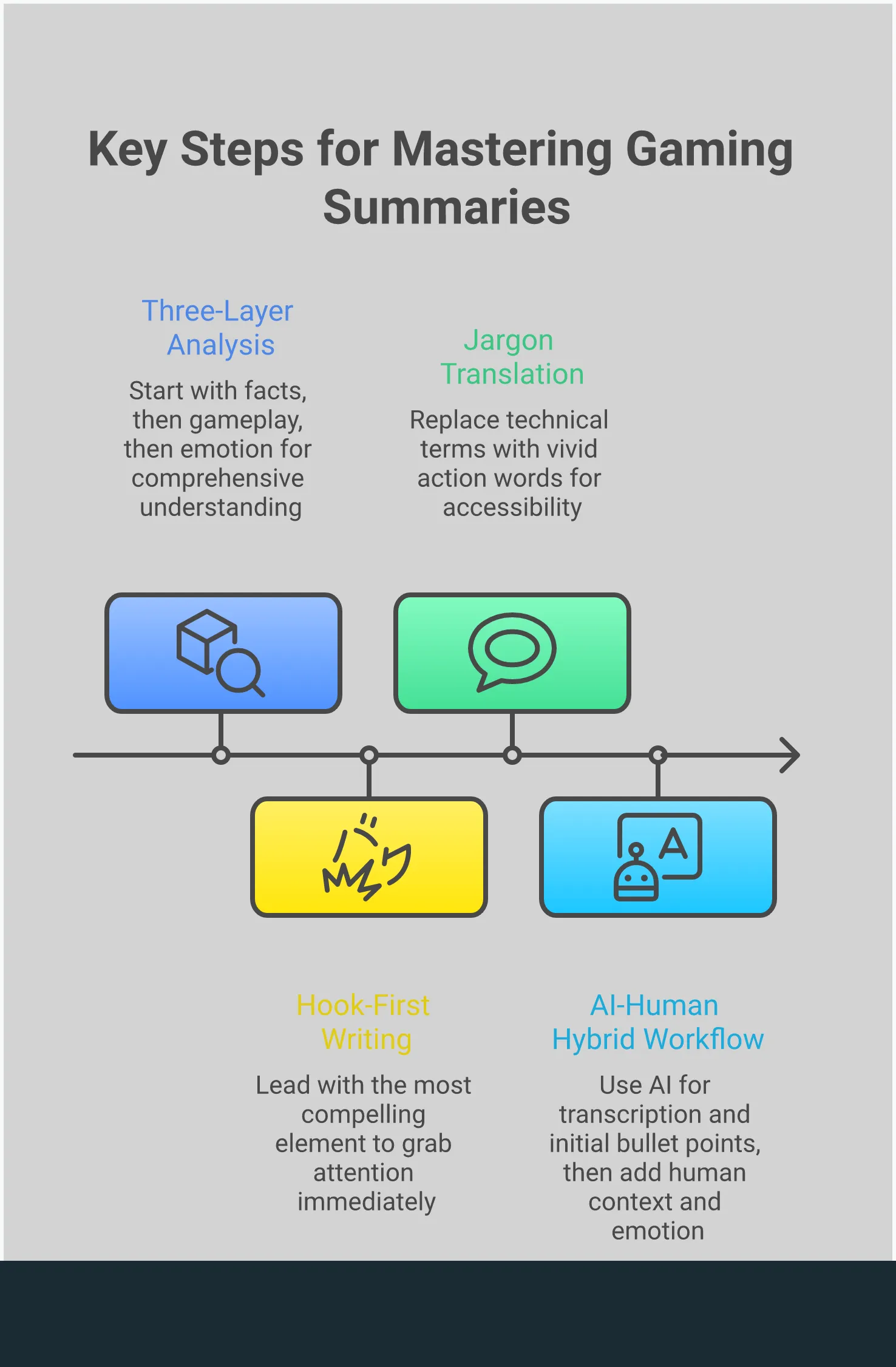
The sweet spot is often found by using AI as a starting point, not the final product. Let an AI tool do the heavy lifting by creating a first draft of a summary from a long article or video. This frees you up to do the more interesting work: adding your own insights, connecting the dots to previous updates, and explaining why this news actually matters to other players. This hybrid approach lets you work faster without losing your unique perspective. By letting AI tools assist you, you can spend less time reading and more time playing, all while staying perfectly in the loop.
How to Summarize Different Types of Gaming Content
Gaming content comes in many forms, so summaries shouldn’t be the same for everything. A review needs a different summary than a fast-moving discussion on Reddit. To create a good summary, think about what the original content is trying to achieve and what readers want to learn quickly. Whether it’s a developer’s news or a complicated game guide, adjusting your summary to fit the content will make it more helpful for other gamers.
Game Reviews and Critiques
When summarizing a game review, focus on the reviewer’s overall opinion and why they came to that conclusion. Pay attention to their thoughts on the most important parts of the game – how it plays, the story, the graphics, and the sound. Did they enjoy some aspects more than others? A good summary will clearly show both the positive and negative points the reviewer made. Your job is to quickly give readers the main idea of the review without revealing too much about the game itself.
News Articles and Announcements
For gaming news and official announcements, clarity is king. Your summary should cut through the marketing speak and deliver the essential facts. Focus on the classic who, what, when, where, and why. What is the announcement—a new game, a DLC, a patch? When is it happening? Who is it for? A good summary gets straight to the point, answering the most pressing questions a player might have. Think of it as the headline and the first sentence of a news report, giving your audience the critical information without any fluff so they can decide if they want to read more.
Strategy Guides and Tutorials
When summarizing a strategy guide or tutorial, focus on what readers can do with the information. They want practical tips to improve their gameplay, so your summary should emphasize the most impactful advice. Don’t just list steps – explain the result of using the strategy. For example, when summarizing a guide about in-game equipment, tell players what that equipment is best for – like excelling at long-distance fights or close-up battles – so they immediately understand how it will help them win. Give them the key takeaway right away.
Community Discussions and Fan Content
When you’re summarizing what people are saying online – like in a Reddit thread or a gallery of fan art – you want to get a sense of the general feeling. Is the conversation positive, negative, or a funny mix of opinions? Look for the main topics, common ideas, or shared jokes that stand out. Your summary should quickly show what the community as a whole thinks. Briefly summarizing long discussions is a good way to understand how players are reacting to a game, especially when big news comes out.
Common Mistakes to Avoid When Summarizing
Creating effective summaries takes practice, and like any skill, it’s easy to stumble along the way. A well-written summary gives your readers a clear and accurate understanding of what happened in a game, update, or community conversation. But mistakes can leave them confused, give away spoilers, or make them feel like they’re missing important details. Fortunately, these errors are simple to avoid if you know what to look for. By prioritizing clear writing, respecting the player’s experience, and remaining unbiased, you can consistently create summaries that are truly useful and interesting for other gamers. Let’s look at the three most common mistakes to help you write better summaries.
Avoid Confusing Gaming Jargon
Everyone uses gaming slang, but when writing for a wider audience, using too much jargon can be confusing. Terms like “DPS,” “AoE,” and “kiting” are common for experienced players, but new players might not understand them. The key is to be clear and welcoming to everyone. Instead of assuming people know what a “gank” is, explain it – for example, “an ambush by multiple players.” This isn’t about simplifying things, it’s about making the information easy to grasp. If you need to use a specific term, quickly explain what it means. Readers will thank you for making complex topics, like building the best loadout in Warzone, understandable.
Don’t Spoil the Experience
Spoilers can quickly ruin the fun of a game, so be careful when talking about story-driven titles, reviews, or fan theories. When summarizing a game, focus on setting the scene, the overall ideas, or how the game plays – avoid revealing key plot points or what happens to characters. If you have to mention a spoiler, always give a clear warning first. Remember, you want to get people excited about playing the game and experiencing its surprises for themselves, not spoil the ending! The goal is to preserve the emotional impact of the game for new players.
Keep Personal Bias in Check
When summarizing something – like game updates or reviews – it’s important to avoid letting your own opinions influence what you write. A good summary should accurately reflect the original source, not be a personal critique. Focus on what’s actually being said, even if you don’t agree with it. Your role is to be an unbiased reporter, delivering the facts. This builds trust with your audience, who will appreciate getting an honest and objective overview. Share your personal thoughts and opinions in a dedicated review or analysis instead, where they’re expected and welcome.
How to Track and Improve Your Summaries
Becoming a skilled summarizer is similar to learning a new skill in a game – it requires practice, patience, and learning from errors. Just like reviewing gameplay to improve, you can analyze your summaries to see what works well and what doesn’t. This helps you turn a basic skill into a strong communication tool. By actively working on summarizing, you can become a more influential voice in any gaming community, whether explaining updates to your group or sharing your thoughts on new releases. Ultimately, the aim is to consistently deliver clear, brief, and engaging summaries.
Develop a Consistent Style
Your writing, like a streamer’s personality, has its own distinct voice. Do you tend to be straightforward and logical, or do you prefer to use humor and internet references? Both styles are fine, but it’s important to be consistent. A good way to discover your voice is to keep a record of your summaries. After a few weeks or months, you’ll be able to see your style developing. Tracking your work isn’t just encouraging—it helps you identify how your voice changes over time. You’ll begin to recognize patterns in your vocabulary and how you construct sentences, which will help you emphasize what makes your summaries special and uniquely you.
Learn from Feedback and Engagement
When you write summaries, remember you’re writing for an audience, so their responses are the best way to improve. If you share your summary on platforms like Discord, Reddit, or forums, watch how people react. Are they asking questions, or are they immediately understanding your key idea? Lots of questions suggest you need to be clearer, while a lack of response might mean your summary didn’t grab their attention. Paying attention to how fans react to new content can teach you a lot about what makes them interested and encourages them to talk about it.
Refine Your Technique Over Time
As a writer, I love seeing how much I’ve improved over time, and I’ve found a really cool exercise to help with that. I try to find a summary I wrote about six months ago and rewrite it as if I were writing it today. It’s amazing to see if I can make it more concise, easier to understand, or just more powerful! It’s not about putting down my old work, but really appreciating how much better I’ve gotten. It’s like how people are always tweaking their Warzone loadouts to get the best results – the more you practice summarizing, the sharper your skills become. That focused practice is what really sets good writers apart from truly great ones, in my opinion.
Related Articles
- Deus Ex LFG: Connect with Other Augs in LFG Feature on Z League App
Frequently Asked Questions
How long should a game summary be? While a single sentence can effectively capture the heart of a game, the best length depends on what you’re trying to achieve. One sentence is great for a quick explanation, but you might need a few sentences to detail important updates, like patch notes for your guild. The most important thing is to be concise while still providing the key information someone needs to understand the game.
Want to get your friends to try a new game? Don’t just explain what it is – tell them how it feels to play! Think about what your friends enjoy in games, and then describe how this one gives them that same experience. For example, instead of saying ‘it’s an open-world RPG,’ try something like, ‘we can team up and create total mayhem in a huge fantasy world!’ Focusing on the fun you’ll have together is much more convincing than just listing the game’s features.
If you’re summarizing something you strongly disagree with, like a review or online discussion, it’s a good chance to practice being objective. When you summarize, focus on reporting the information accurately, not on criticizing it. Make sure your summary fairly represents the main ideas and overall feeling, even if you don’t agree with them. You can share your own opinion elsewhere, but a neutral summary is more reliable and helpful to others.
Yes, it’s perfectly fine to summarize things like fan art or memes! When you summarize creative content, you’re simply explaining the main idea or the joke behind it. For fan art, you might describe what the artist did with the character or the story they’re telling. With a meme, you’d explain the joke and why it resonates with the game’s fans. This demonstrates you understand the community and its spirit, which is just as important as knowing how the game works.
Okay, so I’ve been thinking about using AI to help with my game summaries, and honestly, it’s a pretty good starting point, especially if it’s a long video or article. But I’ve learned you can’t just let the AI do everything. It’s awesome at grabbing the basic facts, but it totally misses the fun stuff – you know, the hype, the little jokes we all share, or even just how something made me feel. What I’m doing now is letting AI get me a first draft, then I jump in and add my own thoughts, explain what’s important to me and other players, and really make the summary feel like it’s coming from a fellow gamer. That’s what makes it actually connect with people, you know?
Read More
- All Itzaland Animal Locations in Infinity Nikki
- Cthulhu: The Cosmic Abyss Chapter 3 Ritual Puzzle Guide
- Persona PSP soundtrack will be available on streaming services from April 18
- Paramount CinemaCon 2026 Live Blog – Movie Announcements Panel for Sonic 4, Street Fighter & More (In Progress)
- The Boys Season 5 Spoilers: Every Major Character Death If the Show Follows the Comics
- “67 challenge” goes viral as streamers try to beat record for most 67s in 20 seconds
- Gold Rate Forecast
- Focker-In-Law Trailer Revives Meet the Parents Series After 16 Years
- Solo Leveling’s New Manhwa Chapter Revives a Forgotten LGBTQ Story After 2 Years
- Rockets vs. Lakers Game 1 Results According to NBA 2K26
2026-02-17 17:29