Author: Denis Avetisyan
A new machine learning approach leverages first-principles calculations to accurately forecast magnetic properties, paving the way for the discovery of novel materials.

Researchers demonstrate a neural network variational Monte Carlo method for predicting magnetism in complex many-electron systems, potentially enabling the design of rare-earth-free magnets.
Predicting magnetic behavior remains a substantial challenge due to the complex interplay of quantum mechanical effects in strongly correlated materials. This is addressed in ‘Predicting magnetism with first-principles AI’ through a novel application of neural network variational Monte Carlo, directly solving the many-electron Schrödinger equation to accurately determine magnetic ground states. The approach successfully predicts both itinerant ferromagnetism in WSe$_2$/WS$_2$ and antiferromagnetic insulation in twisted Γ-valley homobilayers, all within a single calculation-circumventing the need for computationally expensive comparisons across multiple spin sectors. Could this method accelerate the discovery and design of rare-earth-free magnetic materials with tailored properties?
Beyond Traditional Limits: Unveiling the Complexity of Magnetic Prediction
The development of next-generation spintronic devices hinges on the ability to reliably predict magnetic configurations within two-dimensional materials. However, established computational techniques, such as Density Functional Theory (DFT), frequently encounter limitations when addressing systems exhibiting strong electronic correlations – situations where the interactions between electrons significantly influence material properties. These correlations, arising from the complex interplay of quantum mechanics, are often inadequately treated by standard DFT approximations, leading to inaccurate predictions of magnetic ordering and hindering the rational design of materials with tailored magnetic characteristics. This poses a substantial challenge, as precise control over magnetism at the nanoscale is paramount for realizing advanced spintronic functionalities, and conventional methods struggle to accurately capture the subtle energy balances governing these states.
Conventional computational approaches to predicting magnetic behavior, while widely used, face significant hurdles when confronted with the intricacies of many-body effects. The challenge stems from the exponential increase in computational demand as the interactions between numerous electrons are considered; accurately modeling these correlations requires resources that quickly become prohibitive, even with powerful computing infrastructure. This limitation often forces researchers to rely on approximations that, while reducing computational load, can introduce inaccuracies in predicting magnetic states. Specifically, Density Functional Theory, a cornerstone of materials science, can struggle to capture the subtle interplay between electron spins and their environment, leading to unreliable predictions of magnetic ordering and material properties, particularly in materials exhibiting strong electron correlations and complex magnetic textures.
The design of future magnetic materials hinges on a complete understanding of the intricate relationship between a material’s electronic behavior and its atomic arrangement. Traditional approaches often treat these aspects separately, yet magnetism arises from the collective interplay of electron interactions and the resulting distortion of the lattice structure. Accurate predictions require methods that can simultaneously account for how electrons correlate with each other – a phenomenon known as electronic correlation – and how these interactions influence, and are influenced by, the positions of the atoms within the material. Failing to capture this feedback loop can lead to inaccurate modeling of magnetic properties and hinder the discovery of materials with tailored characteristics for advanced spintronic devices; therefore, computational techniques that address both electronic correlations and lattice dynamics are paramount to unlocking the full potential of novel magnetic materials.
A New Paradigm for Magnetic Prediction: Neural Network Variational Monte Carlo
Neural Network Variational Monte Carlo (NN-VMC) utilizes a parameterized neural network to approximate the many-body ground state wavefunction, Ψ. This contrasts with traditional Variational Monte Carlo (VMC) which relies on pre-defined functional forms, such as Slater determinants or Jastrow functions. The neural network, typically a multi-layer perceptron, takes the coordinates of all particles as input and outputs an estimate of the wavefunction value. The network’s adjustable weights and biases serve as variational parameters, allowing the wavefunction to adapt and represent complex quantum states. By employing a flexible, data-driven approach to wavefunction construction, NN-VMC aims to overcome the limitations of fixed-form ansätze and achieve more accurate solutions for many-body problems.
NN-VMC achieves improved accuracy by minimizing the energy expectation value, \langle \Psi | H | \Psi \rangle, through optimization of the neural network’s adjustable parameters. This optimization is performed using Variational Monte Carlo (VMC), a stochastic method that estimates the energy integral using Monte Carlo integration. Traditional VMC methods rely on parameterized wavefunctions with limited flexibility; NN-VMC circumvents this limitation by using a neural network to represent the wavefunction, allowing it to adapt and capture complex many-body correlations more effectively. Consequently, the optimized neural network provides a lower-energy, and therefore more accurate, approximation to the ground state than can be achieved with fixed-form wavefunctions, leading to improved predictions of material properties and system behavior.
Traditional methods for solving the many-body Schrödinger equation often rely on fixed-form wavefunctions, such as Slater determinants or Jastrow functions, which struggle to accurately represent the complex correlations arising from electron-electron interactions. Neural network wavefunctions, employed in NN-VMC, offer increased flexibility by utilizing a parameterized function – the neural network – capable of learning and adapting to these correlations. This adaptability stems from the network’s ability to express a wider range of functional forms compared to their fixed counterparts, allowing for a more nuanced representation of the many-body ground state and, consequently, a more accurate calculation of system properties. The network’s parameters are adjusted during the Variational Monte Carlo optimization to minimize the energy, effectively ‘learning’ the optimal correlated wavefunction.
Decoding Magnetic Orders: Predictions in Two-Dimensional Materials
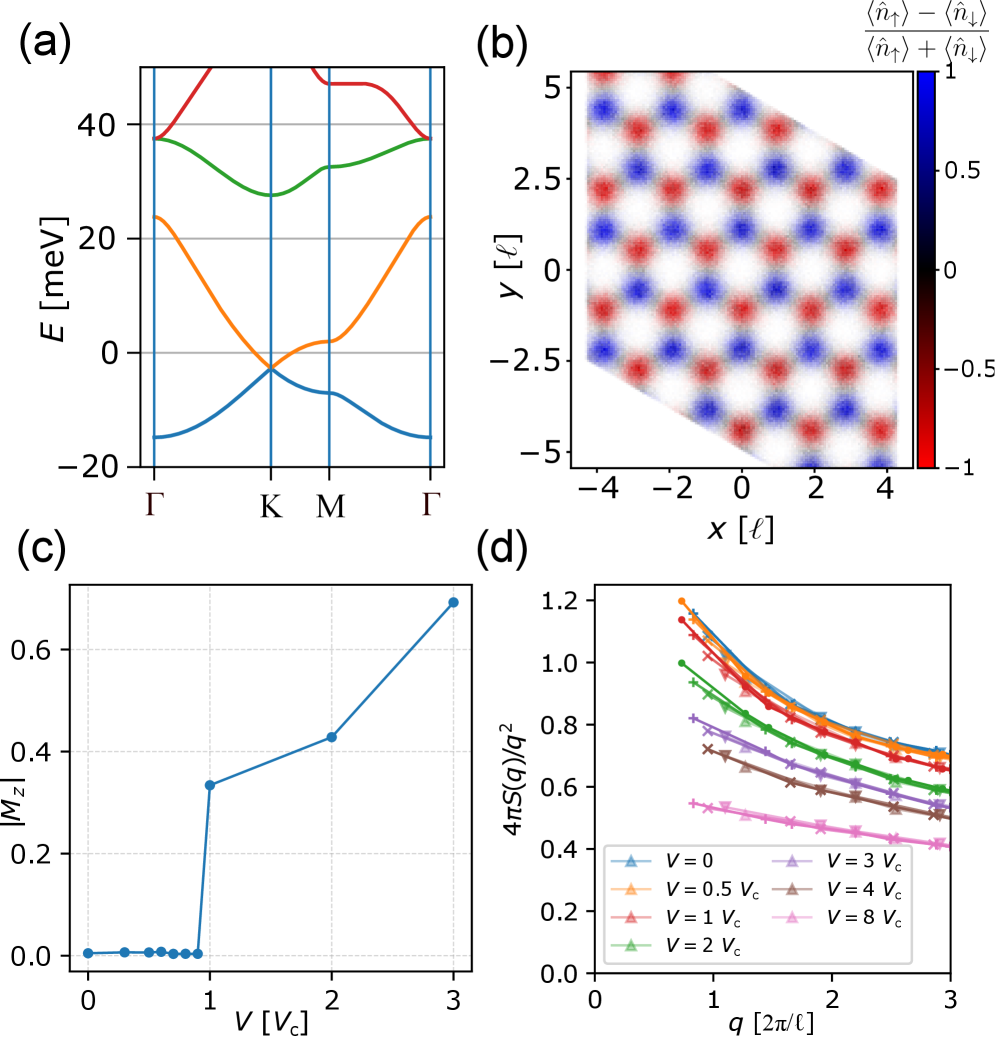
Neural Network Variational Monte Carlo (NN-VMC) calculations performed on the WSe2/WS2 heterobilayer have predicted the emergence of metallic ferromagnetism. This finding demonstrates the capacity of NN-VMC to accurately forecast magnetic states not previously observed in this 2D material system. The predicted ferromagnetic state is characterized by a non-zero magnetization and metallic electronic structure, differentiating it from the insulating antiferromagnetic behavior observed in the constituent homobilayers. This capability is crucial for identifying and characterizing novel magnetic phenomena in complex 2D materials, offering a pathway to materials discovery and design.
Neural Network Variational Monte Carlo (NN-VMC) calculations performed on homobilayers predict an insulating antiferromagnetic ground state. This result demonstrates the method’s ability to accurately model diverse magnetic orders beyond simple ferromagnetic arrangements. The NN-VMC approach successfully identifies the antiferromagnetic configuration as the energetically favored state in these systems, showcasing its versatility in handling different spin alignments and electronic properties compared to other computational techniques. The predicted insulating behavior is a key characteristic of this antiferromagnetic state, indicating a gap in the electronic spectrum.
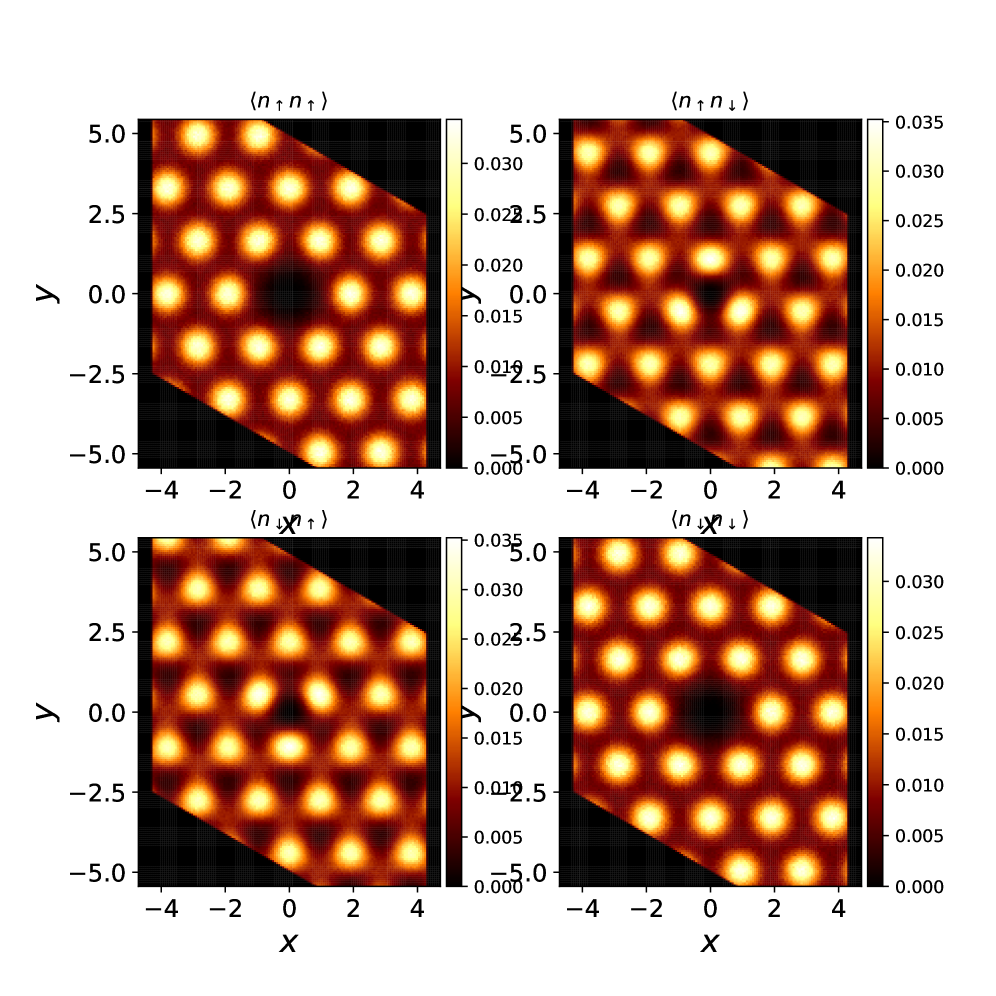
Neural Network Variational Monte Carlo (NN-VMC) calculations successfully determined key magnetic properties, providing validation for the methodology. Specifically, the calculations accurately quantified Spin Density, Total Spin, and Staggered Magnetization within the modeled systems. In the ferromagnetic state, a magnetization of 56 ℏ² was achieved in the Sz=0 sector, which corresponds to the expected value for a total spin of S=7ℏ. This level of quantitative agreement demonstrates the NN-VMC approach’s ability to reliably predict and characterize magnetic orderings and associated magnetic moments.
Neural network variational Monte Carlo (NN-VMC) calculations determined a critical potential strength of 7.7 meV for the antiferromagnetic transition in the investigated 2D material system. This value signifies the threshold at which the system undergoes a change in magnetic order from a correlated metallic state to an insulating antiferromagnetic state. The identification of this critical potential strength supports the conclusion that the observed antiferromagnetism is driven by strong electron correlations rather than solely by direct exchange interactions. This correlation-driven transition is characterized by the system minimizing its energy through the collective behavior of electrons, leading to the ordered antiferromagnetic spin configuration.
The Physics Unveiled: Moiré Potentials and the Emergence of Magnetism
The fascinating emergence of magnetism in layered two-dimensional materials is intimately linked to the subtle distortions created by the Moiré potential. This potential arises when two layers of material are slightly twisted relative to each other, creating a periodic, nanoscale interference pattern. This pattern modulates the electronic structure of the material, effectively altering the interactions between electrons and fostering magnetic ordering. The degree of twist directly impacts the strength and character of this Moiré potential, tuning the material’s magnetic properties – from ferromagnetism to antiferromagnetism, or even inducing exotic magnetic phases. Consequently, controlling the interlayer twist angle provides a powerful mechanism for engineering and manipulating magnetism at the nanoscale, opening avenues for novel spintronic devices and quantum technologies.
The emergence of antiferromagnetic order in stacked two-dimensional materials, or homobilayers, is fundamentally driven by superexchange interactions. This mechanism doesn’t involve direct magnetic coupling between electron spins on neighboring layers; instead, it relies on virtual excitations of electrons across the interlayer potential. This interlayer coupling, arising from the specific stacking and twist angle, facilitates an indirect exchange of spin information. The result is a lowered energy state when spins on adjacent layers align in an antiparallel fashion, creating the observed insulating antiferromagnetic ground state. Effectively, the material minimizes its energy by favoring this staggered spin arrangement, mediated by the electronic structure sculpted by the interlayer interaction, rather than a parallel alignment that would lead to a ferromagnetic state.
Describing the intricate electronic correlations within moiré superlattices requires computational approaches capable of handling many-body interactions with high precision. Researchers have successfully implemented an optimized neural network wavefunction, significantly improving the efficiency and accuracy of these calculations. This wavefunction is further enhanced by the inclusion of a Jastrow factor, which explicitly accounts for electron-electron repulsion, and the Kronecker factored curvature approximation, a technique that streamlines the representation of complex wavefunctions. This combination allows for a robust description of the subtle interplay between electrons, enabling the precise determination of energy scales and ultimately, a deeper understanding of the emergent magnetic properties observed in these layered materials.
Detailed computational analysis has revealed the precise energy scales governing magnetic behavior in these twisted bilayer materials. Calculations pinpoint an energy of 8.22 meV associated with the ferromagnetic state and 7.68 meV for the antiferromagnetic configuration. These quantitatively determined values are crucial, as they demonstrate the subtle energetic preference for antiferromagnetic order and provide a benchmark for validating theoretical models. The relatively small energy difference between these states highlights the sensitivity of the system’s magnetism to external factors, like strain or electric fields, and suggests the potential for manipulating magnetic properties through precise control of material parameters. Understanding these energy scales is therefore foundational for both interpreting experimental observations and guiding the design of novel spintronic devices based on moiré materials.

The pursuit of accurately predicting magnetism through first-principles AI, as detailed in this study, echoes a sentiment articulated centuries ago by Leonardo da Vinci: “Simplicity is the ultimate sophistication.” The complexity inherent in modeling many-electron systems demands a parsimonious approach – one that distills essential features without sacrificing predictive power. This research, leveraging neural networks within a variational Monte Carlo framework, exemplifies that sophistication. Every bias report in the model’s predictions is society’s mirror, reflecting the data’s inherent limitations. The ability to design rare-earth-free materials, a key outcome highlighted, isn’t merely a technological advancement but a responsibility – a conscious effort to move beyond resource dependence and toward sustainable innovation.
Where Do We Go From Here?
The demonstrated capacity to predict magnetism via neural network-enhanced variational Monte Carlo represents a technical achievement, yet sidesteps the more fundamental question of what constitutes ‘progress’ in materials discovery. The acceleration of materials design is not inherently beneficial; it simply amplifies existing priorities. This work, while enabling the search for rare-earth-free magnets – a clearly desirable goal – does not inherently address the geopolitical or environmental consequences of increased magnetic material production, or the potential for novel applications to exacerbate existing inequalities.
Future iterations of this methodology must acknowledge that every algorithmic choice – the network architecture, the training data, the definition of ‘accuracy’ – encodes a worldview. The current framework excels at prediction, but offers limited insight into the underlying physics driving magnetic behavior. A conscious effort to integrate explainability – to move beyond black-box predictions – is paramount. The field should prioritize not merely finding magnetic materials, but understanding the principles governing magnetism, fostering a deeper, more ethical approach to materials design.
Ultimately, the true test lies not in the predictive power of the algorithm, but in the wisdom with which its results are deployed. The automation of materials discovery demands a parallel automation of ethical considerations, ensuring that the pursuit of technological advancement does not outpace the capacity for responsible innovation.
Original article: https://arxiv.org/pdf/2602.09093.pdf
Contact the author: https://www.linkedin.com/in/avetisyan/
See also:
- Off Campus Season 1 Soundtrack Guide
- X-Men ’97 Finally Gave Gambit the Hero Moment He Deserved
- 46 Years Later, The Mandalorian & Grogu Answers A Major Empire Strikes Back Question
- 10 Worst End-Game Couples In Sitcom History
- HoI4 fans harsh reactions to the announcement of another DLC pack
- Chainsaw Man Volume 24’s Cover Art Reveals a Brand-New Denji
- Hatsune Miku cosplayer goes viral selling $15 cups of “foot juice” to thirsty anime fans
- Emily Henry Says to ‘Trust the Vision’ For Beach Read Adaptation
- Gold Rate Forecast
- DoorDash responds after customer uses AI to make food look bad and get a refund
2026-02-12 05:53