Author: Denis Avetisyan
A new approach leverages diffusion models to rapidly identify critical vulnerabilities in power systems before they escalate into widespread outages.
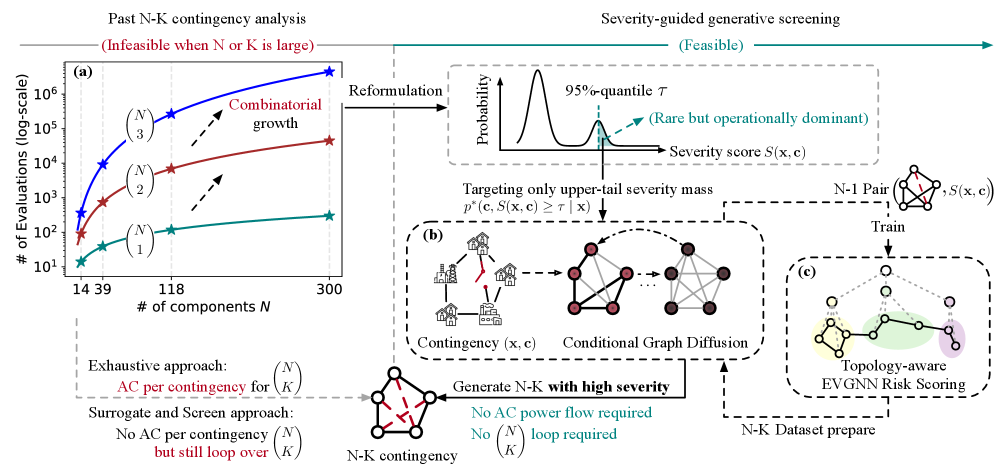
This review details a scalable framework for state-aware inference of high-impact N-k contingencies using graph neural networks and diffusion models, improving power system security assessment.
Increasing penetration of renewable energy sources and dynamic grid conditions are challenging traditional approaches to power system security assessment, particularly for higher-order N-k contingencies. This paper introduces a novel framework-‘Scalable and Reliable State-Aware Inference of High-Impact N-k Contingencies’-that leverages conditional diffusion models and graph neural networks to efficiently identify critical outages without exhaustively enumerating all possible scenarios. By learning from base and N-1 cases, the proposed method prioritizes high-severity contingencies, demonstrably outperforming uniform sampling given limited computational resources. Could this state-aware inference approach fundamentally reshape how power system operators proactively manage risk and ensure grid resilience?
The Evolving Reliability Imperative of Modern Power Systems
The unwavering stability of the electric power grid remains a fundamental pillar of modern society, yet achieving this reliability is becoming increasingly challenging. Historically, power flowed predictably from large, centralized generators to consumers. However, the rise of distributed generation – encompassing sources like rooftop solar panels and wind turbines – alongside the insatiable energy demands of sprawling data centers, has fundamentally altered this landscape. This shift introduces greater complexity, creating a more interconnected and dynamic system where localized fluctuations can rapidly propagate across vast distances. Maintaining consistent voltage levels and preventing cascading failures now requires sophisticated monitoring and control strategies capable of adapting to this new, decentralized paradigm, demanding a proactive approach to grid management that anticipates and mitigates potential disruptions before they impact consumers.
Conventional N-k contingency analysis, a vital practice for ensuring grid resilience, faces escalating challenges in the face of modern power system evolution. This methodology systematically evaluates grid performance under various component failures – losing a single line (N-1), multiple lines (N-k), or even critical transformers – but its computational demands grow exponentially with grid size and complexity. Each contingency requires solving a power flow calculation, and the sheer number of plausible failure scenarios quickly overwhelms even high-performance computing resources. The increasing integration of renewable energy sources, the proliferation of distributed generation, and the rise of data centers – all contributing to a more dynamic and interconnected grid – exacerbate this problem, rendering traditional methods increasingly slow and potentially inadequate for real-time assessment and proactive reliability management. Consequently, researchers are actively exploring innovative techniques, including parallel computing, advanced algorithms, and data-driven approaches, to enhance the scalability and efficiency of contingency analysis and maintain a consistently reliable power supply.
The bedrock of power grid security rests upon the N-1 contingency criterion, a principle demanding continued system operation even after the loss of any single component. Ensuring adherence to this standard, however, necessitates exhaustive testing-a computational undertaking that scales dramatically with grid size and complexity. Each transmission line, transformer, and generator represents a potential failure point, requiring simulations to verify the system’s ability to redistribute load and maintain stability. Modern grids, increasingly characterized by renewable energy sources and bi-directional power flow, present an exponential increase in these potential failure scenarios. Consequently, validating N-1 compliance isn’t merely a matter of running a few simulations; it’s a massive optimization problem demanding sophisticated algorithms and substantial computing resources to proactively identify and mitigate vulnerabilities before they impact service.
Generative Screening: A Paradigm Shift in Contingency Analysis
Generative Screening addresses the computational burden of contingency analysis by moving away from exhaustive, ‘n-1’ simulations. Traditional methods require detailed analysis of every credible contingency, a process that scales poorly with system size and complexity. Generative Screening instead employs algorithms to intelligently select a reduced set of contingencies that are representative of the broader contingency space. This selective approach allows for a statistically sound analysis using a fraction of the computational resources, while maintaining an acceptable level of accuracy and reliability in identifying critical system vulnerabilities. The reduction in required simulations directly translates to lower processing times and costs, enabling more frequent and comprehensive grid assessments.
Generative models, including conditional Generative Adversarial Networks (cGANs), conditional Variational Autoencoders (cVAEs), and Diffusion Models, are employed to synthesize realistic contingency scenarios for power system analysis. These models are trained on historical operational data and system parameters to learn the underlying distribution of credible events, such as line outages or generator failures. cGANs utilize a generator network and a discriminator network in a competitive process to produce high-fidelity contingency simulations. cVAEs learn a probabilistic latent space representation of contingencies, enabling the generation of diverse scenarios through sampling. Diffusion Models progressively add noise to data and then learn to reverse the process, generating new contingencies by denoising. The output of these models provides a statistically representative set of contingencies for subsequent analysis, reducing the need for exhaustive enumeration of all possible events.
Surrogate models are employed to reduce the computational burden of detailed power flow analysis during contingency analysis. These models, often utilizing machine learning techniques, are trained on data derived from full AC power flow simulations. Critically, their accuracy is enhanced by incorporating Line Outage Distribution Factors (LODF), which quantify the impact of individual line outages on power flows throughout the system. By leveraging LODF as input features, the surrogate model can more accurately predict system responses to contingencies without requiring repeated, time-consuming AC power flow calculations. This allows for a substantial acceleration of the overall contingency analysis process, enabling faster identification of potential system vulnerabilities.
Conditional generation techniques enable the creation of contingency scenarios specifically tailored to defined system conditions, moving beyond random or uniformly distributed contingency selection. This is achieved by inputting relevant system states – such as load levels, generation dispatch, or network topology – as conditioning variables to the generative model. The model then produces contingencies that are statistically consistent with these specified conditions, allowing analysts to focus on scenarios most likely to occur under particular operating circumstances. This targeted approach improves the efficiency and accuracy of contingency analysis by reducing the number of irrelevant scenarios evaluated and increasing the probability of identifying critical vulnerabilities under realistic conditions.
Network Topology: The Foundation of Intelligent Risk Assessment
Accurate contingency analysis in power systems requires a comprehensive understanding of network topology. The physical and logical arrangement of grid components – transmission lines, transformers, and buses – directly governs the path and magnitude of disturbance propagation following a fault or outage. A disturbance at one location does not impact the system uniformly; its effects are constrained and directed by the interconnectedness of the network. Consequently, analytical tools must explicitly account for these structural relationships to reliably predict system behavior under stress. Ignoring topological factors leads to inaccurate assessment of cascading failures, voltage instability, and overall grid vulnerability, as the model fails to capture the true pathways of disturbance propagation and the resulting system response.
Edge Varying Graph Neural Networks (EVGNN) represent a class of neural network architectures specifically designed to leverage the topological characteristics of networked systems for enhanced risk assessment. Unlike traditional Graph Neural Networks (GNNs) which utilize static edge representations, EVGNNs assign learnable parameters to each edge in the network, allowing the model to differentiate the influence of various connections on risk propagation. This approach enables the incorporation of line ratings, impedance data, and other edge-specific attributes directly into the risk scoring process. Furthermore, EVGNNs facilitate generative screening by identifying critical edges and substructures that, when compromised, pose the greatest threat to system stability, allowing for proactive vulnerability assessment and mitigation strategies.
Edge Varying Graph Neural Networks (EVGNNs), when integrated with risk scoring methodologies, enable the identification of critical vulnerabilities within a network by assessing the potential impact of various contingencies. These models operate by learning node embeddings that capture both feature data and topological relationships, allowing for the quantification of risk associated with specific network elements and their interconnectedness. The risk score, derived from these embeddings, facilitates prioritization of contingencies based on predicted impact, enabling operators to focus mitigation efforts on scenarios with the highest potential for cascading failures or service disruptions. This approach moves beyond static vulnerability assessments by dynamically evaluating risk in relation to the network’s evolving state and the specific characteristics of each contingency.
The capacity of Edge Varying Graph Neural Networks (EVGNNs) to generalize to previously unencountered contingencies stems from their ability to learn inherent patterns within the network’s graph structure. Unlike traditional risk assessment methods reliant on predefined scenarios, EVGNNs extract features directly from the network topology – node connectivity, edge weights representing transmission capacity, and spatial relationships between components. This learned topological understanding allows the model to predict the impact of novel disturbances, even those differing in location or magnitude from training data. Consequently, EVGNNs contribute to enhanced grid resilience by proactively identifying vulnerabilities and enabling a more adaptable and robust contingency response, improving system-wide stability in the face of unforeseen events.
Towards Proactive Grid Resilience and Future Directions
Traditional N-k Contingency Analysis, a cornerstone of power grid reliability assessment, faces a substantial computational hurdle as the number of potential failures (contingencies) grows exponentially with system size. Generative Screening, leveraging an Evolutionary Variational Graph Neural Network (EVGNN), addresses this challenge by intelligently prioritizing which contingencies require detailed analysis. Instead of exhaustively examining every possible failure scenario, the EVGNN learns to generate a focused subset of high-impact contingencies, dramatically reducing the computational load. This targeted approach allows grid operators to proactively identify critical vulnerabilities without being overwhelmed by the sheer volume of possibilities, enabling faster response times and improved system security – a particularly crucial advantage as power grids become increasingly complex and incorporate more distributed energy resources.
By shifting from reactive responses to preventative measures, grid operators can significantly bolster the reliability and security of power systems. This proactive approach, facilitated by techniques like generative screening, allows for the identification of potential vulnerabilities before they cascade into widespread outages. Instead of addressing failures as they occur, operators gain the ability to strategically reinforce weak points in the grid, optimize resource allocation for contingency events, and ultimately minimize the impact of disruptions. This transition not only improves system stability but also enhances resilience against an increasing range of threats, from extreme weather events to coordinated cyberattacks, paving the way for a more dependable and secure energy future.
The increasing prevalence of inverter-based resources – such as solar and wind power – introduces unique challenges to grid stability due to their differing operational characteristics compared to traditional synchronous generators. Effectively managing this growing penetration requires a shift towards proactive resilience strategies, and generative screening techniques, coupled with graph neural networks, offer a powerful means of anticipating vulnerabilities specifically within systems heavily reliant on these resources. These methods can model the dynamic behavior of power grids with a high degree of accuracy, identifying potential cascading failures triggered by the intermittent and less predictable nature of renewable energy sources. By intelligently prioritizing contingency analysis focused on inverter-based resource interactions, grid operators can enhance system security and maintain reliable power delivery even as the energy landscape continues to evolve towards greater sustainability.
Continued advancements in generative models and graph neural network architectures promise increasingly robust solutions for bolstering grid resilience against a dynamic landscape of challenges. Current research focuses on refining these models to not only predict potential vulnerabilities with greater accuracy, but also to generalize effectively to unseen grid configurations and evolving threat profiles. Exploration of novel generative approaches – beyond those currently employed – aims to create more realistic and diverse contingency scenarios for training, while innovations in graph neural network design seek to capture increasingly complex interdependencies within power systems. These combined efforts will enable proactive identification of critical weaknesses, facilitate rapid response to disruptions, and ultimately support a more secure and reliable electricity grid capable of accommodating the increasing integration of renewable energy sources and facing unforeseen future demands.
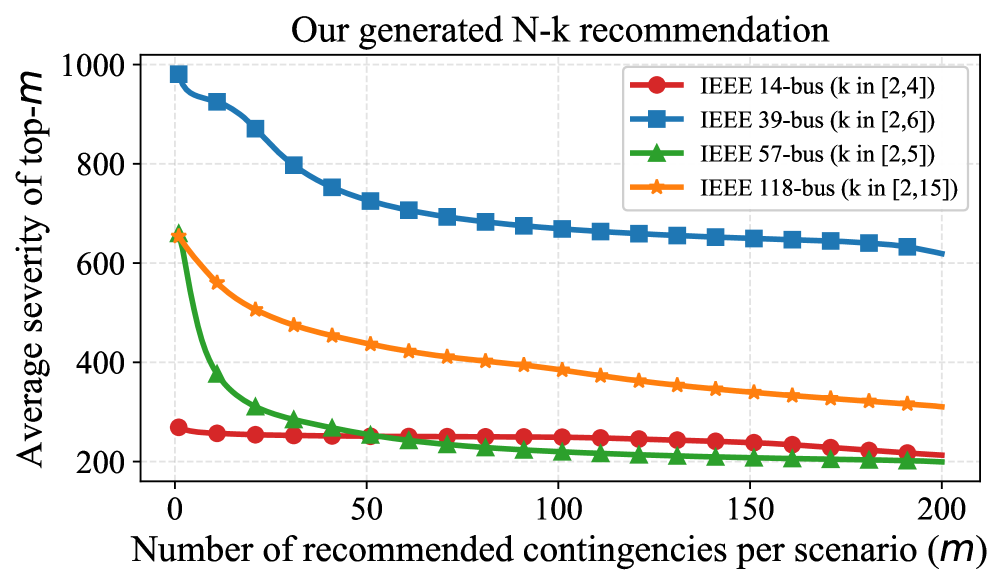
Evaluations on the standard IEEE 118-bus system demonstrate the framework’s substantial improvement in identifying critical grid vulnerabilities. The approach consistently achieves an average top-m severity of approximately 430 when considering the 50 most severe contingencies, and maintains a value around 310 when expanded to the top 200. This performance notably surpasses that of uniform random sampling, a common baseline technique, which experiences a significant decline in identified severity – dropping from 250 to 130 over the same range. This difference highlights the framework’s ability to efficiently prioritize and detect high-impact events, offering grid operators a more effective tool for proactive resilience planning and mitigating potential disruptions.
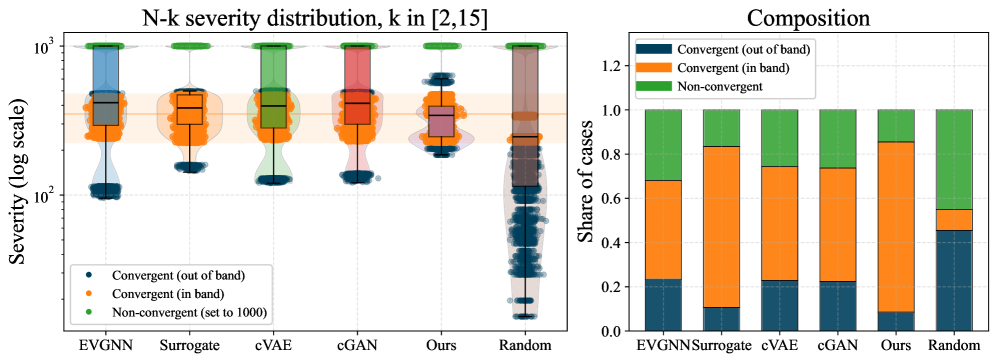
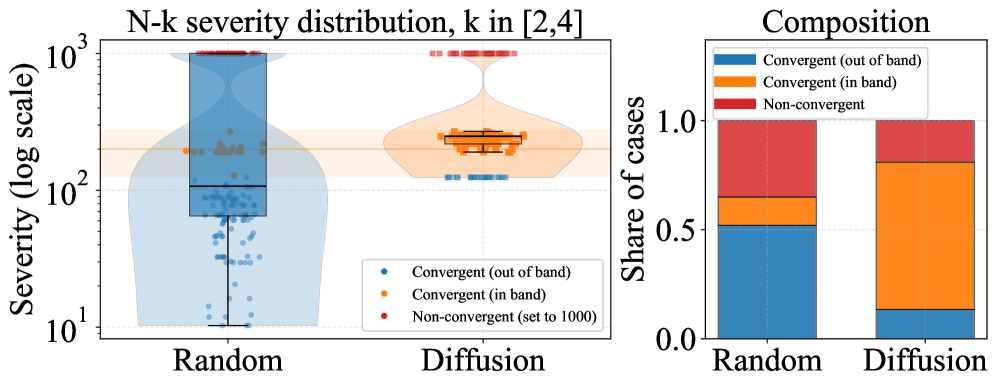
The effectiveness of this proactive grid analysis lies in its ability to pinpoint genuinely critical vulnerabilities, demonstrated by a remarkably high in-band fraction of 90.1%. This indicates that the vast majority of identified contingencies converge to a solution within power flow calculations-and crucially, represent high-severity events threatening grid stability. Complementing this precision is a practical ACPF convergence rate of 87.1%, signifying the method’s robust computational performance even when assessing complex scenarios. These metrics collectively suggest a substantial improvement over traditional methods, allowing grid operators to focus resources on addressing the most impactful threats and bolstering overall system resilience with a high degree of confidence.
The pursuit of robust power system security, as detailed in this work, demands a foundation built on mathematical rigor. The framework’s reliance on diffusion models and graph neural networks isn’t merely a technological advancement, but a commitment to provable reliability. As Robert Tarjan once stated, “Programmers waste enormous amounts of time thinking about things that ultimately don’t matter.” This sentiment echoes the core concept of contingency screening; by efficiently narrowing the scope of analysis-identifying only high-impact N-k contingencies-the system sheds irrelevant computational burden, focusing instead on the essential conditions that truly threaten stability. The method’s strength lies not just in its scalability, but in its potential to formally address the problem of power system vulnerability.
What’s Next?
The presented framework, while demonstrating a reduction in computational complexity for N-k contingency analysis, does not resolve the fundamental ambiguity inherent in defining ‘high-impact.’ Severity estimation, even with the predictive power of diffusion models, remains tethered to the chosen metrics – a distinctly practical, rather than mathematical, constraint. The elegance of a provably optimal contingency set remains elusive; current approaches, including this one, offer only approximations, albeit efficient ones.
Future work must address the limitations of graph neural network generalization. Performance gains observed on benchmark systems are, predictably, not guarantees of robustness across the vast and heterogeneous landscape of real-world power grids. A formal analysis of the framework’s sensitivity to network topology and data quality is critical. The current reliance on supervised learning introduces another layer of approximation; an exploration of unsupervised or self-supervised methods, grounded in the inherent physics of power systems, could yield more principled results.
Ultimately, the true measure of progress will not be in faster computation, but in a demonstrable reduction of uncertainty. Contingency analysis, at its core, is a problem of risk assessment. The field requires a move beyond predictive accuracy and towards probabilistic guarantees – a quantification of the likelihood that a selected contingency set genuinely encompasses all credible threats. Only then can the pursuit of algorithmic efficiency be justified as more than merely an exercise in applied pragmatism.
Original article: https://arxiv.org/pdf/2602.09461.pdf
Contact the author: https://www.linkedin.com/in/avetisyan/
See also:
- Off Campus Season 1 Soundtrack Guide
- 46 Years Later, The Mandalorian & Grogu Answers A Major Empire Strikes Back Question
- X-Men ’97 Finally Gave Gambit the Hero Moment He Deserved
- 10 Worst End-Game Couples In Sitcom History
- HoI4 fans harsh reactions to the announcement of another DLC pack
- Chainsaw Man Volume 24’s Cover Art Reveals a Brand-New Denji
- Emily Henry Says to ‘Trust the Vision’ For Beach Read Adaptation
- Hatsune Miku cosplayer goes viral selling $15 cups of “foot juice” to thirsty anime fans
- Katanire’s Yae Miko Cosplay: Genshin Impact Masterpiece
- DoorDash responds after customer uses AI to make food look bad and get a refund
2026-02-12 00:48