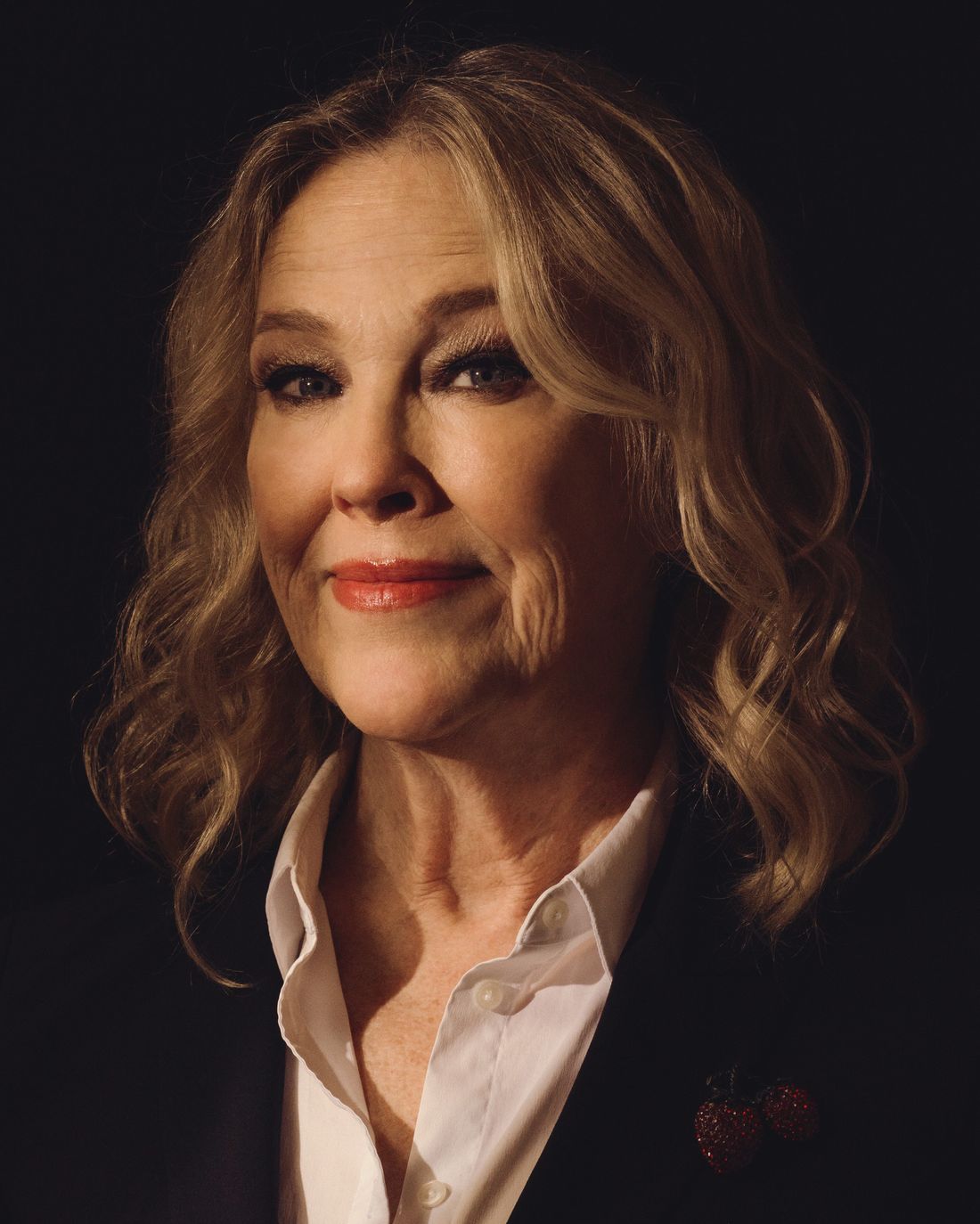
This interview first appeared on March 20, 2019. We are republishing it in memory of Catharine O’Hara, who recently passed away at the age of 71.
Catherine O’Hara, despite a long and successful career, remains remarkably down-to-earth – she even complimented my hair right away! It turns out she’s quite skilled at styling hair, having practiced on herself and her Second City and SCTV castmates back in the 1970s to create diverse characters. This talent has served her well in a variety of roles, including films with Christopher Guest and Eugene Levy like Waiting for Guffman, Best in Show, A Mighty Wind, and For Your Consideration, as well as classics like Beetlejuice and Home Alone. More recently, she’s known for her role as the eccentric, accented Moira Rose in Schitt’s Creek. “Some actors prefer to play similar characters, but I love variety,” she explains. “I want to explore different roles and not be limited – I’m still figuring out who I am!”
Moira Rose from Schitt’s Creek is known for being wonderfully unusual – from her wigs and outfits to the way she speaks. The actor who played her was asked if the character was inspired by anyone in real life. They explained that creating Moira’s look – the hair, makeup, and clothes – helped them transform into the character physically. The unique voice, they said, came from imagining a collection of accents and mannerisms picked up during travels around the world, almost like souvenirs. They were initially inspired by someone they knew who spoke in a very specific and hard-to-understand way. They also mentioned that Madonna’s ability to reinvent herself and claim a persona as if it had always been there, and a moment where Kathleen Turner affected a Brazilian accent on television, were also influences.
You mentioned being hesitant about taking on the show initially. What ultimately convinced you to do it? Well, honestly, a bit of it was just being comfortable and not wanting a long-term commitment. But mostly, my background at Second City has really spoiled me. I’m used to having the freedom to develop my own characters, write my own material, and improvise. I enjoy constantly having something new to work on. That was my biggest worry about a series – seeing friends stuck in roles where their creativity wasn’t valued and being told how to perform by people who hadn’t previously recognized their talent.
Were other people’s approaches more controlling and less of a team effort? It felt like my hesitation stemmed from fear rather than what was actually happening. You never really know what to expect. When considering a long-term commitment to the show, I hoped for a character I’d enjoy playing, and Daniel and Eugene Levy thankfully cast the actress in a way that allowed for growth. I also discussed how I envisioned the character speaking with Eugene, and then I asked about using different wigs. They were incredibly supportive, even offering a whole wall of wigs! Everything about the experience was appealing, and I’m grateful that something – whether it was intuition or just luck – led me to accept the role.
You mentioned that some actors create characters based on their own personalities, while others use characters to hide parts of themselves. I’m curious, do you lean more towards one of those approaches? Well, I think it’s impossible not to draw on your own experiences, especially in improv. That’s all you really have to work with – your own memories and instincts. But you can also start by thinking, ‘How would I handle this situation?’ and then deliberately change your reaction to fit the character. Once you start understanding how the character thinks, it becomes much easier to improvise and truly become them. I don’t think anyone on this show started with a fully formed idea of who their character would be. Even with time to prepare, you’re constantly influenced by the other actors. It’s a collaborative process, and you evolve together.
I get asked about characters I really connected with a lot. Honestly, it’s tough to pick just one. I think I initially hesitated with the role of Temple Grandin in an HBO movie because she was portrayed as simply a kind person – not that I’m saying that’s not a good thing! But I often gravitate towards more complex characters.
Claire Danes was amazing, wasn’t she? I really enjoyed working with her. She kept apologizing between takes, explaining she wasn’t fully connecting because she was portraying Temple Grandin, a person with autism, and needed to stay in character. She’d apologize for not being completely present with me, but I’d tell her that was perfectly fine – she was Temple Grandin, and that was all I needed. It was easy to be supportive and care for her while we worked together.
When I first read it, my impression was simply that she was a kind person. But truly memorable characters are rarely just nice; even people we know in real life are much more complex than they seem. Everyone is, really. The writing didn’t immediately capture my attention, perhaps because I often misinterpret things on a first read. You need to give it time, relax, and stop trying to impress others. I don’t consciously approach work with that in mind, but I think we all need to let go of the need to show off and simply be ourselves. That’s actually the key to life: just be.
I worried I’d fall into playing the stereotypical ‘bitchy wife’ – I did that a lot with Moira, and often played either crazy or unpleasant characters when I was starting out at Second City. I really didn’t want to repeat that with Eugene, and I’m glad neither of us played characters who didn’t genuinely love each other. I think we portray a truly loving couple in this project.
I’ve noticed a pattern in the characters I play – they often feel insecure and live a bit in their own world. It strikes me that I’m drawn to playing people unaware of how they come across, but the more I think about it, the more I realize that’s true for all of us. Social media feels like a way to try and manage how others perceive us, but we’ve always done that to some extent. Following someone on Twitter – what is that, really? I haven’t ever felt like I was deliberately hiding who I am, but I’ve also never considered myself particularly fascinating. I occasionally think, ‘That’s a clever thought, I should share it,’ but honestly, does anyone not think that way sometimes?
These days, everyone’s on social media. But young people especially might not have fully figured out who they are yet. They’ll probably cringe at old posts later, thinking, “Did I really say that?” It’s natural to want some privacy about things you did when you were younger – things that maybe only your friends saw at the time. But now, everything is public and permanent. Once something is online, it’s there forever.
Many people attempt to carefully manage how others perceive them. But ultimately, won’t you eventually need to interact with the world directly?
It’s funny, a lot of parents try to shield their kids from certain things, but I found myself completely disarmed by my own children. See, my kids are grown now, 24 and 21, and when I’d ask them to put down the video games, they’d immediately counter with, “But Dad, people are making serious money doing this!” They were talking about this gamer who streams online, and honestly, I didn’t get it. Then I saw him interviewed on The Colbert Report, and it all clicked. He actually showed clips of what he does, and it was impossible to argue with the fact that this was a legitimate career path. It completely ended the conversation!
To what extent is your work a commentary on society? Well, that’s really the heart of improvisational comedy, like what we do at Second City. It’s about noticing everyday things – something you see on the way to work, a snippet of conversation – and thinking, ‘That’s funny!’ You collect those little observations and use them as a starting point. But the humor always comes from recognizing ourselves, our own silly behaviors. It’s about the ridiculous, wonderful, and complex nature of being human – all the good, the bad, and everything in between.
When we were doing celebrity impressions on SCTV, it was a really collaborative process. Writers would suggest who might be funny to parody – like, someone working on a sketch would say, “What if Meryl Streep was in this?” or “How about Brooke Shields?” Then I’d give it a shot. With Brooke Shields, it was funny because I was in my 30s and thinking, “Really?” But we had a great hair and makeup team. Back then, there was no internet, so I’d just record anything I could on VHS – really bad quality stuff. I’d tape people on talk shows, and I remembered seeing Brooke Shields on Johnny Carson trying to do a silly bit where she pretended to trip. It was so interesting because she’s naturally beautiful and people wouldn’t let her be funny. They’d just ask if she was okay instead of realizing she was performing! Nobody believed she was trying to be funny—but I did! I thought, ‘They just won’t let a beautiful woman attempt that kind of humor!’
Many of my impersonations were actually based on Marty Short’s, since he did fantastic versions of Katharine Hepburn and Elizabeth Taylor. It’s funny how seeing a really good impersonator can make you realize quirks about the original person you never noticed before. They reveal something new about the person they’re imitating. For example, Frank Caliendo on Mad TV did a Bush impression I’d never heard before, and Will Ferrell did his own take, which was also brilliant.
When we were working on SCTV, if someone suggested a celebrity impersonation, I’d only do it if I actually liked the person. I didn’t want to waste my time and energy on someone I didn’t find interesting.
It’s understandable why people might be upset by impressions done of them, but it really depends on how those impressions are done. If someone puts a lot of effort into accurately portraying you, it could even be seen as a compliment – it means they’ve spent time observing and thinking about you. However, if an impression is quick, exaggerated, and unflattering, then it’s perfectly reasonable to be upset. It also depends on the person – if they’re a public figure, dealing with impressions – both good and bad – often just comes with the territory.
You really should check out Anthony Atamanuik’s appearance on Colbert. He explains how he created his Trump impersonation, and it’s incredibly impressive. It’s almost like watching a masterclass on impersonation techniques. He describes how he finds the physical center – or lack thereof – of the character, and then completely transforms into Trump right before your eyes. He doesn’t even need a wig or makeup to pull it off. It’s a truly fantastic and convincing performance – he’s the best Trump impersonator out there.
SCTV was mostly a show run by men. Was it hard to share your ideas when the writers were brainstorming?
Yes, it was. When I first started, I’d quietly suggest ideas to Dave Thomas, and he would then present them as his own – without giving me credit. If the idea didn’t get a good reaction, I’d immediately stop speaking up. I was very insecure! I only spoke up if an idea I’d suggested actually made people laugh, and then I’d quickly claim it as my own. It felt like I had to get Dave Thomas’s approval before any of my ideas were considered.
It’s amusing looking back now. There was still a lot of sexism back then, a result of how those comedians were raised. Their generation had been taught certain ways of looking at women, but because they were actors, not just stand-ups, they were more open to different perspectives. I really liked those guys – they weren’t intentionally mean. It was more a numbers issue, and that was just how things were at the time. Second City casts almost always had only one or two women. Just recently, I asked Andrew Alexander if he’d ever had more women than men in a cast, and he said he had, frequently. That was great to hear! I then asked about diversity beyond just race, and he confirmed they had plenty of non-white performers, and performers who weren’t straight and white. Things are much more open now, but back then, it was usually limited to just two women.
Oh, yes, and I worked with Andrea Martin, but also with several other women. I started by understudying Gilda Radner, and then Rosemary Radcliffe, who was already in the cast with Gilda. Later I worked with Andrea and Robin Duke. Once, when the cast got a break, we put together an all-women show with Robin, Andrea, Mary Charlotte Wilcox, and a few others – it was a lot of fun! It was funny because if the male writers had a scene about men, they’d just add, “And then the women come in!” as if we were all the same person. We’d try to suggest, “Could we maybe be different women entering at the same time?” But it was a different time back then, with women’s liberation just starting to gain momentum. Things have definitely changed since then.
Were you ever restricted in the types of characters you could create due to gender roles? Absolutely. We based our work on real life, and we were essentially mirroring society. We could only create comedic versions of women who were allowed to have careers and public lives at the time. I think comedy has evolved because the world has evolved. Nowadays, more women are given the opportunity to reach their full potential than in the past, although there’s still progress to be made.
Early on with SCTV, the writers weren’t officially credited or paid. It didn’t make much sense, and Andrew Alexander, the producer, apologized, explaining it was just how things operated back then. He’s since made things right, and we’re all on equal footing now. He was always great creatively, but it highlights a bigger issue – even today, women often don’t receive equal pay for equal work.
Looking back, it’s funny how my perspective shifted. When we first started the TV show, I was just thrilled we were even making a show! I’d always been pretty carefree about money, honestly. Even at Second City, I was just happy to be performing and getting paid – it felt unbelievable! So, when the TV show came along, I had the same feeling – pure excitement. I don’t think it immediately dawned on me that we weren’t being compensated properly. I remember John Candy bringing it to light – he wasn’t getting paid either! The three of us – John, Andrea, and me – weren’t on the same financial footing as the others. John was amazing, though. He had so much self-respect and wasn’t afraid to speak up. I’m sure his confidence encouraged me. He was a true ally, both professionally and personally, and I always felt supported by him. I definitely remember talking to Alexander about it, probably saying something like, ‘What is going on here?’
I suddenly realized my negotiation skills came entirely from watching the comedy show SCTV. I figured out that when someone tries to devalue your worth, it just means they’re trying to pay you less, not that they actually think you’re less valuable. They’re just hoping to get a better deal. I also learned to always ask for more than you expect, so you can negotiate down to a price you’re actually happy with. The biggest takeaway is not to take these negotiations personally.
With Christopher Guest’s films, the script isn’t a fully written story, but more of a basic outline. And surprisingly, the finished movie closely follows that original outline. The process relies heavily on improvisation – each actor is given a lot of freedom to create their character. There isn’t much pre-planning or discussion, except if actors are playing a couple. In those cases, they might talk things through a little. For example, in Best in Show, Eugene Levy and I had to discuss the details of dog training and showing. We didn’t even discuss our character looks beforehand – it was a fun surprise to see what the other person came up with, especially when we found out we were married! You have to be flexible and adjust your ideas based on what your fellow actors bring to the table.
After the initial setup, we’d often improvise scenes. Chris would let us run with it, and after a couple of tries, he’d ask us to revisit a specific part – like how our characters met. He wasn’t necessarily looking for the same lines, but he knew something was missing from the original plan or wanted to emphasize a certain point. We’d constantly be asking if we could try completely new material, or if we should work in jokes we’d thought of. It was a thrilling experience, always trying to figure out how much we could change with each take.
Do you often try improvising and experimenting with each scene as you film it? Absolutely. Everyone involved is working in the moment, and I realized on those kinds of projects that you’re never really alone – just like in life. You collaborate with others to develop your character, and you can help them build theirs through how you interact, sharing spontaneous details or memories. It’s about acknowledging what others bring to the scene. The core of improv is about accepting offers – saying “Yes, and” or, if you disagree, “No, but” – and then adding something of your own. For example, if someone says, “Remember when I tried to kiss you in school?” you wouldn’t deny it. You might say, “I don’t remember, but I do remember what happened later!” or “Yes, I remember, but I think you were the one who initiated it!” It’s all about building on each other’s ideas and creating something together.
Did anything about the “For Your Consideration” campaign happen spontaneously? Absolutely! They predicted I’d go to extreme lengths for awards attention – even suggesting a facelift, which you’re seeing play out now. They even talked about using tape to pull my face back, but I refused. I learned from my years doing comedy that you have to be able to show your real face at the end of the day. And, honestly, I wasn’t in my thirties when we were doing all that! When was “For Your Consideration” anyway?
Back in 2006, I knew my face would eventually need to return to its natural state. So, I focused on facial exercises, holding the poses for as long as possible, and even tried to mimic a look I’d seen on women who’d had bad cosmetic work done. The only truly artificial thing was a set of false teeth. I’d noticed that women who’ve had a lot of work done often have a lengthened space between their nose and upper lip, and my teeth were covered, so they made me a set that would create that effect – big, white, and straight, which isn’t my natural look. Then, our makeup artist, Kate Shorter, gave me a really shiny, almost plastic-looking, and strangely highlighted complexion.
Someone asked how I practiced this technique and if it was exhausting. It’s simply about lifting and strengthening the facial muscles – the more you do it, the better the results! We all have muscles under our skin, even in our face, and my mother practiced this her entire life. She never had plastic surgery or a face-lift. Even at 81, when she passed away, her eyebrows were remarkably high and she had no wrinkles on her forehead. Her cheeks were also very lifted! I wish I had photos to show you. She started with lower eyebrows in her 20s, but they moved up significantly by the time she was in her 80s. She would manually lift her face, and she was always conscious of how to look her best. It really worked for her – she naturally lifted her face over time.
Have you ever thought about how your career could have taken a different path? I used to have meetings with studio executives and directors, and it always felt like an audition – trying to gauge whether they were interesting people or not. I remember one lunch with Milos Forman, who I worked with on Heartburn. I was incredibly nervous on that set, surrounded by Jack Nicholson, Meryl Streep, Stockard Channing, Richard Maser, and Milos Forman. We were supposed to portray a group of close couples, and honestly, I kept wondering what I was doing there. I was so anxious I almost panicked on the first day of rehearsal. I just told myself to stay quiet and listen. Mike Nichols, who was a genius, had a knack for spotting something unique in people and throwing them into the mix. He did that with a lot of talented individuals, and it helped them thrive. He chose me to be part of that group, and it was a wild experience.
So, after seeing the movie, a month or two later, Milos Forman invited me to lunch. I honestly have no idea what he was thinking – whether it could have led to something more, or even just a good conversation. I’m not saying it would have, but it was a chance to pick his brain about his life in Prague, where he grew up. From what I’ve learned since, his childhood sounded incredible. But instead of asking, I was completely caught up in my own head – was he interested in me? Was this a date, or was he considering me for a job and sizing me up? I was so insecure and clueless. Looking back, I regret missing those opportunities far more than any missed movie. I fancy myself an observer of people, someone who learns from them, but in that moment, I was too afraid of being judged to actually listen. He was such a fascinating, gifted man, and I could have learned so much, maybe even worked with him again. I was just… naive. He actually told me some amazing stories, and I swear, my reaction was often something like, “Yeah, right!” [Laughs.] That’s the really sad part, honestly.
Looking back on ‘Home Alone,’ it’s funny because it wasn’t considered a sure hit when I first signed on. It just had a great script and talented people like John Hughes and Chris Columbus involved. I never really focus on whether a film will be big or not – you can’t control that. It wasn’t until I was negotiating for the second movie that I realized just how popular the first one might become! That’s when I was offered a lot of money upfront. I used that opportunity to negotiate a shorter shooting schedule. I could have taken more money if I was available for all 12 weeks, but filming in Chicago during winter meant they’d often switch between indoor and outdoor scenes depending on the weather. For the first ‘Home Alone,’ I was there the entire time. But for the sequel, I knew I wasn’t in every scene, so I took less money in exchange for condensing my work schedule. That was the only way I really benefited from the film’s success – being able to have more control over my time, especially since it was a beloved sequel. It’s still amazing to think about how much people love that movie.
It’s become much harder for mid-range films to get made. The film industry no longer offers a solid financial middle ground for actors; you’re either earning a top salary, like the biggest stars, or working on very low-budget, passion projects. TV still provides some decent income, but I’m now being offered movie roles that pay only $1,500 a week – and those are independent films. It’s similar to what’s happening in the broader economy. When I started out, I earned good money for my early film roles, and I was thrilled! Now, the films I’m offered are small, independent projects that pay far less than those first jobs.
It’s not just actors who are facing changes in the industry. My husband, a production designer, has experienced it too. He used to be able to land a job after a simple interview, and while that still happens sometimes because of his reputation, even very talented designers now have to create detailed visual presentations – essentially designing the movie’s look – before they even get the interview. I don’t mean to sound like I’m complaining, just pointing out that the process has really changed.
I knew the SNL stint was brief, but I was curious what you originally hoped to achieve there. I wanted to do the same kind of comedy I’d been doing on SCTV. We were pretty low-profile on SCTV, and I really liked everyone at SNL. It was considered the best show on television, and I saw it as a chance to perform that kind of comedy on a larger, live stage. I thought it could be a perfect blend of Second City and SCTV. But SCTV was often facing cancellation. Andrew Alexander would constantly negotiate new deals, calling us with updates like, “We’re on a new network!” or “We’ve been extended to a half-hour, then 45 minutes, then 90 minutes!” I got the SNL offer during one of those down periods. Then, right before SNL was about to start its new season, Andrew called with a deal for 90-minute SCTV shows on the same network, NBC. I explained the situation to Dick Ebersol, the SNL producer at the time, and told him I had to return to SCTV. There was a rumor in a book that I was scared, but that wasn’t true. It wasn’t scary, it was just boring. They even painted “Danger” on the wall, but it didn’t faze me. It felt like a bad first date – not terrible, just, “Thanks, but no thanks.” Honestly, I don’t look back on that experience with any fondness. It wasn’t a good thing to accept the SNL job, lead them to believe I was committed, and then leave. Ultimately, I just wanted to stay with my friends at SCTV.
I was really hoping to stick with SCTV, and suddenly, it happened! Andrew worked out a deal, thankfully. Honestly, even if things had been messy behind the scenes, I think I could have handled it – it wasn’t a big deal to me. But thankfully, it all worked out without any drama.
I still enjoy watching Saturday Night Live when it’s good, and I really miss Mad TV – they had a lot of talented performers. I also check out shows at The Groundlings every now and then.
When it comes to SNL, Kate McKinnon is fantastic – she’s definitely the show’s biggest star right now. I also really enjoy Cecily Strong. For a while, she seemed limited to playing news-related characters, but I think she’s incredibly talented. Thinking about the old show SCTV, I’d compare Andrea Martin to Kate McKinnon and see myself as Cecily Strong. I think I connect with Cecily more because she’s a bit more understated in her performances. That’s not to say Kate isn’t bold – she’s obviously brilliant and hilarious.
After working on SCTV, you shifted away from writing scripts, and I was curious if you ever wished you’d written more of your own material. Actually, I ended up selling a show idea to HBO quite unexpectedly. I was having lunch with Carolyn Strauss, who was running HBO at the time, and she simply asked if I had any show ideas. I casually mentioned a funny experience my husband and I had as parents at a school event. She immediately said she wanted to develop it! I hadn’t even intended to pitch anything, but just by sharing a story, I accidentally landed a deal!
The show was called Everyone Has One. It focused on the realities of marriage and raising children. Interestingly, the first episode didn’t have a traditional structure – it didn’t really have a clear resolution. I actually thought that was fine, and I believe it was quite innovative for its time! The show wasn’t picked up, but I really enjoyed working on it.
People tell me I was creating high-quality, complex TV shows—what’s now called ‘prestige TV’—before it was even a thing! Whenever I have a writing project with a deadline, I realize how much I enjoy it and gain confidence, and I always think, ‘Why am I not doing this regularly?’ But then life gets in the way—family, friends, acting… all the good stuff!
‘Schitt’s Creek’ has been amazing because it’s given me the chance to rewrite dialogue, which I love doing, and Daniel Levy has encouraged me. I even have a producer credit, which basically acknowledges that I’m involved in more than just acting. But the best part is simply having the opportunity to write again. I keep telling myself each year that this will be the year I finally work on some of my own ideas, but I never seem to get around to it. I think I just need the structure of a deadline to really motivate me and keep me disciplined.
Temple Grandin is a biopic from 2010 starring Claire Danes as the title character, an animal-husbandry expert who has autism. O’Hara plays her aunt Ann, and received an Emmy nomination for Outstanding Supporting Actress in a Miniseries or Movie.
His identity is off the record, but it’s not difficult to figure out.
“Farm Film Report” was a recurring sketch starring John Candy and Joe Flaherty as Big Jim McBob and Billy Sol Hurok, respectively, where they would review films and interview celebrities before eventually blowing them up. O’Hara played celebrity guests like Meryl Streep, Helen Reddy, and Brooke Shields.
In Best in Show, O’Hara played Cookie, the co-owner of the Norwich terrier Winky with Gerry (Eugene Levy).
In For Your Consideration, O’Hara played Marilyn Hack, an aging character actress who contracts campaign fever when there’s Oscar buzz around her role in Home for Purim.
O’Hara’s husband, Bo Welch, is a production designer. They met on the set of Beetlejuice and got married in 1992.
Dick Ebersol brought O’Hara onto the cast of SNL in 1981, where she came and left before the season began shooting.
In the SNL oral history, Live From New York,Dick Ebersol said that when someone spray-painted the word danger on the wall, it scared O’Hara off the show.
Read More
- Netflix’s Little House On The Prairie Reboot: Release Date, Cast & Everything We Know
- Off Campus Season 1 Soundtrack Guide
- YouTuber arrested after viral AI bodycam videos spark real police complaints
- Silver Rate Forecast
- Prime Video’s New R-Rated Spy Thriller Is Officially No.1 On Streaming Despite Poor Reviews
- Brent Oil Forecast
- Gold Rate Forecast
- Bulgakov’s Take: Koreans Bet the Farm on Chips, Crypto, and Chaos
- EUR ZAR PREDICTION
- Peaky Blinders: The Immortal Man’s Tommy Shelby Is a Better Father Than Michael Corleone
2026-01-30 22:04