Author: Denis Avetisyan
New research shows how machine learning can forecast time-to-injury for elite female soccer players, offering a proactive approach to athlete health.
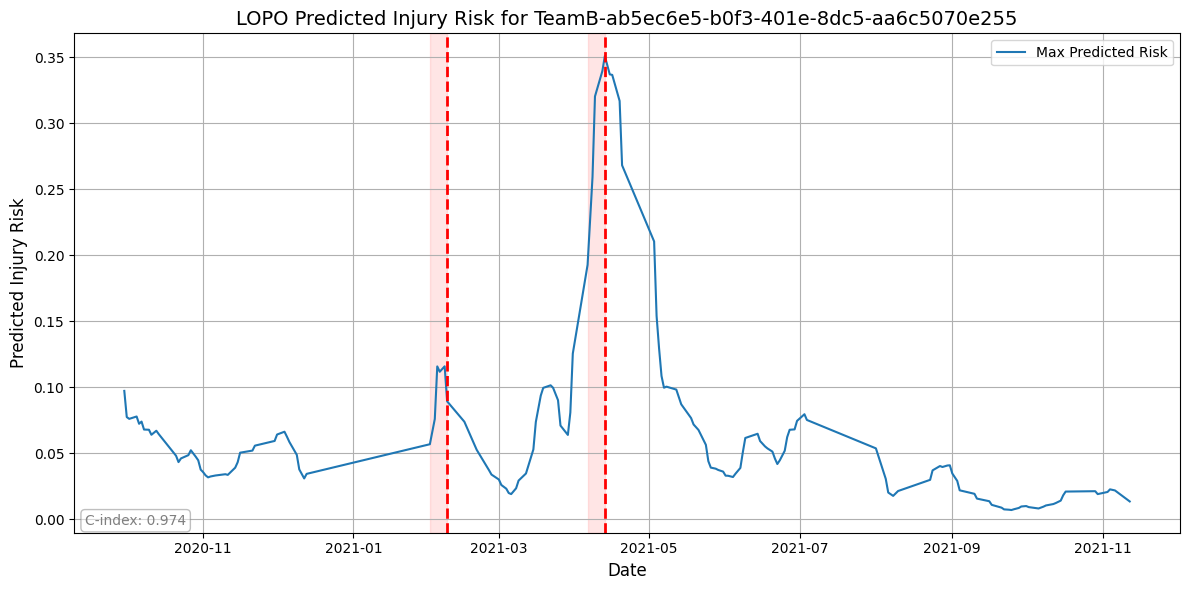
A DeepHit survival model, trained on longitudinal monitoring data, demonstrates strong predictive performance and interpretable risk estimates for injury in women’s soccer.
Predicting athlete injury remains a complex challenge despite growing volumes of monitoring data. This is addressed in ‘Time-to-Injury Forecasting in Elite Female Football: A DeepHit Survival Approach’, which investigates a novel application of deep learning to forecast when injuries may occur in professional soccer players. By leveraging longitudinal data and a DeepHit neural network, the study achieved improved predictive performance and interpretable, individualised risk estimates. Could this approach refine injury prevention strategies and ultimately enhance athlete wellbeing across all competitive levels?
Forecasting the Inevitable: Understanding Athlete Injury as a Systemic Challenge
Athlete injury remains a pervasive and costly challenge within sports science, extending far beyond immediate performance setbacks. The incidence of musculoskeletal injuries not only hinders an athlete’s ability to compete at peak levels, but also frequently precipitates long-term health complications and can dramatically shorten career longevity. Beyond the individual athlete, these injuries create substantial economic burdens for teams and governing bodies, stemming from medical expenses, rehabilitation programs, and the loss of valuable player contributions. Consequently, a dedicated and multifaceted approach to understanding the underlying mechanisms of injury – encompassing biomechanics, physiology, and individual risk factors – is crucial for mitigating these effects and safeguarding the well-being of athletes across all disciplines.
Conventional approaches to forecasting athlete injuries frequently falter when confronted with the dynamic nature of athletic performance and the sheer volume of individual data points. These models often rely on static risk factors – things like past injury history or baseline physical assessments – failing to fully capture the subtle shifts in biomechanics, workload, and physiological stress that accumulate over time. The complexities inherent in longitudinal data – tracking an athlete’s condition through a season, rather than at a single point – present a significant analytical hurdle. Furthermore, treating each athlete as a uniform data point overlooks crucial individual variations in training adaptation, recovery rates, and even psychological factors, leading to generalized predictions with limited real-world accuracy. This inability to account for both the temporal evolution of an athlete’s condition and their unique physiological fingerprint remains a primary limitation in the field of sports injury prevention.
Moving beyond simply identifying athletes at risk of injury, contemporary sports science increasingly focuses on predicting when those injuries are most likely to occur. This shift necessitates a move away from static risk assessments and toward dynamic, longitudinal analyses. Researchers are employing advanced analytical techniques – including machine learning algorithms and time-series modeling – to identify critical moments of vulnerability. These models integrate a multitude of variables, from training load and biomechanical data to sleep patterns and physiological markers, to forecast injury incidence within specific timeframes. The goal isn’t merely to flag potential issues, but to anticipate them, allowing for proactive interventions and optimized training schedules that minimize risk at the precise moments athletes are most susceptible.
Beyond Static Assessment: Introducing the DeepHit Model for Dynamic Injury Prediction
Survival analysis is a branch of statistics focused on analyzing the expected duration of time until an event occurs. Unlike traditional regression models that predict a binary outcome – whether an event has happened – survival analysis models the time until the event. This is particularly relevant in fields like medical research and sports science, where understanding the duration before an event, such as equipment failure or athlete injury, is crucial. Key components of survival analysis include hazard functions, which describe the instantaneous risk of an event, and survival functions, which estimate the probability of surviving beyond a specific time. Data in survival analysis often includes ‘censored’ observations, representing cases where the event of interest hasn’t been observed during the study period; these observations are accounted for in the statistical modeling process to avoid bias.
The DeepHit model represents an advancement over traditional survival analysis techniques, such as the Cox proportional hazards model, by utilizing deep neural networks to model non-linear relationships present in longitudinal patient data. Traditional methods often rely on pre-defined features and assume proportional hazards, limitations that can hinder accurate prediction. DeepHit, however, directly learns complex feature interactions and temporal dependencies from raw data streams – including time-varying covariates – without requiring explicit feature engineering. This is achieved through the integration of a deep neural network with a Cox-like loss function, allowing the model to estimate hazard functions and predict the probability of an event – such as athlete injury – occurring at any given time point, based on individual patient histories.
Traditional injury prediction often yields a binary outcome – injured or not injured – offering limited insight for preventative interventions. The DeepHit model diverges from this approach by directly forecasting the time until an injury event is likely to occur. This temporal prediction allows for a more granular risk assessment; rather than simply identifying at-risk athletes, DeepHit estimates when an injury is probable. Consequently, training and conditioning programs can be proactively adjusted based on individual athlete risk timelines, facilitating targeted interventions designed to mitigate injury risk before the event occurs. This shift from binary classification to time-to-event prediction provides a more actionable and nuanced forecast, enabling preventative strategies grounded in estimated injury timing.
Building a Predictive Framework: Preparing Longitudinal Data for Analysis
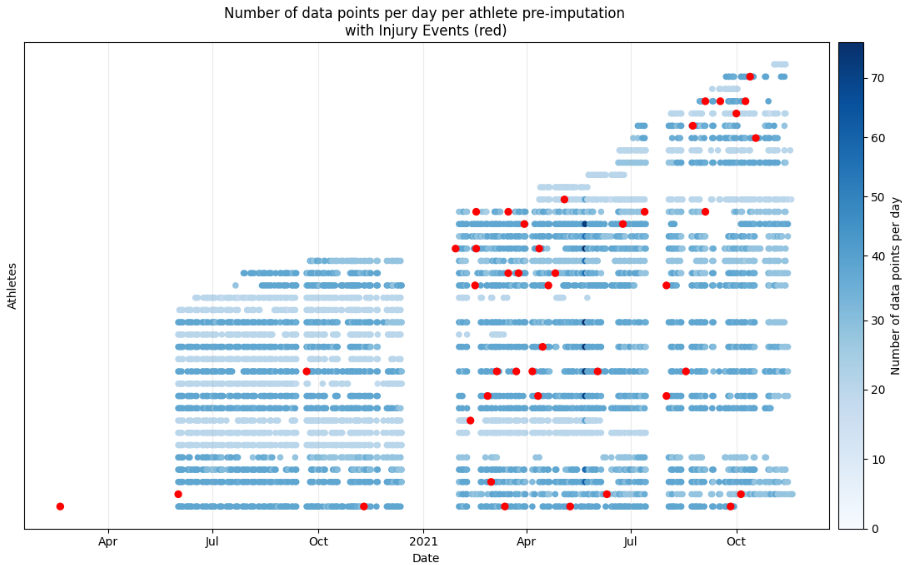
The SoccerMon Dataset comprises detailed performance metrics tracked over multiple seasons for a cohort of professional female footballers. This longitudinal data includes approximately 70 distinct variables capturing player statistics – such as distance covered, sprint speed, passing accuracy, and physiological indicators – recorded during both training sessions and competitive matches. The dataset’s temporal scope allows for the analysis of player development, fatigue patterns, and the impact of training interventions. Data was collected using a combination of GPS tracking devices, heart rate monitors, and subjective wellness questionnaires, providing a multi-faceted view of athlete performance and well-being. The sample size includes data from over 200 players, offering statistical power for robust modeling and generalization.
Missing data within the SoccerMon dataset was addressed using multiple imputation strategies to mitigate potential bias in predictive modeling. A primary method involved median imputation, replacing missing values with the median value of the respective feature. However, recognizing the limitations of a single approach, a bespoke formula was also implemented for specific variables; this formula leveraged available player statistics and match context to estimate missing values based on established relationships within the data. The selection of imputation method was determined by the nature of the missing data and the potential impact on model accuracy, with careful consideration given to minimizing distortion of the underlying data distribution.
Feature engineering within the SoccerMon dataset involved the derivation of new variables from existing raw data to enhance predictive model performance. Specifically, rolling averages of key performance indicators (KPIs) – such as total distance, sprint speed, and acceleration – were calculated over multiple game windows to capture athlete fatigue and form trends. Interaction terms were also created by multiplying KPIs to represent combined effects, for example, combining sprint speed and acceleration to quantify explosive power. Additionally, polynomial features, such as the square of total distance, were generated to model non-linear relationships between variables and potential injury risk. These engineered features provide the models with more nuanced and informative inputs than the raw data alone, ultimately improving prediction accuracy and interpretability.
Validating Predictive Power and Uncovering Actionable Insights
To rigorously assess its performance, the DeepHit model underwent benchmarking against several established machine learning techniques – Random Forest, XGBoost, and Logistic Regression. This comparative analysis wasn’t simply a one-time test; it involved a systematic process called Grid Search. Grid Search meticulously explored a range of hyperparameter combinations for each model, effectively optimizing them to achieve peak performance on the dataset. This ensured a fair comparison, as each algorithm was pushed to its full potential before evaluating DeepHit’s predictive capabilities. The intent was to demonstrate not just that DeepHit could predict injury risk, but that it did so more effectively than commonly used, well-established methods after those methods had been finely tuned for optimal results.
The DeepHit model’s performance was rigorously assessed using the concordance index, or C-index, a metric evaluating the model’s ability to correctly rank players by their risk of injury. Achieving a C-index of 0.762 signifies a substantial capacity to differentiate between players who will and will not sustain injuries, exceeding the discriminatory power of many conventional predictive tools. This score suggests the model doesn’t simply predict who will be injured, but accurately estimates the likelihood of injury across the player cohort, offering a nuanced risk assessment valuable for proactive injury prevention strategies. The result demonstrates the potential of deep learning to move beyond basic prediction and provide a more reliable, data-driven understanding of athletic injury risk.
The DeepHit model demonstrated a marked advancement in predictive capability when contrasted with Random Forest, the leading baseline model in the evaluation. While Random Forest achieved an F1-score of 0.533, indicating moderate performance in identifying at-risk players, DeepHit substantially surpassed this benchmark. This improvement suggests that the DeepHit model’s architecture, capable of capturing complex, non-linear relationships within the data, offers a more nuanced understanding of injury risk factors. The higher F1-score reflects a greater ability to accurately predict both players who would sustain injuries and those who would remain healthy, potentially enabling more targeted preventative interventions and ultimately reducing the incidence of in-game harm.
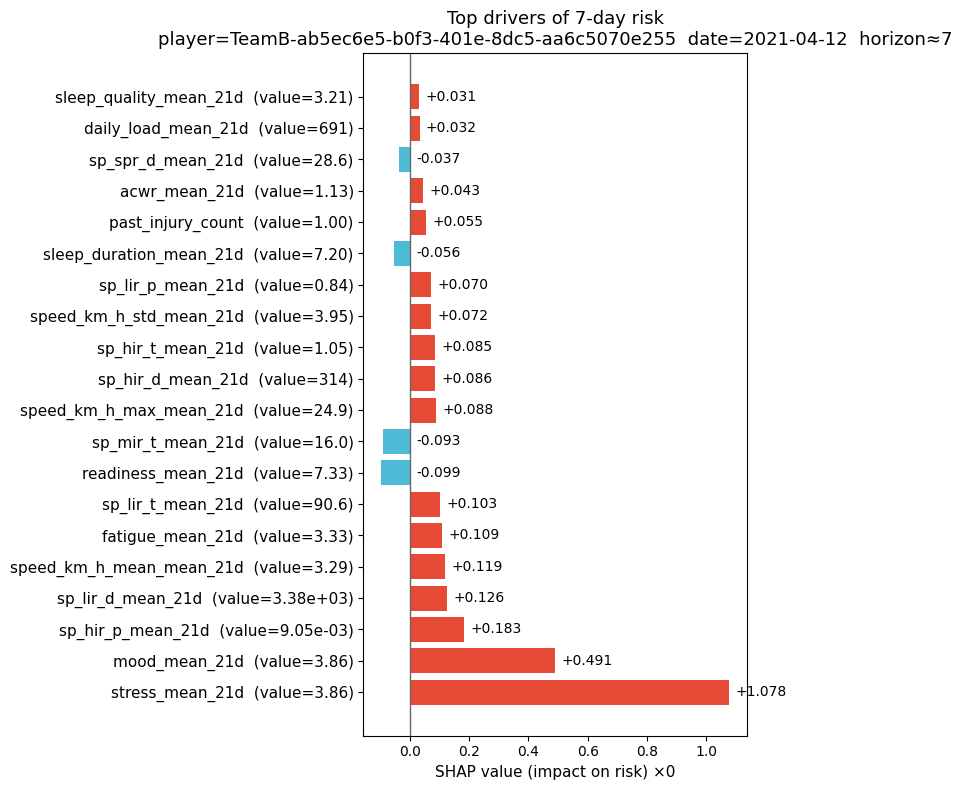
To understand why the DeepHit model predicted certain injury risks, a SHAP (SHapley Additive exPlanations) analysis was performed. This technique dissected the model’s output, revealing the contribution of each input feature – things like player load, speed, and game statistics – to individual predictions. The analysis highlighted specific features as major drivers of injury risk; for example, consistently high-velocity movements coupled with a recent history of moderate impacts were identified as a particularly concerning combination. By quantifying these feature contributions, SHAP analysis not only validated the model’s predictive power, but also provided actionable insights into the biomechanical and situational factors that most strongly influence player vulnerability, offering a path toward more targeted preventative measures.
Rigorous evaluation of the DeepHit model’s generalizability utilized a Leave-One-Player-Out (LOPO) validation technique, which systematically excluded each player’s data during model training and subsequent prediction on that individual. This process revealed a considerable interquartile range of 0.192 for the concordance index (C-index), signifying substantial variability in the model’s predictive performance across different players. This suggests that while the model demonstrates strong overall predictive capability, its accuracy is not uniform; certain players present more challenging prediction scenarios than others, potentially due to unique biomechanical profiles, playing styles, or data characteristics not fully captured by the feature set. Understanding this player-specific variability is crucial for refining the model and tailoring injury prevention strategies for individual athletes.

The study’s success in forecasting time-to-injury through DeepHit modelling underscores a fundamental principle of systemic integrity. Just as a city’s infrastructure must evolve incrementally without wholesale demolition, so too must athlete monitoring systems adapt and refine their predictive capabilities. Barbara Liskov aptly stated, “It’s one of the difficult things about systems programming-the less you know about what you’re doing, the more likely you are to do it wrong.” This research demonstrates that a nuanced understanding of longitudinal data, combined with sophisticated modelling, allows for more accurate risk assessment and proactive intervention, mirroring the elegance of a well-maintained and evolving system.
The Road Ahead
This demonstration of DeepHit modelling within elite female football offers more than just a predictive tool; it’s a glimpse into the inherent complexity of athletic performance. The system, as it stands, functions much like a detailed map of tributaries – it charts the course to injury, but doesn’t fully explain the underlying watershed. Future work must address this; simply knowing when an injury might occur offers limited utility without understanding why. A nuanced integration of biomechanical data, psychological states, and even contextual factors – training load as a function of weather, for instance – will be crucial.
The very strength of the DeepHit model – its ability to provide interpretable risk estimates – also highlights a critical limitation. These estimates, however precise, remain tethered to the data provided. The absence of truly longitudinal datasets, spanning entire careers and accounting for evolving player profiles, represents a fundamental constraint. One cannot repair a fractured tibia without first understanding the complete skeletal structure, and similarly, accurate forecasting demands a holistic, lifetime view of the athlete.
Ultimately, the path forward lies not in refining the predictive algorithms themselves, but in expanding the scope of data collection and fostering a systems-level understanding of athletic injury. The goal should not be to eliminate risk – that is a futile endeavor – but to manage it intelligently, responding to the inevitable disruptions with informed, proactive strategies. The challenge, as always, is to see the forest for the trees, recognizing that the athlete is not merely a collection of data points, but a complex, adaptive organism.
Original article: https://arxiv.org/pdf/2601.19479.pdf
Contact the author: https://www.linkedin.com/in/avetisyan/
See also:
- Netflix’s Little House On The Prairie Reboot: Release Date, Cast & Everything We Know
- Off Campus Season 1 Soundtrack Guide
- YouTuber arrested after viral AI bodycam videos spark real police complaints
- Silver Rate Forecast
- Prime Video’s New R-Rated Spy Thriller Is Officially No.1 On Streaming Despite Poor Reviews
- Brent Oil Forecast
- Peaky Blinders: The Immortal Man’s Tommy Shelby Is a Better Father Than Michael Corleone
- Gold Rate Forecast
- Bulgakov’s Take: Koreans Bet the Farm on Chips, Crypto, and Chaos
- EUR ZAR PREDICTION
2026-01-28 17:29