Author: Denis Avetisyan
New research explores whether tracking macroeconomic indicators can offer valuable early warnings for public health challenges, particularly related to system capacity and workforce strain.
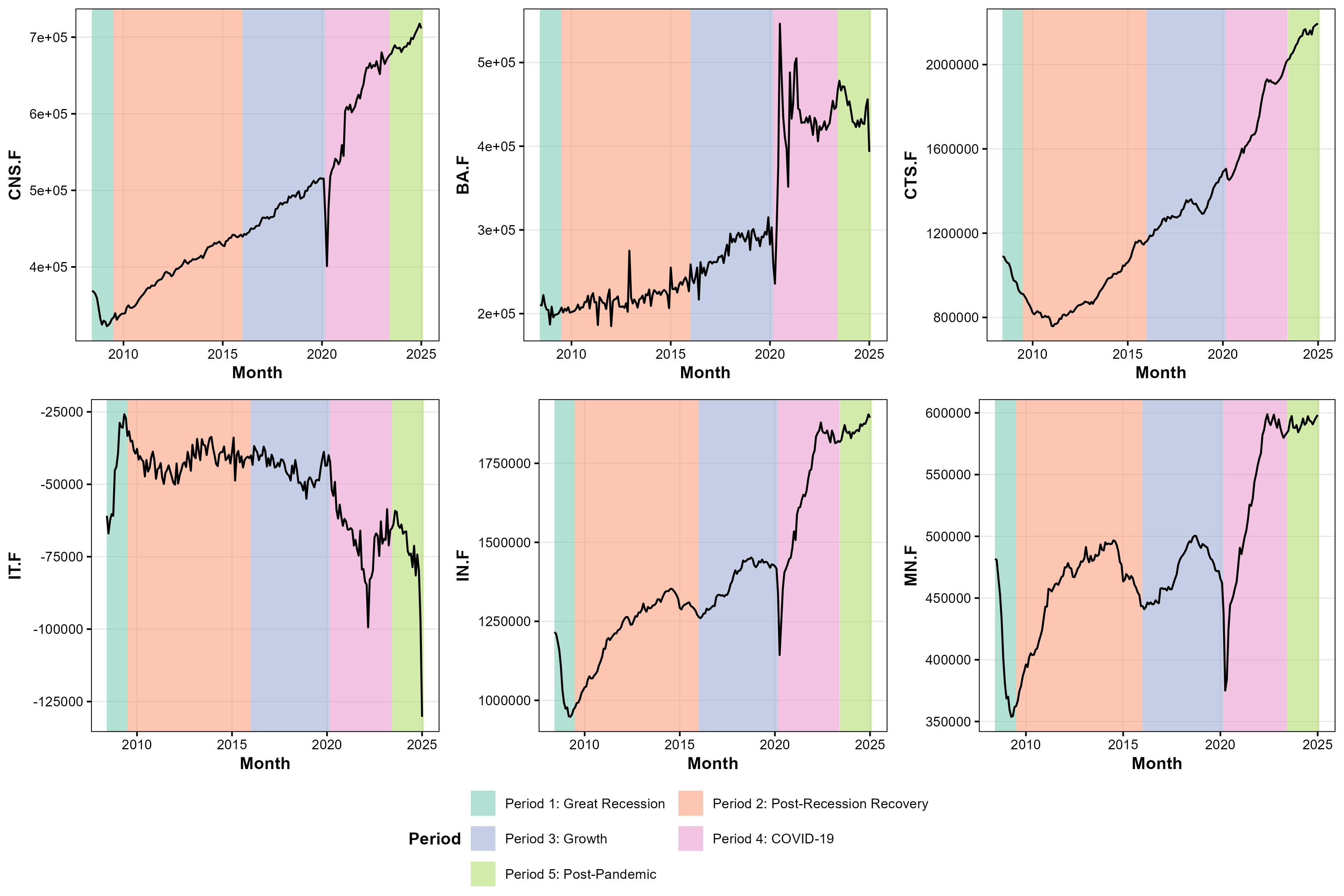
This review assesses the predictive power of macroeconomic indicators for public health forecasting using time-series analysis and machine learning techniques.
Despite increasing recognition of the interplay between economic conditions and public health, systematically evaluating macroeconomic indicators as leading signals of health system capacity remains a challenge. This study, ‘Assessing the informative value of macroeconomic indicators for public health forecasting’, investigates whether selected economic indicators can predict key public health targets-including workforce levels, new business applications, and construction spending-using monthly U.S. time series data and a range of forecasting approaches. Findings demonstrate consistent predictive value for certain capacity measures, particularly those related to workforce and infrastructure, though model stability is crucial during periods of economic volatility. Can incorporating these upstream economic signals into digital public health monitoring systems improve forecasting accuracy and proactive resource allocation?
The Inevitable Forecast: Anticipating Strain in Complex Systems
Effective public health hinges on the ability to anticipate future needs, making accurate forecasting of critical indicators – such as healthcare employment levels and the availability of essential resources like hospital beds and medical supplies – absolutely paramount. Proactive planning, based on these predictions, allows health systems to strategically allocate personnel, optimize supply chains, and ultimately, enhance their capacity to respond effectively to emerging health crises or shifts in population health. Without reliable forecasts, public health organizations risk being caught unprepared, leading to potential shortages, compromised care, and increased morbidity and mortality rates. The capacity to foresee these challenges isn’t simply about preparation; it’s a foundational element of a resilient and responsive public health infrastructure, directly impacting the well-being of entire communities.
Conventional forecasting techniques in public health frequently falter when confronted with the intricate realities of healthcare systems. These methods, often relying on linear projections, struggle to account for the disproportionate impacts of external events – like pandemics, policy shifts, or economic recessions – and the non-linear relationships between various health indicators. A sudden surge in demand, for example, doesn’t necessarily translate to a proportional need for resources; instead, it can trigger cascading effects and bottlenecks that traditional models fail to predict. Consequently, projections of healthcare employment, hospital bed availability, or even disease prevalence can be significantly off-target, hindering effective planning and resource allocation, and ultimately impacting public health outcomes. The inherent dynamism and susceptibility to unforeseen disruptions necessitate more sophisticated approaches capable of capturing these complex interactions.
Healthcare systems are not simple, linear entities; they are intricate networks influenced by a multitude of interconnected factors-demographics, socioeconomic conditions, behavioral changes, and unforeseen events like pandemics. Consequently, effective forecasting requires models that move beyond traditional statistical approaches and embrace the capacity to learn and adapt. These advanced systems must be capable of identifying subtle relationships between variables, acknowledging feedback loops, and incorporating real-time data to recalibrate predictions as conditions evolve. Simply extrapolating from past trends proves insufficient; instead, models should utilize machine learning algorithms and complex simulations to anticipate how shifts in one area of the system will ripple through others, ultimately providing more reliable insights into future healthcare needs and resource allocation.
Modeling the Inevitable: Statistical and Machine Learning Approaches
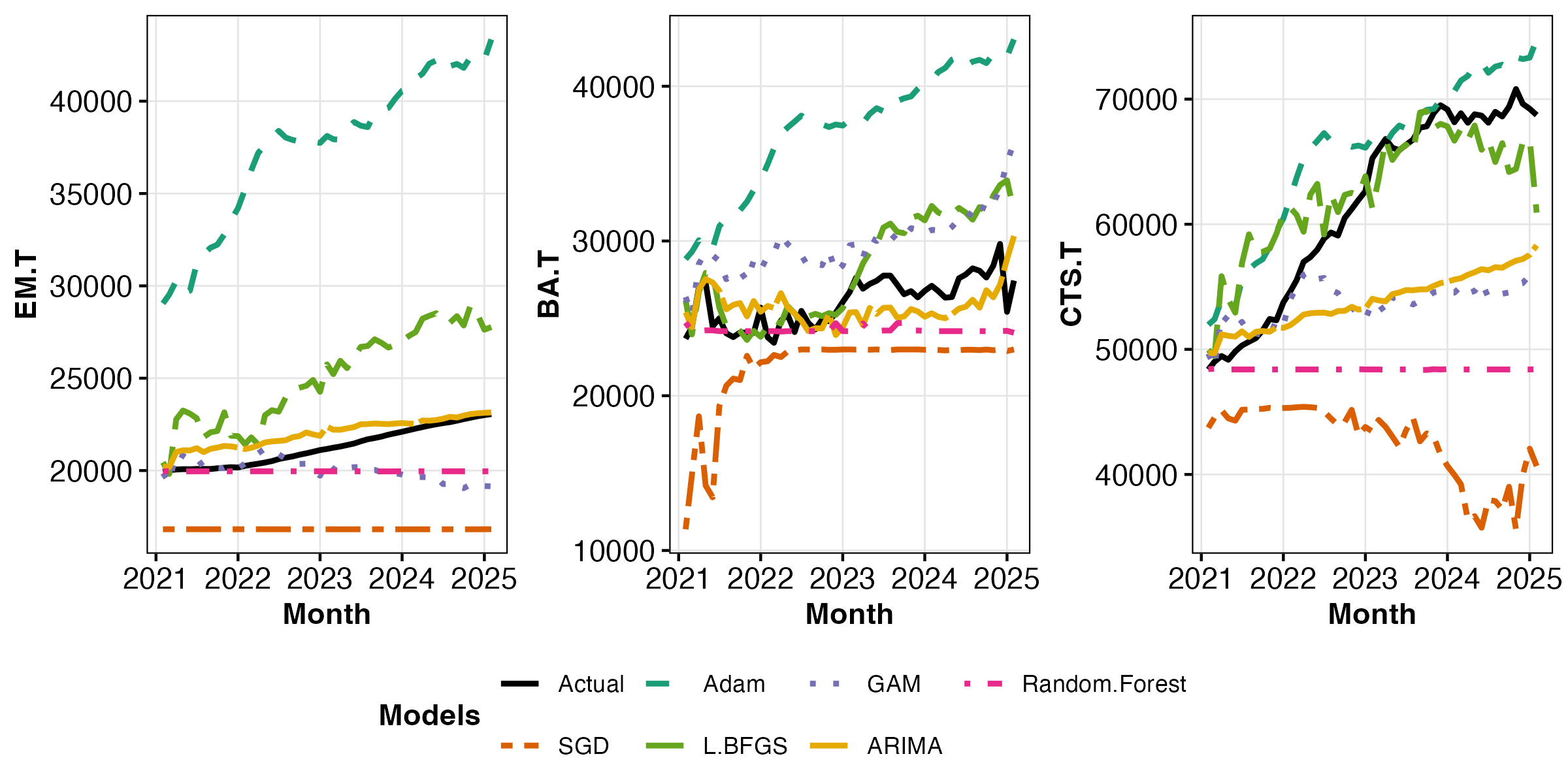
The forecasting model investigation encompassed both time-series and statistical methods to analyze public health data trends. Autoregressive Integrated Moving Average (ARIMA) models were utilized to forecast future values based on past observations, assuming stationarity or transformability to stationarity. Generalized Additive Models (GAMs) provided a flexible framework to model non-linear relationships between predictor variables and the public health targets, allowing for smooth functions to capture complex patterns without strict parametric assumptions. These models served as benchmarks and provided interpretable insights into underlying trends, complementing the more complex machine learning approaches employed in the analysis.
Machine learning models, specifically Random Forest and Neural Networks, were integrated to capture non-linear relationships within the public health data that traditional statistical methods may not effectively represent. Neural Networks were trained using three distinct optimization algorithms: Adam, L-BFGS, and Stochastic Gradient Descent (SGD). Adam utilizes adaptive moment estimation, L-BFGS is a quasi-Newton method employing a limited-memory approximation of the Hessian matrix, and SGD iteratively adjusts model weights based on the gradient of the loss function. The implementation of these diverse training methods aimed to optimize model performance and generalization capability across the dataset, enabling the capture of complex interactions and patterns indicative of public health trends.
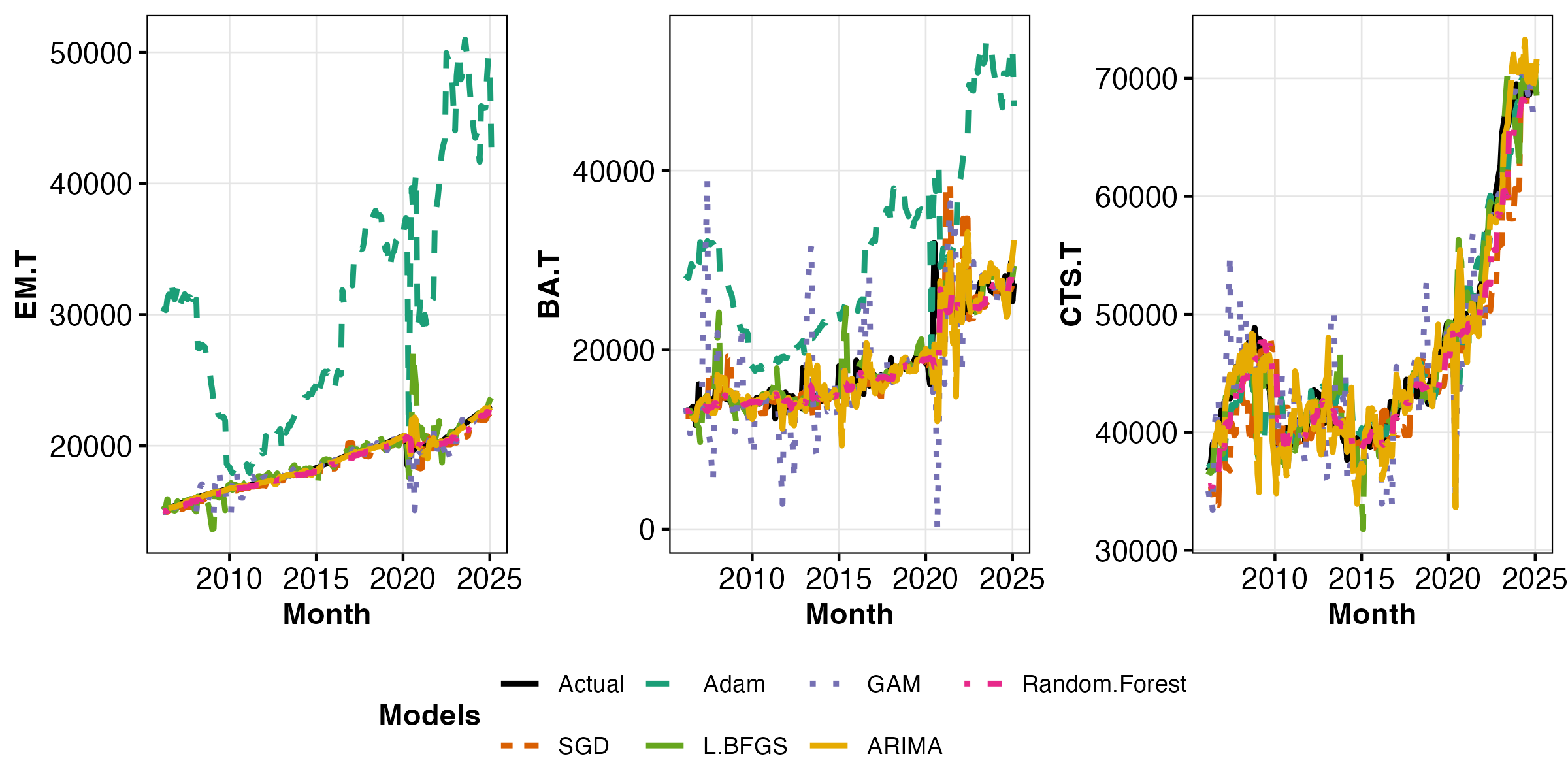
Analysis indicates macroeconomic indicators are predictive of specific public health targets, notably those concerning workforce availability and infrastructure stability. Across multiple evaluation designs, both Random Forest and ARIMA models demonstrated consistent performance in forecasting these targets. The predictive power observed suggests a correlation between economic conditions and public health outcomes related to these areas, allowing for potential early warning signals and resource allocation adjustments. While other models were investigated, these two consistently yielded reliable results when incorporating macroeconomic data as input features.
Evaluating the Inevitable: Quantifying Model Performance
Model performance was quantitatively assessed using three common forecasting error metrics: Mean Absolute Error (MAE), Root Mean Squared Error (RMSE), and Normalized RMSE (N-RMSE). MAE calculates the average magnitude of the errors, providing a linear score. RMSE, expressed in the same units as the forecasted variable, penalizes larger errors more heavily due to the squaring operation. RMSE = \sqrt{\frac{1}{n}\sum_{i=1}^{n}(y_i - \hat{y}_i)^2}. N-RMSE normalizes RMSE by dividing it by the mean of the actual values, allowing for performance comparison across datasets with different scales. N-RMSE = \frac{RMSE}{\text{mean}(y)}. These metrics provide a standardized and objective evaluation of the model’s predictive accuracy.
To validate model performance and assess generalization capability, two evaluation methodologies were implemented. A fixed training-testing split provided a baseline assessment using a single, static division of the dataset; the model was trained on a designated subset and evaluated on the remaining, unseen data. Complementing this, a rolling window evaluation technique was employed. This involved iteratively training and testing the model on sequentially shifted subsets of the data, simulating a real-world forecasting scenario and providing a more robust estimate of performance across different time horizons. This dual approach helped to mitigate potential overfitting to the specific training data and ensured the reliability of the reported results.
The Random Forest model demonstrated specific performance levels when evaluated using an 80-20 training-testing split. For forecasting Health Care and Social Assistance Employees (EM.T), the model achieved a Root Mean Squared Error (RMSE) of 809.41 and a Normalized RMSE (N-RMSE) of 0.038. Performance on forecasting Health Care and Social Assistance Business Applications (BA.T) resulted in an RMSE of 1736.88 and a corresponding N-RMSE of 0.067. These metrics quantify the model’s error in predicting these specific employment and business application variables within the health care and social assistance sector.
The Inevitable Outcome: Implications for Public Health and Future Systems
Public health agencies stand to benefit significantly from the incorporation of these newly identified forecasting models directly into existing surveillance systems. These models aren’t merely predictive tools; they function as an early warning system, capable of signaling potential strains on critical resources – from hospital beds and ventilators to essential medications and trained personnel. By continuously analyzing real-time data, these integrated systems can move beyond reactive crisis management toward proactive resource allocation, allowing for the pre-emptive bolstering of supplies and staffing in anticipation of emerging health threats or localized outbreaks. This shift enables a more efficient and effective response, minimizing the impact on both the healthcare system and the public it serves, and ultimately improving overall public health outcomes through preparedness and timely intervention.
Enhanced forecasting accuracy in public health translates directly into the capacity for proactive resource allocation, fundamentally shifting responses from reactive crisis management to preventative preparedness. By anticipating surges in demand for hospital beds, ventilators, or specialized personnel, health systems can strategically position these critical resources before they are overwhelmed. This foresight extends beyond immediate needs, enabling pre-emptive stockpiling of essential medications and personal protective equipment, and facilitating the timely training of additional healthcare staff. Consequently, improved forecasting not only minimizes the strain on existing resources during public health challenges, but also enhances the overall effectiveness of interventions, ultimately leading to reduced morbidity and mortality rates, and a more resilient healthcare infrastructure.
Continued advancements in public health forecasting necessitate a multi-pronged research approach. Investigations should prioritize the integration of diverse data streams – encompassing not only traditional epidemiological surveillance but also real-time information from sources like social media, internet search queries, and environmental sensors – to create more holistic and responsive models. Simultaneously, exploration of advanced modeling techniques, including machine learning algorithms and agent-based simulations, promises to capture the complex interplay of factors influencing health system dynamics. These efforts are crucial for moving beyond simplistic predictive models and developing systems capable of anticipating and mitigating the impact of emerging health threats within increasingly interconnected and complex health systems, ultimately bolstering preparedness and response capabilities.
The pursuit of predictive modeling, as demonstrated in this study, often resembles tending a complex garden rather than assembling a machine. While researchers seek stable indicators to forecast public health targets, the inherent dynamism of systems suggests that absolute predictability remains elusive. As Paul Feyerabend observed, “Anything goes.” This isn’t a dismissal of rigorous analysis, but an acknowledgement that unforeseen factors-shifts in economic conditions, behavioral changes-will inevitably influence outcomes. The study’s emphasis on model stability underscores a vital point: resilience isn’t achieved through rigid control, but through a system’s capacity to absorb and adapt to inevitable perturbations. A system isn’t built, it evolves, and forecasting, therefore, becomes an ongoing process of observation and adjustment.
The Currents Shift
The pursuit of predictive accuracy in public health, tethered to the fluctuating signals of macroeconomic indicators, reveals less a path to mastery and more an acceptance of inherent instability. This work rightly emphasizes model stability-a fleeting grace, at best. Each refinement of a forecasting model is, inevitably, a carefully constructed invitation for unforeseen failure. The system does not respond to intervention; it becomes the intervention, warping around each attempt to control it.
The focus on workforce and infrastructure capacity is prescient. These are not merely targets of prediction, but the very bones upon which any predictive framework rests. To believe one can foresee demand without acknowledging the brittle nature of supply is a category error. The true challenge lies not in identifying leading indicators, but in cultivating resilience – in building systems that can absorb shock, rather than collapse under pressure.
Future efforts will, no doubt, explore more granular data and complex algorithms. Yet, the underlying paradox remains: the more precisely one attempts to map the future, the more one ensures its divergence. The system grows, and with each iteration, the prophecy of its eventual reshaping is self-fulfilled. It is not a question of if the model will break, but how beautifully, and what unexpected forms will emerge from the wreckage.
Original article: https://arxiv.org/pdf/2601.15514.pdf
Contact the author: https://www.linkedin.com/in/avetisyan/
See also:
- Off Campus Season 1 Soundtrack Guide
- Chainsaw Man Volume 24’s Cover Art Reveals a Brand-New Denji
- X-Men ’97 Finally Gave Gambit the Hero Moment He Deserved
- 46 Years Later, The Mandalorian & Grogu Answers A Major Empire Strikes Back Question
- 10 Worst End-Game Couples In Sitcom History
- HoI4 fans harsh reactions to the announcement of another DLC pack
- DoorDash responds after customer uses AI to make food look bad and get a refund
- Gold Rate Forecast
- Emily Henry Says to ‘Trust the Vision’ For Beach Read Adaptation
- Katanire’s Yae Miko Cosplay: Genshin Impact Masterpiece
2026-01-23 16:08