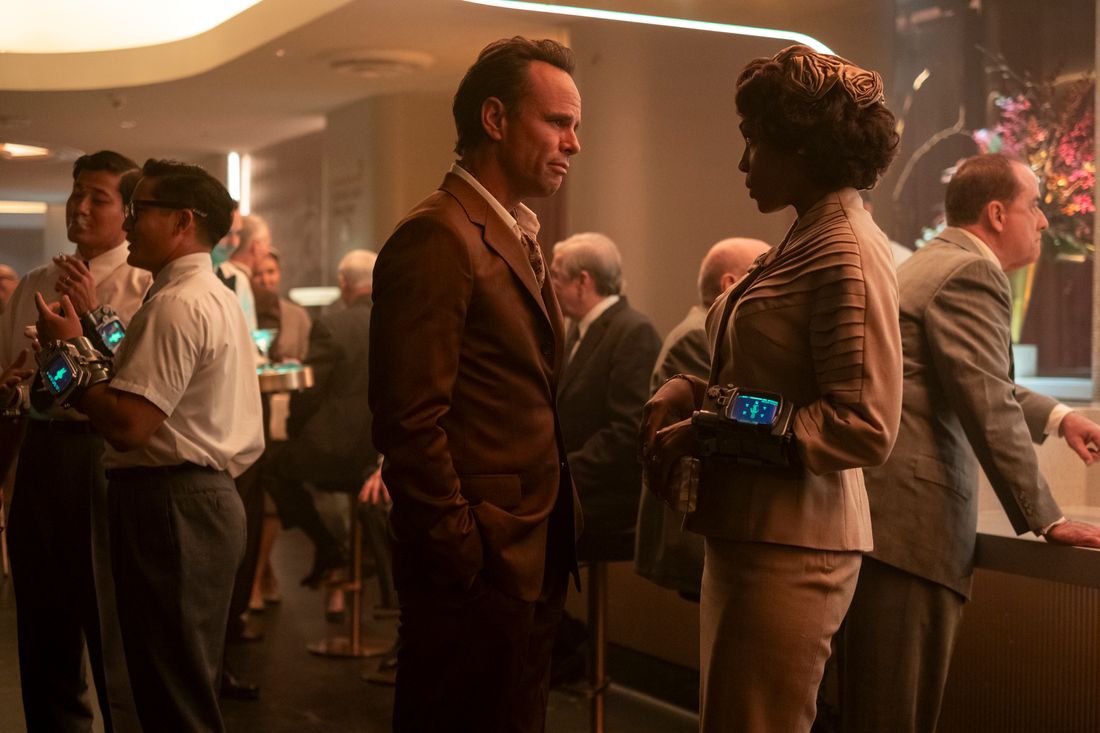
Did anyone else think of the book Pluribus while watching this week’s episode? “The Other Player” was another great 50 minutes of Fallout – I consistently rate it four stars because it’s a solid show without major highs or lows – and it explored familiar moral questions. The episode asks if the wasteland is even worth saving, given all the violence and cruelty. It also touches on why humans are so prone to war and why conflict never seems to change. At one point, the episode even questions whether humanity deserves to survive. Hank’s speech about All Quiet on the Western Front is a clear, if a bit dramatic, example of the show’s writers using a metaphor to illustrate our endless cycle of conflict. The episode was written by Dave Hill, who has also worked on Game of Thrones and The Wheel of Time.
Hank, facing Lucy in the vault, remarked that he’d seen the same thing: people squabbling over trivial items, like bottlecaps. While he’s likely used to the world of Fallout by now, it’s funny to picture actor Kyle MacLachlan reading that line and wondering why anyone would fight over… bottlecaps. Of course, bottlecaps are the main form of money used throughout the wasteland, and surprisingly, they’re consistently used everywhere.
Let’s get back to the story. Hank has created a large workforce – people controlled by his new mind-control chip. It seems he’s fixed the exploding heads, though there might still be some off-screen violence – after all, progress requires sacrifice! These people, including former cannibals and others who survived the apocalypse, have had their individuality removed. They aren’t a hive mind, but they act as one peaceful, constantly smiling group. Lucy is disturbed by what her father has done – he’s stolen their lives, memories, and personalities. However, many of them may have wanted to give those things up to escape their past trauma, much like someone willingly accepting a fresh start. As Max and Thaddeus point out, Lucy’s strong beliefs are likely due to her sheltered upbringing in a vault. Life underground isn’t perfect, but it’s safer than facing constant danger above ground, like attacks from mutants. Even brainwashed, these people seem content to stay when Lucy offers them a chance to leave. Ultimately, the story asks a big question: is peace worth losing what makes us human?
When you really look at the devastated world of Fallout, the question of whether Hank’s actions were justified isn’t so simple, and his solutions don’t seem that crazy. In fact, that internal struggle – holding onto your humanity – is at the heart of the entire Fallout series. It’s easy to get caught up in the game’s over-the-top style and humor, but the world is filled with real tragedy, like the acceptance of child slavery and even cannibalism. This conflict is perfectly embodied by The Ghoul and Cooper Howard, two distinct personalities trapped inside one man who have been battling each other for centuries. It’s powerful that even while impaled and facing a gruesome death, The Ghoul clings to his past, reminding himself, “My name is Cooper. I have a daughter. Her name is Janey. She’s alive.” It feels like this is the first time he’s truly acknowledged the man he once was.
It was heartbreaking watching The Ghoul almost free himself, driven by the thought of seeing his family again, only to slip and fall back onto that awful pole. Then, just when things looked truly hopeless, this massive figure – a real behemoth – shows up and snaps the pole in half like it’s nothing! He carries The Ghoul back to his…well, let’s just say a very messy home. Now, as a longtime Fallout fan, I instantly recognized this guy as a Super Mutant. You can tell by the size and that deep, gravelly voice. But if you’re new to the series, Super Mutants are usually created when someone is exposed to the Forced Evolutionary Virus – FEV, which Norm was researching last episode. We’ve seen different kinds throughout the games. In Fallout 3 and 4, they’re mostly just enemies, though you can even team up with a smart one named Fawkes in Fallout 3. New Vegas gets more interesting, with a whole town of friendly mutants in Jacobstown. And if you go way back to the original Fallout, they’re the big bad guys, led by a seriously twisted character called The Master. They’re a fascinating part of the Fallout universe, and seeing one rescue The Ghoul was a wild moment!
There’s a fantastic cameo to point out: Ron Perlman plays a mutant! Fans of the Fallout games will recognize his voice – he’s the narrator and has delivered the iconic line, “War never changes,” in every major game since the late 90s. It’s perfect casting, really – his deep, powerful voice and imposing physique make him ideal as a super mutant. In a particularly memorable scene, he even shoves a piece of uranium into The Ghoul’s wound, saying he needs to be healthy for the coming war. He then reveals some important backstory, identifying their enemy as the group responsible for the nuclear apocalypse – The Enclave.
I won’t say I predicted it, but it was pretty clear last week how things were going to unfold. I am a little pleased I guessed the Enclave would be the main villains this season, though Fallout reminds us to avoid overconfidence. While it feels a bit predictable to use the bad guys from the original games, it would have been stranger if they hadn’t shown up at all. A flashback confirms the Enclave’s involvement: Barb meets Wilzig (Michael Emerson) at Vault-Tec headquarters before the war. He was frozen like the other characters who survived to the present day. We also learn he’s the one who convinced Barb to profit from the idea of nuclear war, as seen in the season one finale.
After Cooper finally corners Barb at the Lucky 38, she reveals everything. He’s shocked that she’d so casually accept the coming apocalypse, but she insists she’d do anything to save their daughter, Janey – even if it meant the end of most life on Earth and a permanently ruined world. She argues that there are even more dangerous people out there, and then tells Cooper about her meeting with Wilzig. This suggests the Enclave is secretly in control, and it seems The Ghoul knows much more about them than he’s revealed, considering he’s lived for over two centuries and witnessed all the terrible things the Enclave has done.
Shortly after, Cooper finds Hank, who is heavily intoxicated, and takes him back to his room at the Lucky 38. While Hank is passed out, Cooper unlocks the case handcuffed to his wrist, revealing a device used for extraction. Barb then uses the device on Hank’s neck to remove the fusion chip. Back in the present, Max and Thaddeus are brought to The Ghoul, who is injured from his experience in Freeside, but thankfully still alive. He doesn’t seem happy to see them, though he hasn’t lost his personality.
Bottle Caps
I haven’t talked much about what’s happening in Vault 33 because, frankly, it’s the least compelling part of the show right now. While the “Uranium Fever” musical number was a well-directed bit of entertainment, it’s setting up a predictable conflict: a struggle between practical, sensible leaders like Betty (who focuses on things like water rationing) and the exciting, but ultimately reckless, populism of characters like Reg and his followers. The show also throws in some obvious parallels to current issues, specifically xenophobia, with lines like, “You’re from Vault 31. We know things are different there,” and the response, “It’s good to finally hear someone say that out loud!”
Thaddeus revealed he was born in a place called The Boneyard, which was the original name for Los Angeles in the first Fallout game – it got that name because the ruined skyscrapers looked like bones. Fans have been curious about how The Boneyard might fit into the show’s current story. He only says he grew up in the rough part of town, but it’s likely somewhere within the ruins of Los Angeles. Interestingly, the show also moved the location of Shady Sands from the original Fallout games, so there might be some minor changes to the established backstory.
Hopefully, we’ll see more conflict between the NCR and the Legion later in the season, but even if not, the scene in the executive vault was a great nod to fans.
I definitely remember the beginning of the episode, where House—or someone pretending to be him—and Barb talked about trading cold fusion for the mind-control device. I’m eager to see how that storyline develops in the remaining episodes.
Finally, let’s talk about chips. We haven’t mentioned the Platinum Chip from Fallout: New Vegas yet. This device held the data needed to improve Mr. House’s defenses in Vegas, and it was scheduled to arrive just after the bombs started falling. If it had arrived on time, not a single nuclear weapon would have hit Vegas. Although, even as it was, only a few nukes actually struck the city itself.
Read More
- Gold Rate Forecast
- What is Omoggle? The AI face-rating platform taking over Twitch
- Elden Ring Is Back With A New Free Game, Thanks To The Fans
- Audible opens first ‘bookless bookstore’ in New York
- Wartales Curse of Rigel DLC Guide – Best Tips, POIs & More
- 10 Adorable Quotes from Diana in Pragmata
- Netflix’s Remake Of R-Rated Denzel Washington Classic Carries On A Rotten Tomatoes Trend
- Below Deck Down Under Recap: Battle of the Egos
- The Devil Wears Prada 2 Cameos You May Have Blinked and Missed (Plus Lady Gaga)
- Bitcoin May: The Grim Parade of Institutions and a New Era
2026-01-21 17:56