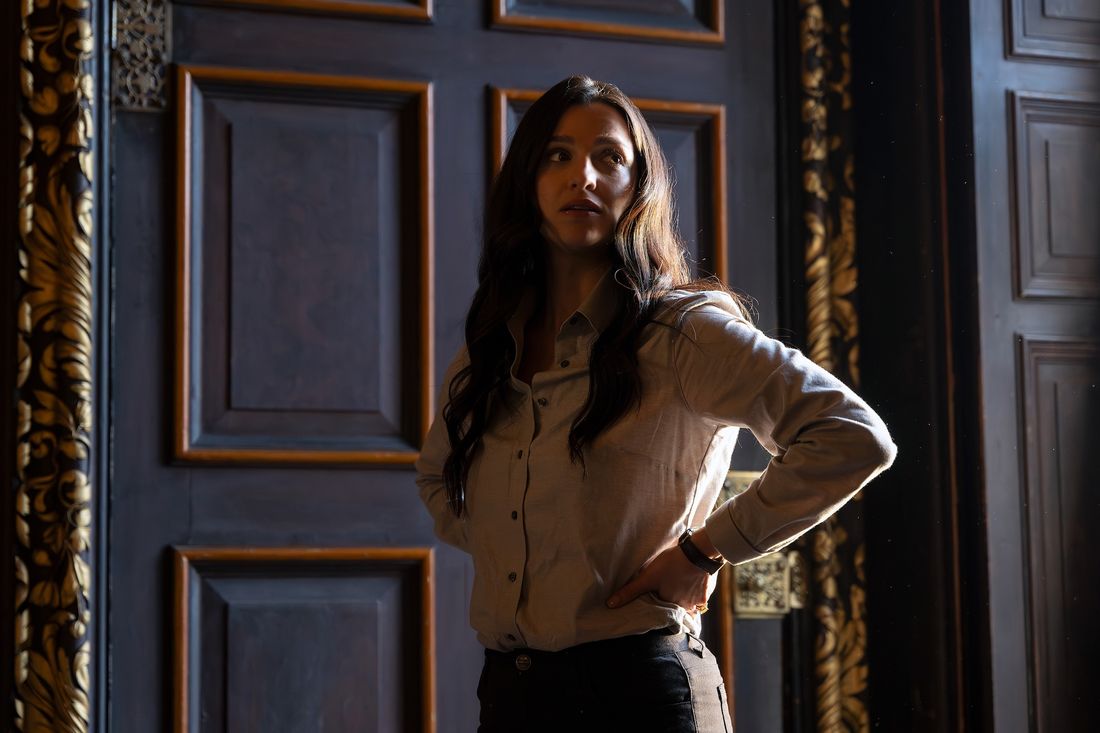
Yasmin wished Molly, the housemaid, would stop drawing the curtains so she and Henry could have some privacy on the morning of Sir Muck’s birthday. She asked Molly to stop, but Molly continued, feeling she had to. She worried about what would happen if she didn’t fulfill her duties – was drawing curtains even necessary, or were housemaids themselves becoming obsolete? Henry defended Molly, insisting she needed to be allowed to do her job, as if it were a basic necessity. Yasmin saw a house as a place to live, but Henry’s estate felt like a living entity, and she began to question the role of everyone within it – the maid, the wife, even the master – as simply essential parts of a working home.
Kit Harington delivers a genuinely funny line with believable frustration. Viewers used to seeing him as the serious, heavily-clad Jon Snow in Game of Thrones will be surprised by his comedic talent, particularly when the scene requires physical comedy. He’s both vulnerable and engaging in “The Commander and the Grey Lady,” an episode similar in style to season three’s “White Mischief” and season two’s “Kitchen Season.” This episode focuses on a pivotal day in Henry Muck’s life: the day he surpasses his father’s age, knowing his father tragically died by suicide at 40.
The episode begins as the results of the general election are being announced. Forget celebratory balloons and loud music – this is England. The scene is more like a school PTA meeting, except even stranger, with a man wearing a trash can as a mask sharing the stage. He’s running for office with the Count Binface Party – a fitting sight in a country that once tried to name a ship “Boaty McBoatface.” Henry tries to remain calm when he learns he’s lost his seat as MP for Wakefield, a city in Yorkshire he’s barely visited. Later, he’ll break down and cry to Yasmin, but they also find a moment to share a laugh, promising to support each other: We’ll get through this together.
By December, Henry is oversleeping, being disrespectful to his uncle (who also financially supports him, Lord Norton), and even showing up to photoshoots with a hangover, wearing wrinkled pants! He’s drinking a lot of expensive champagne and using drugs, which has left him completely ineffective. Yasmin married Henry to escape the problems surrounding her father – his suspicious death, financial crimes, and accusations of abuse – but she did genuinely love him. Now, she’s struggling to find anything to love in the man he’s become, but Henry doesn’t seem to care. He casually asks Lord Norton, “What’s she going to do, really?”
This episode, beautifully directed by the creators themselves, is just… a lot. It’s tragic, funny, and so carefully made. The way they cut between scenes feels as important as the scenes themselves – it’s like poetry in motion. Early on, there’s a moment with Yasmin surprising Henry with his dad’s old car – a really evocative touch. It instantly brought to mind classic story beats – Cinderella running down the stairs, Captain Hook and the crocodile, even Scrooge’s crazy clock. It made me realize how a simple object, like a timepiece, can feel genuinely unsettling. Henry quickly excuses himself, but the camera stays with Yasmin and Norton. Norton reassures her they’ll get through to him. Then, we cut to Henry surrounded by guns, and it’s clear something’s brewing. He comes up with a ridiculous excuse to have the gun room lock changed, and the gamekeeper – who’s known him forever – sees right through it. It’s heartbreaking, really – everyone is constantly walking on eggshells around this guy, perpetually worried about him.
Henry’s birthday plans include a morning hunting trip, followed by a 2 p.m. meeting with Whitney Halberstram to talk about his job at Tender. The day will end with a lavish, alcohol-fueled dinner party inspired by Versailles, with a guest list of some of Britain’s most unpleasant characters. The hunting trip will give Henry a chance to confront his uncle, who admits Henry struggles with depression—he’s taken lithium in the past—but disapproves of his lifestyle. Henry, however, feels he’s reached a point where medication, therapy, and exercise aren’t enough. His friend Norton offers empty encouragement, telling him to simply ‘integrate it into your life.’ In response, Henry points a rifle at the one person who cares about him.
“The Commander and the Grey Lady” avoids portraying Henry’s depression as simple. He’s clinically depressed, but also prone to spoiled and childish behavior. Crucially, he’s caught up in a self-created narrative about his destiny. He frames his depression as a “genetic inheritance,” using this as justification for his harmful actions and even romanticizing his situation. He believes his depression is passed down from his father, leading him to view suicide as inevitable – if not now, then sometime in the future.
Henry surprisingly manages to impress Whitney in their meeting, exceeding Yasmin’s expectations. The meeting also explains why Max Minghella uses an American accent in the show Industry: Tender needs a co-founder who isn’t part of the established British elite, allowing Sir Henry to be the insider the company relies on. Later, Whitney suggests Henry take over Jonah’s former CEO position. She wants a partner with a recognizable name, someone who understands the unique language and customs of the upper class educated at Oxford and Cambridge, and who embodies that world. Henry briefly pushes back against Whitney’s insincere praise, quoting Fitzgerald’s line about there being “no second acts.” Whitney completes the quote – “In American lives” – implying that in this world, anything is possible, even failure, as seen with the collapse of Bulb.
Okay, so finally dinner rolls around, and honestly, the costumes were a high point. Yas absolutely nailed Marie Antoinette, Norton was convincingly regal as a cardinal, and Otto… well, he went full pirate-meets-colonial with an eye patch and wig – a really odd, anachronistic take on Admiral Nelson, maybe? Even Yasmin’s aunt, Claire Forlani (who, according to IMDb, is 54 – wow!), showed up in full 18th-century glory despite saying she might be late. I appreciate a commitment to a theme, but even these fantastic outfits couldn’t save this disastrous party. It was just… a mess.
Where do we even start? Aunt Cornelia is sharing way too much about her affair – she calls her lover “Babygirl” – and is telling Yasmin not to be overly devoted to Henry. She bluntly warns that men sometimes harm women who give them complete and unquestioning love, telling Yasmin to “get off your knees.” It’s a strangely empowering message, though it’s hard to take advice from Cornelia when she’s about to have an affair with the sleazy Otto. Speaking of Otto, he’ll probably just compliment Cornelia on being a better kisser than her brother, and leave it at that. Like a secret society, whatever happens with them stays private, more or less.
Yasmin, wanting to impress her in-laws, brought together Cardinal Norton, who was offended by the new Labour government, and Jenni Bevan, who thankfully didn’t try to match a silly dress code. Despite their enormous house, they met in the kitchen because Norton wanted to demonstrate his power – he could clear the room simply by clearing his throat! Jenni remained respectful, pointing out that the gap between rich and poor in London was even wider than in Korea, but that Norton’s influence in the newspapers was all that was preventing a financial downturn. Even after the election, the power of the press hadn’t diminished.
On his birthday, Yas discovers Louis indulging in drugs alone in their bedroom, and a fight erupts – he seems just as unmotivated as he was while recovering from a hangover the day before. She harshly calls him helpless and gives Henry an ultimatum: accept Whitney’s deal, or she’ll leave. When Henry mentions their unfavorable prenuptial agreement, Yasmin doesn’t even pretend to be upset. She’s determined to get everything she’s entitled to. Instead of arguing about the prenup itself, she points out the track marks on Henry’s arms, implying that like any contract of employment, the agreement includes clauses about his behavior.
Right now, Yas just wanted Henry to blow out the candles on his birthday cake. But Henry was in a dark mood, wishing he could just disappear. He came downstairs and immediately started a fight with Jenni, making a shocking accusation about her and his uncle, then kissed her forcefully. He even announced to everyone that he was having trouble with erectile dysfunction. Just as he was about to stumble into a Christmas tree, an old friend – known as the “Commander” – showed up and quickly took him away from the chaotic party.
I initially thought Henry had just taken a stimulant to perk himself up before returning to dinner, but it’s possible he’d taken a very small dose of LSD. Or maybe everything that followed was inevitable, regardless of any drugs he might have used. A man about Henry’s age arrived after the appetizers, but no one except Henry seemed to notice him. Looking back, it should have been obvious what was happening, but it took me far too long to understand. The Commander had been dead all along. Then, Henry’s father – a playful ghost from the past – appeared to guide his son through the night.
The Commander proposes a unique way for the two men to celebrate their fortieth birthdays – a party mirroring the one he always wanted but never got to experience. The new plan involves going to a pub for drinks, a potential fight, and a fleeting, impersonal encounter. It quickly becomes clear that the Commander is a deeply unpleasant character, even when seen through the distorted lens of his son’s mind. His speech is reminiscent of scandalous gossip, filled with shocking pronouncements. He tells his son that having sex with a model is the ultimate way to avoid thinking about death, but admits that sometimes, a simple, ordinary woman can be strangely appealing, even if it’s a disturbing attraction.
At the pub, Henry unexpectedly encounters Molly, her overly affectionate companion George, and, surprisingly, the priest who has been a constant figure throughout his life – baptizing him, marrying his parents, and officiating his father’s funeral. The situation quickly escalates. George starts sharing some relatively harmless gossip about Yasmin feeling unhappy and out of place with her privileged lifestyle, but then descends into vulgar and offensive rumors about Lady Muck, including an antisemitic remark. Henry’s father, the Commander, leans in and whispers a threatening instruction to his son – as if any encouragement were needed – to violently attack George.
Once the initial shock wore off, Henry asked the pub owner if he would be calling the police. The owner reassured him, saying they knew it was self-defense. Everyone in the pub was connected to the estate – either working there, having family who did, or being a tenant – and therefore felt obligated to protect the lord of the manor. The novel brilliantly captures the subtle complexities of money and class in Britain. For example, Molly’s judgment of Yasmin reveals a lot. Henry needed a wife who fit the traditional role of a lady of the house, but he ended up marrying a wealthy woman from London. Yasmin, though rich, wasn’t from the upper class, and Molly, because of her own class biases, is far more critical of Yasmin than she is of Henry, despite his own flaws – like being unable to even open his curtains.
Knowing Henry’s father died by suicide on his 40th birthday, I initially found his Rolex watch to be a strange gift. Now I understand it was meant for me, the viewer, as a subtle clue. I didn’t realize the Commander was Henry’s father until he showed off his watch at the bar. Just as father and son are about to leave, a priest approaches Henry, offering the support he wishes he’d given him when he was a young, heartbroken child.
Even before dawn, I realized the truth I was searching for was something I’d always subconsciously known,” the unsettling priest murmured. It hit me I’d been tricked again when I wrote in my notes, “Is that what you wish you’d told a child?” I wondered if Molly or George had ever noticed the priest, and what were the odds that a man so central to Henry’s life would be at the local pub on this particular night? It was strange, too, that if the priest was there, he’d speak in fragments – lines pieced together from authors like Cormac McCarthy and W.H. Auden, and probably others I didn’t catch. He felt like a warning from the future, a ghostly messenger of things to come.
We’re still missing one visitor. Henry had the gamekeeper change the lock on the gun room, but he didn’t bother securing the garage by asking the chauffeur to block it. Instead of going to bed, Henry…
Henry sits in the driver’s seat of his father’s Jaguar, the same car his father drove before taking his own life, and starts the engine. We’ve already learned Henry witnessed his father’s suicide by hanging himself from the old oak tree in the garden. However, the shocking final reveal is that the Commander saw his son watching through the window and proceeded with the act anyway. The last words he ever spoke to Henry were a request for him to polish his shoes.
Okay, so things get really weird. Just as Henry’s about to black out, he hears Yasmin calling his name, pulling him back to the present. He bursts out of the garage, and suddenly it’s a brand new day – he’s forty years old, even older than the Commander ever lived to be! He races home in the Jag, frantically searching for his wife, and… well, let’s just say they have a very public reunion on the hood of the car. It’s a cold, bright morning, and it’s all incredibly shocking. And get this – Lord Norton, who’s apparently an early bird, is watching the whole thing from the same window where Henry watched his father die. Is that significant? Probably not, honestly. But it’s a neat little visual echo, you know?
The peace between Yasmin and Henry won’t last. She sweetly wishes him a happy birthday, but still bears a visible reminder of the recent violence – a smear of blood on her face from kissing her husband’s hands. Yasmin feels a flicker of happiness when Henry suggests they start a family. However, she’s conflicted; how can she be excited about having children with a man who’s been drinking heavily and struggling with suicidal thoughts? But then again, she married a man set to inherit a title and all the responsibilities that come with it – she should have anticipated this.
Everyone has a role to play in life, and a son is an important part of a healthy family.
Read More
- Gold Rate Forecast
- What is Omoggle? The AI face-rating platform taking over Twitch
- Scientology speedrun trend escalates as viewers map out Hollywood facility
- Man pulls car with his manhood while on fire to raise awareness for prostate cancer
- Wartales Curse of Rigel DLC Guide – Best Tips, POIs & More
- Detonate codes (December 2025)
- Steam Drops 24 Free Downloads In Limited-Time Giveaway
- The Boys Confirm Why People Still Look Up to Homelander
- How To Grow Money Trees In Animal Crossing: New Horizons
- Bithumb’s Dance with Fate: Court Halts Ban, But BTC Blunder Looms
2026-01-19 07:00