Author: Denis Avetisyan
New research reveals that correlated noise in networks of spiking neurons can surprisingly stabilize activity and induce unique states of metastability.
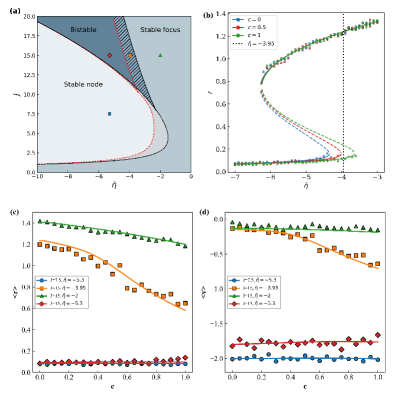
This study demonstrates how correlated noise in quadratic integrate-and-fire neuron networks can regulate collective dynamics, leading to correlated-noise-inhibited spiking and robust metastability.
While neural networks are often assumed to be disrupted by noise, the precise impact of correlated noise-arising from shared input fluctuations-on collective activity remains poorly understood. This study, ‘Macroscopic dynamics of quadratic integrate-and-fire neurons subject to correlated noise’, investigates this phenomenon using a mean-field approach to model networks of spiking neurons. Surprisingly, our analysis reveals that increased noise correlation can suppress network activity and induce robust metastability, characterized by spontaneous transitions between distinct states. How might these findings reshape our understanding of neural computation and state transitions in biological systems, and could correlated noise serve as a fundamental regulatory mechanism?
The Illusion of Randomness: A Baseline of Noise
Neuronal circuits are not the quiet, precisely tuned systems once imagined; instead, they exist within a constant barrage of synaptic activity, creating what appears as substantial noise. This background activity arises from the sheer number of neurons-billions in the human brain-each constantly firing and forming connections. Even in the absence of specific stimuli, synapses are spontaneously releasing neurotransmitters, resulting in fluctuating electrical signals. This isn’t simply random interference, however. The intensity of this background noise is surprisingly high-often approaching the level of the signals neurons use to communicate-and is a fundamental characteristic of brain function. It represents a baseline level of activity against which meaningful signals must be detected, and shapes how neurons integrate information and make decisions.
For decades, the inherent randomness within biological systems – often termed ‘noise’ – was largely considered an impediment to reliable function, a source of error in neuronal signaling. However, a growing body of research challenges this long-held assumption, revealing that this seemingly disruptive activity may, in fact, be fundamental to efficient neural computation. Evidence now suggests noise isn’t merely an annoyance to be filtered out, but an integral component that can enhance signal detection, promote robust decision-making, and even facilitate learning by allowing neurons to explore a wider range of states. This constructive role of noise appears to stem from its ability to modulate neuronal excitability, prevent neural networks from becoming locked in suboptimal configurations, and provide a dynamic backdrop against which weak signals can be amplified, ultimately contributing to the brain’s remarkable adaptability and processing power.
The brain doesn’t operate in silence; rather, neuronal circuits are constantly bombarded with background activity, a form of correlated noise that extends beyond simple random fluctuations. Recent investigations suggest that neurons aren’t simply overwhelmed by this noise, but actively process and even utilize it. This correlated noise appears to enhance the sensitivity of neural circuits, allowing for faster and more reliable detection of weak signals. Furthermore, the structure of correlated noise can shape neuronal responses, influencing decision-making and learning processes. Deciphering the mechanisms by which neurons encode and decode correlated noise is therefore paramount to understanding how the brain achieves efficient and robust information processing, potentially revealing fundamental principles governing neural computation and paving the way for novel approaches to artificial intelligence.
Beyond Randomness: The Shared Fate of Neurons
Correlated noise distinguishes itself from traditional, independent random noise by introducing temporal dependencies in the fluctuations experienced by neuronal populations. In scenarios with uncorrelated noise, each neuron receives input fluctuations that are statistically independent. Conversely, correlated noise manifests as shared fluctuations across multiple neurons, meaning a significant proportion of neurons within an ensemble experience similar, simultaneous deviations from their baseline activity. This shared input induces population dynamics that are not predicted by models relying on independent noise assumptions, leading to phenomena such as altered synchronization patterns and modified responses to external stimuli. The degree of correlation, often quantified by metrics like the cross-correlation coefficient, directly influences the resulting population behavior, creating a distinct regime of neural activity.
Analysis reveals that increasing the degree of correlation within noise applied to neuronal populations leads to a reduction in overall spiking activity, a process designated Correlated-Noise-Inhibited Spiking (CNIS). This effect is observed as a quantifiable decrease in the mean population firing rate as noise correlation increases. Data indicates that while uncorrelated noise generally promotes stochastic spiking, highly correlated noise effectively synchronizes inhibitory pressure, leading to a net suppression of excitatory output. The magnitude of this suppression is dependent on both the level of correlation and the intrinsic excitability of the neuronal population, with stronger correlations producing more pronounced decreases in firing rate.
The observation of Correlated-Noise-Inhibited Spiking indicates a potential regulatory role for correlated noise in neuronal populations. While random noise typically increases neuronal excitability, increasing the correlation of noise inputs can demonstrably decrease the mean population firing rate. This suggests that correlated noise doesn’t simply add to the stochastic drive of neurons, but actively modulates their collective excitability. The degree of suppression is dependent on the strength of the correlation; stronger correlations lead to greater inhibition of population spiking. This regulatory mechanism implies that neuronal populations can dynamically adjust their responsiveness to stimuli based on the statistical properties of their noise inputs, providing a novel means of controlling overall network excitability.
Decoding the Dynamics: A Mathematical Mirror
The Cumulant Expansion Method and the Fokker-Planck Equation provide a means of reducing the dimensionality of analyses concerning neuronal population activity. Traditional mean-field approximations often simplify population dynamics by focusing solely on average values, neglecting higher-order statistical moments and correlations. These methods, however, allow for systematic inclusion of these neglected terms via expansions of the probability density function. Specifically, the Cumulant Expansion provides a perturbative approach to approximate the probability distribution, while the Fokker-Planck Equation describes the time evolution of this distribution. This results in a lower-dimensional description – typically involving only the first and second moments – that more accurately captures the system’s behavior than purely mean-field models, without requiring computationally expensive simulations of the full, high-dimensional system.
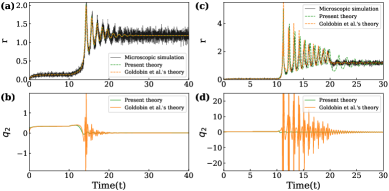
The Cumulant Expansion Method and Fokker-Planck Equation facilitate the accurate characterization of macroscopic variables – specifically, mean firing rate and mean membrane potential – even when subject to correlated noise. Validation of this approach demonstrates a high degree of correspondence between solutions derived from these methods and results obtained through direct microscopic simulations. Quantitative comparisons reveal minimal deviation, establishing the efficacy of these techniques as a computationally efficient alternative to simulating large populations of neurons. This accuracy extends to scenarios with varying levels of noise correlation, confirming the robustness of the derived low-dimensional descriptions for analyzing population activity.
Analysis of population activity demonstrates that correlated noise introduces non-linear effects beyond simple additive contributions. Specifically, increasing the correlation of noise within the population induces a shift in the system’s phase diagram, altering qualitative behaviors. This is evidenced by changes in macroscopic variables like firing rate and membrane potential, which deviate from predictions based on uncorrelated noise models. The observed non-linearity indicates that the impact of noise correlation is not proportional to its magnitude; rather, it triggers a change in the fundamental dynamics of the population, leading to distinct operational regimes.
Beyond Disruption: Order Within the Noise
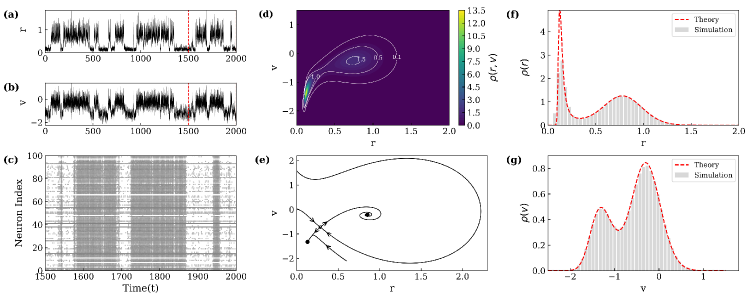
Recent research demonstrates that correlated noise – fluctuations shared across a population of neurons – can surprisingly give rise to a state of robust metastability. This isn’t simply random firing; instead, neuronal populations exhibit coherent transitions between periods of high activity and relative quiescence. The shared nature of the noise appears to act as a coordinating signal, effectively aligning the activity of individual neurons and enabling this collective switching behavior. This dynamic isn’t fragile; the system reliably returns to these alternating states even with perturbations, suggesting correlated noise isn’t just a disruptive force but a mechanism for stabilizing complex population dynamics and potentially underpinning cognitive functions requiring flexible, yet reliable, neural processing.
The observed influence of correlated noise extends beyond neuronal dynamics, echoing principles found in seemingly disparate complex systems. Similar to the Moran Effect – a model of evolutionary dynamics where beneficial mutations spread through a population despite random fluctuations – correlated noise appears to facilitate the dominance of certain states or behaviors. This parallels the synchronization of coupled oscillators, where shared noise can align their rhythms, fostering a collective, coherent state. In both cases, and now demonstrated in neuronal populations, correlated noise isn’t simply disruptive; it actively promotes a form of collective behavior, suggesting a fundamental role for shared fluctuations in organizing systems across biology, physics, and beyond. This highlights a broader principle: that seemingly random influences can, under certain conditions, drive surprising levels of order and coordination.
The prevailing view of noise as a disruptive force is increasingly challenged by evidence suggesting its constructive role in complex systems. Recent research demonstrates that correlated noise – where fluctuations aren’t random but linked across elements – actively shapes system dynamics, rather than simply obscuring underlying signals. This isn’t limited to neuroscience; principles mirroring this phenomenon appear in contexts ranging from evolutionary game theory, exemplified by the Moran Effect where correlated fluctuations drive population shifts, to the synchronization of coupled oscillators. Consequently, correlated noise is now understood as a key ingredient, potentially essential for the emergence of coherent behavior and flexible adaptation, particularly in population coding where noisy neural activity is crucial for representing and processing information.
The exploration of neuronal networks, as detailed in this study, reveals a precarious balance. Researchers find that correlated noise, rather than simply disrupting activity, can sculpt it, inducing metastability and influencing spiking patterns. This echoes a sentiment articulated by John Locke: “No man’s knowledge here can go beyond his experience.” The paper demonstrates that the network’s behavior isn’t predetermined by its structure, but fundamentally shaped by the ‘experience’ of noise correlations-a constant interplay of signals that define the boundaries of its operational state. Every calculation of network stability, every attempt to predict its response, is ultimately a temporary approximation, vulnerable to the ever-present influence of stochastic forces.
Beyond the Signal
The demonstration of correlated-noise-inhibited spiking and robust metastability in quadratic integrate-and-fire neuron networks invites consideration of the fragility inherent in dynamical systems. Multispectral observations-in this case, careful manipulation of noise correlations-enable calibration of models positing regulatory mechanisms. Yet, the very success of these simulations highlights a troubling recursion: the more accurately a model captures observed phenomena, the more readily it obscures the limitations of its foundational assumptions. The imposed noise structure, though revealing, remains an external control-a phantom limb directing the dance.
Comparison of theoretical predictions with the emergent dynamics demonstrates both achievements and constraints of current analytical techniques. The cumulant expansion, while powerful, inevitably truncates the infinite hierarchy of correlations. Future work must grapple with the consequences of this simplification. Investigations into higher-order statistics and non-Gaussian noise distributions may reveal previously unforeseen instabilities or, perhaps, a graceful degradation of predictability.
The persistent question isn’t simply how noise regulates activity, but whether regulation is even a meaningful concept. Perhaps these networks, like all complex systems, are merely self-organizing towards states of maximal entropy, and any appearance of control is an illusion projected by a desperate desire for order. The event horizon looms-beyond it lies not understanding, but the quiet acceptance of irreducible complexity.
Original article: https://arxiv.org/pdf/2601.10032.pdf
Contact the author: https://www.linkedin.com/in/avetisyan/
See also:
- Off Campus Season 1 Soundtrack Guide
- DoorDash responds after customer uses AI to make food look bad and get a refund
- Jon Bernthal Explains Why Marvel Let Him Make The Darkest Punisher Story Ever
- Umamusume has been transformed into a D&D game with new race
- Ethereum Eyes Break Above $2,420 as Rally Hangs in the Balance
- All Golden Ball Locations in Yakuza Kiwami 3 & Dark Ties
- How to Get to the Undercoast in Esoteric Ebb
- 10 Most Universally Beloved Sci-Fi Movie Villains, Ranked
- The Strongest Battlegrounds codes (May 2026)
- HSR Banner Schedule (Honkai Star Rail)
2026-01-19 04:36