Author: Denis Avetisyan
Researchers have developed a novel framework that leverages dynamic graph structures and meta-learning to improve the accuracy of traffic flow forecasting.
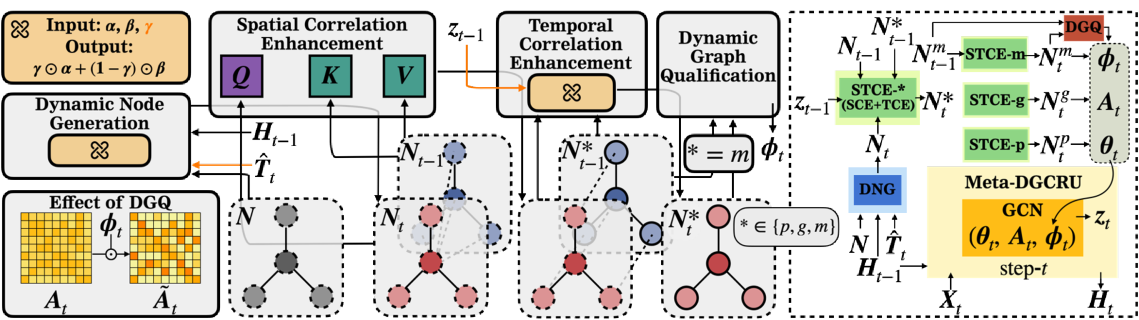
MetaDG unifies spatio-temporal modeling with heterogeneity to enhance predictions by dynamically qualifying edges within a GCRU structure.
Accurately modeling complex spatio-temporal dependencies remains a central challenge in traffic flow prediction, despite advancements in dynamic graph construction. This paper introduces Meta Dynamic Graph for Traffic Flow Prediction, a novel framework designed to bridge the gap between spatial and temporal modeling by leveraging dynamic graph structures of node representations. MetaDG unifies the capture of spatio-temporal heterogeneity within a single dimension, extending dynamic modeling beyond simple topological changes and achieving improved predictive accuracy. Could this approach to unified spatio-temporal modeling unlock further advancements in diverse fields reliant on complex system forecasting?
The Illusion of Static Systems: Why Traditional Models Fail
Conventional spatio-temporal modeling techniques, such as DCRNN, STGCN, and GWNet, frequently dissect the interconnectedness of space and time, analyzing each dimension in isolation. This ST-Isolation approach, while computationally efficient, fundamentally restricts the model’s capacity to discern intricate dependencies between locations and their evolution over time. By treating spatial and temporal components as independent entities, these models struggle to represent the nuanced feedback loops and cascading effects characteristic of real-world dynamic systems; for example, a traffic incident in one area may not be fully accounted for in predictions for a geographically distant, yet connected, location. Consequently, predictive accuracy suffers, particularly when dealing with complex interactions where changes in one spatial region directly influence conditions in others across various time steps.
Traditional traffic forecasting methods frequently struggle with the inherent interconnectedness of spatial and temporal dynamics, resulting in diminished predictive accuracy. These systems often treat location and time as independent variables, failing to account for how congestion in one area rapidly influences traffic flow in neighboring locations, or how rush hour patterns evolve across a city. This disconnect is particularly problematic in real-world scenarios where traffic is a continuously evolving network; a stalled vehicle on a highway, for example, doesn’t simply affect that single point in space, but propagates delays across multiple routes and over extended periods. Consequently, models built on this separation exhibit suboptimal performance, missing crucial cascading effects and failing to capitalize on the rich interplay between where and when traffic events occur.
A fundamental challenge in accurately forecasting dynamic systems lies in the inability of current models to fully capture the interwoven relationship between location and time. Traditional approaches often dissect space and time, treating them as independent variables, which prevents the system from recognizing how a change in one geographic area propagates and evolves across others. This separation obscures the crucial feedback loops and cascading effects that characterize real-world phenomena like traffic flow or weather patterns. Consequently, predictions are often limited by a failure to account for how spatial dependencies-the influence of neighboring locations-shift and intensify over time, hindering the development of truly adaptive and insightful forecasting models.
MetaDG: Abandoning Isolation for a Unified View
MetaDG overcomes the limitations of traditional Spatio-Temporal (ST)-Isolation approaches by implementing a unified framework for modeling both spatial and temporal dependencies. Existing methods often treat spatial and temporal aspects separately, hindering their ability to capture complex interactions. MetaDG directly addresses this by dynamically representing relationships between nodes within a graph structure that evolves over time. This unified approach, termed ST-Unification, allows the model to simultaneously consider the spatial context of locations and the temporal dynamics of traffic flow, leading to improved performance in tasks requiring prediction based on both factors. The framework’s design prioritizes the integration of these dependencies, rather than treating them as independent components, thereby enhancing its ability to represent real-world complexities.
MetaDG employs a Dynamic Adjacency Matrix to represent the relationships between nodes within a spatio-temporal network, differing from static graph approaches. This matrix is not fixed but is updated iteratively to reflect changes in node connectivity over time. The values within the matrix represent the strength of the relationship between nodes at a specific time step, allowing the model to capture temporal dependencies. This dynamic representation is crucial for modeling real-world phenomena where relationships between entities are not constant; for example, traffic flow between locations changes throughout the day. The matrix dimensions are N x N, where N represents the number of nodes in the network, and its values are updated based on observed data and model parameters at each time step.
The Edge-Weight Adjustment Matrix within MetaDG serves to modulate the influence of each edge during graph convolution, directly impacting information flow between nodes. This matrix is calculated based on observed data, quantifying the reliability of information propagation along each connection. Specifically, edges representing consistently accurate information transfer are assigned higher weights, amplifying their contribution to the convolutional process, while unreliable edges receive lower weights, diminishing their impact. This dynamic weighting scheme ensures that the model prioritizes information from trustworthy connections, leading to more robust and accurate spatio-temporal predictions. The matrix is updated iteratively, allowing the model to adapt to evolving network conditions and refine its understanding of information reliability over time.
MetaDG dynamically generates meta-parameters to modulate the graph convolution process, enabling adaptation to fluctuating traffic patterns. These parameters are not static; instead, they are computed based on real-time traffic conditions and incorporated into the graph convolution weights. This dynamic adjustment of weights allows the model to prioritize relevant spatial and temporal dependencies, improving the accuracy of traffic predictions. Specifically, the meta-parameters control the influence of neighboring nodes during the convolution operation, effectively weighting the contribution of each node based on its current relevance to the predicted traffic state. This adaptive weighting scheme ensures that the model can effectively handle non-stationary traffic dynamics and improve overall prediction performance.
Under the Hood: How Dynamic Graphs and Attention Refine Predictions
MetaDG utilizes Dynamic Node Generation to establish initial node representations at each discrete time step. This process involves transforming node features – including attributes like location, type, and inherent characteristics – into a vector space, creating what are termed ‘raw dynamic node embeddings’. These embeddings serve as the foundational input for subsequent processing layers. The generation is performed independently for each node at each time step, effectively capturing the node’s instantaneous state prior to considering relationships with other nodes or temporal dependencies. This allows the model to represent changes in a node’s attributes over time and provides a basis for tracking its evolution within the dynamic graph.
Dynamic Graph Qualification operates by assessing the validity of information flow between nodes within the graph. This module refines the initial adjacency matrix, typically represented as A, by assigning qualification scores to each edge. These scores, derived from the node embeddings and potentially other features, represent the strength and relevance of the connection. Edges with low qualification scores are then down-weighted or removed entirely, effectively pruning irrelevant connections and focusing the graph convolution on significant relationships. This process improves the efficiency of subsequent computations and enhances the model’s ability to capture meaningful spatio-temporal dependencies by reducing noise from spurious or weak connections.
Spatio-Temporal Correlation Enhancement employs a Cross-Attention mechanism to refine node embeddings by explicitly modeling relationships between nodes at different time steps. This process involves attending to information from all other nodes and time steps when updating a given node’s embedding, allowing the model to capture dependencies beyond immediate neighbors or the previous time step. Specifically, queries are generated from the current node embedding, while keys and values are derived from embeddings of all nodes across all time steps. The attention weights, computed from query-key interactions, determine the contribution of each node-time step combination to the final refined embedding, effectively capturing intricate spatio-temporal correlations and enabling the model to discern relevant contextual information for each node at each time step.
The MetaDG architecture utilizes a Gated Recurrent Unit (GRU) customized for graph-structured data, termed GCRU, to process spatio-temporal information. This GCRU incorporates graph convolution to aggregate information from neighboring nodes at each time step, allowing for the encoding of both spatial dependencies and temporal dynamics. The gating mechanism within the GRU – specifically, the update and reset gates – regulates the flow of information, enabling the model to selectively retain or discard past states based on current input and node features. This results in a robust and efficient mechanism for learning complex temporal patterns within the graph data, facilitating both the encoding of historical information and the decoding of future predictions based on the evolving graph structure and node attributes.
Beyond Accuracy: Stabilization, Robustness, and the Potential for Wider Application
MetaDG incorporates Z-score Normalization as a crucial preprocessing step to address potential instabilities during model training. This technique standardizes the input data by transforming values to have a mean of zero and a standard deviation of one, effectively scaling each feature independently. By centering the data around zero, Z-score Normalization mitigates the risk of gradients exploding or vanishing, a common challenge in deep learning, particularly when dealing with diverse or large-scale datasets. This standardization ensures that all features contribute equally to the learning process, preventing features with larger magnitudes from dominating the optimization. The result is a more stable and efficient training process, leading to improved model convergence and overall performance in predicting complex dynamic systems like traffic flow.
The MetaDG model incorporates Huber Loss as its primary loss function, a strategic choice designed to enhance predictive accuracy and model resilience. Unlike traditional Mean Squared Error which is highly sensitive to outliers, Huber Loss combines the benefits of both squared error and absolute error. For data points close to the prediction, it utilizes squared error to ensure precision, while switching to absolute error for outliers, thereby reducing their disproportionate influence on the learning process. This adaptive approach mitigates the impact of noisy or anomalous data frequently encountered in real-world traffic patterns, resulting in a more stable and robust model capable of generating consistently reliable traffic flow predictions. By effectively minimizing the influence of outliers, Huber Loss contributes significantly to the improved overall accuracy observed in MetaDG compared to models employing more sensitive loss functions.
MetaDG distinguishes itself in traffic flow prediction through a synergistic combination of innovative techniques. The model’s architecture dynamically adjusts to the evolving relationships within traffic networks, facilitated by adaptive parameters that respond to real-time conditions. This dynamic graph structure, coupled with the implementation of Huber Loss – a robust optimization method less sensitive to outliers – allows MetaDG to achieve demonstrably superior performance compared to established models like AGCRN, STSGCN, DGCRN, and HimNet. Rigorous evaluation on the PEMS03, PEMS04, PEMS07, and PEMS08 datasets, utilizing metrics such as Mean Absolute Error (MAE), Root Mean Squared Error (RMSE), and Mean Absolute Percentage Error (MAPE), consistently reveals MetaDG’s enhanced accuracy and reliability in forecasting traffic patterns.
The architecture underlying MetaDG presents a compelling framework applicable beyond traffic prediction, with ongoing research directed towards dynamic systems exhibiting complex spatio-temporal relationships. Specifically, investigations are underway to adapt MetaDG for weather forecasting, where accurate predictions rely on understanding the interconnectedness of atmospheric variables across both space and time. Similarly, the model’s capacity to discern patterns within evolving data streams makes it a promising tool for financial modeling, potentially improving the accuracy of forecasting market trends and assessing risk. This expansion leverages MetaDG’s core strength: its ability to model dependencies within dynamic graphs, allowing it to capture nuanced interactions that traditional methods may overlook, ultimately offering enhanced predictive capabilities across diverse scientific and economic domains.
The pursuit of elegant architectures for traffic flow prediction, as detailed in this MetaDG framework, feels…predictably optimistic. This paper attempts to unify spatio-temporal dependencies and heterogeneities through dynamic graphs and GCRU structures, a commendable effort. Yet, the history of system design suggests that any attempt at a ‘universal’ solution invites unforeseen complexities. As Edsger W. Dijkstra observed, “Simplicity is prerequisite for reliability.” The very dynamism intended to capture real-world variation introduces another layer of potential failure, another surface for production environments to exploit. One can’t help but suspect that tomorrow’s tech debt will be the cost of today’s ‘unified’ modeling, regardless of how clever the edge qualification mechanisms may be.
What’s Next?
The pursuit of spatio-temporal prediction will invariably discover that every qualified edge will, at some point, require re-qualification. MetaDG rightly addresses the heterogeneity inherent in traffic networks, but the cost of adaptability is measured in continuous monitoring. The framework achieves a unification of dependencies, a neat architectural victory – yet architecture isn’t a diagram, it’s a compromise that survived deployment. Future iterations will likely focus on the practical limits of meta-learning; optimization always finds diminishing returns, and everything optimized will one day be optimized back.
The current emphasis on graph construction and edge weighting, while effective, implies an assumption of relative stability in network topology. Production systems rarely indulge such assumptions. A natural progression will involve incorporating mechanisms for self-repair and dynamic graph evolution, essentially building systems that learn how to learn new connections as quickly as they lose old ones. The real challenge isn’t prediction accuracy, but sustained prediction viability.
Ultimately, the field will need to move beyond feature engineering and embrace systems capable of autonomous feature discovery. The goal isn’t simply to forecast traffic flow, but to build a self-aware network that anticipates its own failures, and adapts accordingly. It’s not about predicting the future, it’s about hedging against the unpredictable. The code isn’t refactored-hope is resuscitated.
Original article: https://arxiv.org/pdf/2601.10328.pdf
Contact the author: https://www.linkedin.com/in/avetisyan/
See also:
- Off Campus Season 1 Soundtrack Guide
- DoorDash responds after customer uses AI to make food look bad and get a refund
- Hideo Kojima says Metal Gear Solid 2 became the future he hoped would not happen
- HSR Banner Schedule (Honkai Star Rail)
- Gold Rate Forecast
- How to Get to the Undercoast in Esoteric Ebb
- 10 Most Universally Beloved Sci-Fi Movie Villains, Ranked
- Umamusume has been transformed into a D&D game with new race
- Euphoria Season 3’s New R-Rated Sydney Sweeney Scene Proves The Show Is Trolling Us
- Jon Bernthal Explains Why Marvel Let Him Make The Darkest Punisher Story Ever
2026-01-18 01:32