The dashboard as a winter map lies open on the table, a chorus of digits and diagrams where the future pretends to walk upright. Keyrock and Dune offer twelve charts like twelve breaths of a city that never sleeps, a ledger whispering of liquidity’s tides, of value returning as if it remembered its own address, and of rails growing into the backbone of something larger-a machine that wears economics like a new coat, with a wink and a shrug. Yes, it’s all rather dramatic, and yes, a little ridiculous 😅🤔.
The premise moves with simple gravity: each chart binds a live dataset to a 2026 forecast. Together they read like a litany of crypto’s core crafts-trading, issuance, payments, and funding-each muttering about depth, about institutions learning to walk on ice, about markets deciding they aren’t just playgrounds but rooms where serious furniture gets moved.
First comes the chorus of prediction markets, now somehow fashionable again after 2025’s fever dream. Weekly volume rose 9.2x to just under $5 billion, while Kalshi, Polymarket and Opinion kept a nearly complete monopoly at the time of writing. For 2026, the dashboard dares a 5x leap to $25 billion in weekly volume and a matching 5x rise in open interest, as markets learn to keep risks colorful and persistent like a well-loved umbrella in a restless wind.
Tokenization appears as the river’s second voice: non-stablecoin onchain real-world assets (RWA) AUM, stripped of stablecoins to see what capital markets assets do when they walk on-chain. Growth of 3.4x in 2025, with a forecast of more than 4x in 2026, led by tokenized cash-like products-T-bills and money-market funds-and private credit; with early hints that equities and ETFs may join as the weft of market structure and regulation becomes more patient and grown-up.
The x402 thread is a strange new thread, an open payments protocol Coinbase seeded in 2025 to let software-yes, including AI agents-pay for digital services using stablecoins. The measured dream: weekly x402 volume surpassing $100 million in 2026, a quiet banner for “machine-native commerce” arriving in production, as if a city decided to pay its bills with clever code and a smile.
On-chain asset management wears a new cloak: vault AUM across major providers. 2025 was about product maturity; 2026 promises distribution. The forecast speaks of vault AUM tripling to $36 billion by year’s end, and of at least one major broker-dealer offering an on-chain vault “yield shelf,” as if the market were politely arranging furniture for a longer stay.
Derivatives are the clearest crucible for depth. The DEX-to-CEX futures trading ratio grew more than 3x in 2025, from 6.34% to 21%, and now open interest-not mere volume-appears to be the true barometer of whether venues can “hold risk in size” as new asset classes migrate on-chain. The 2026 target? On-chain perpetuals open interest above $50 billion, a number that sounds like a dare whispered by chalk on a board.
Value return softens the air through buybacks. The report points to multi-million-dollar programs in 2025 from Hyperliquid, Raydium, and Pump.fun, with a forecast of weekly buyback spend at least twice 2025’s level, and a shift away from fixed-fee models toward “value-aware” execution-think pacing bands and triggers, disciplined accumulation, as if markets finally learned to be patient and courteous.
Solana MEV is cast as a distribution problem as much as a trading one. Tip-based MEV-validator and Jito tips-fell from a peak of 100,000 SOL to a low of 1,000 SOL, and the narrative pivots to the Block Assembly Marketplace (BAM), which could reshape where MEV is captured, moving away from reflexive tip spikes toward explicit execution pricing set by apps and venues. A reshaping, not a miracle, but a rumor with a map 🗺️.
Privacy wears a pragmatic mask: shielded ZEC as a proxy, with shielded deposits rising from 4.9 million to more than 7 million by end-2026. On Ethereum, the blob market-rooms of data-shows whether a meaningful fee floor develops, predicting a median hourly blob cost of at least $0.05 per blob on a full-year basis. The future costs, like cheap coffee, are hard to notice until you drink them all at once ☕💸.
Payments appear in consumer form through crypto card spend, with the report forecasting a $500 million monthly spend print at least once in 2026. TradFi integration is tracked via spot BTC ETF AUM, with Keyrock projecting holdings exceeding 2.5 million BTC in 2026 and net inflows positive in at least eight months, because who doesn’t love a chart that pretends to be a calendar and a fortune-teller at once?
Finally, stablecoin funding anchors on Aave’s USDC variable borrow APY on Ethereum, which wandered from 2.4% to 9.8% in 2025. The forward-looking claim is about rate stability rather than level: a drop in 30-day rolling volatility of USDC borrow APY to an average under 0.25 versus roughly 0.40 in 2025-positioned as a prerequisite for longer-duration, institution-style strategies, like a whispered promise that the roller-coaster might finally return to gentle hills.
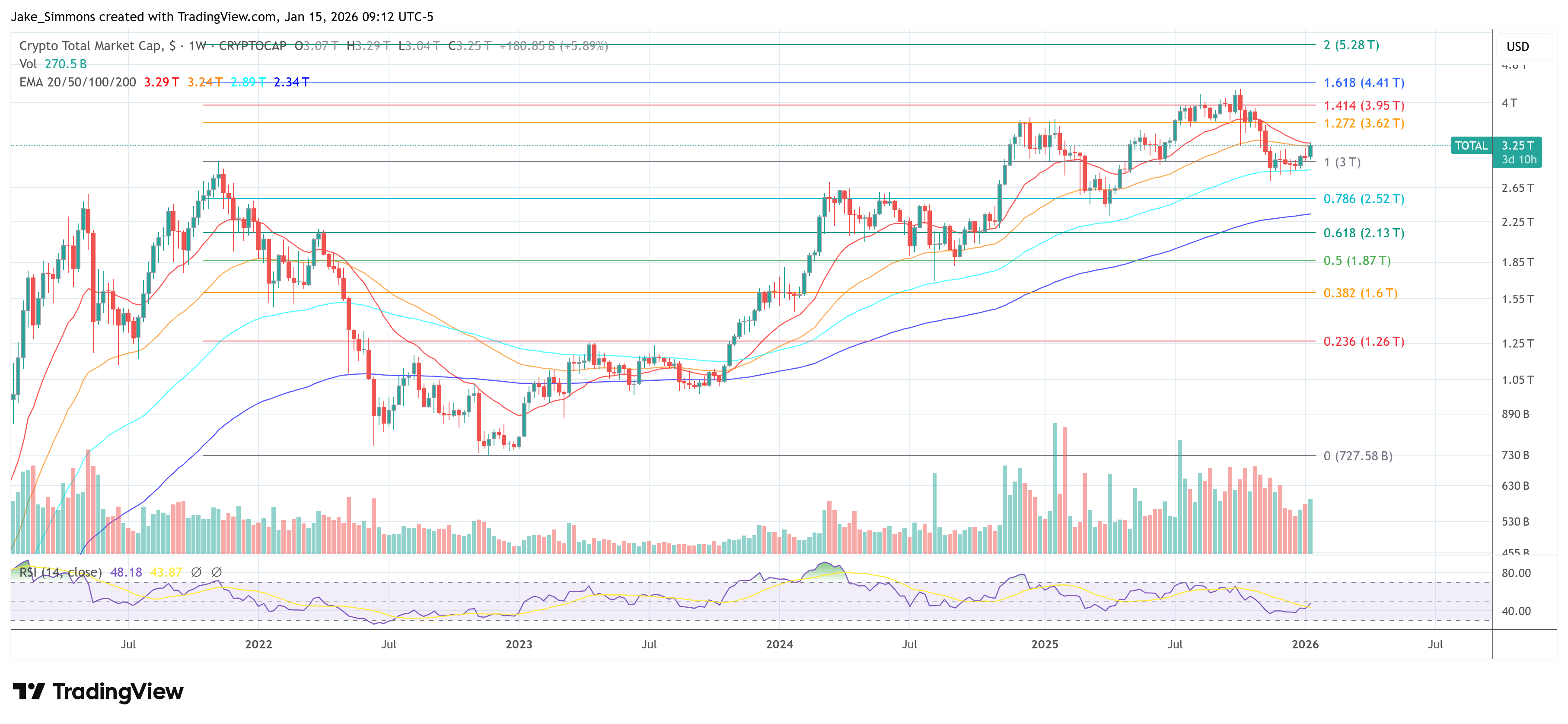
At press time, the total crypto market cap stood at $3.25 trillion, as if the horizon itself had learned to breathe in unison with the screens. And yes, the future looks complicated, stubborn, and deliciously absurd-so pour another coffee and watch the numbers dance. ☕🕯️
Read More
- Off Campus Season 1 Soundtrack Guide
- Euphoria Season 3’s New R-Rated Sydney Sweeney Scene Proves The Show Is Trolling Us
- Gold Rate Forecast
- DoorDash responds after customer uses AI to make food look bad and get a refund
- Jon Bernthal Explains Why Marvel Let Him Make The Darkest Punisher Story Ever
- Olympian Says Heated Rivalry Tugged At His Heartstrings
- All Golden Ball Locations in Yakuza Kiwami 3 & Dark Ties
- Dutton Ranch Review: Paramount+’s New Western Takes All The Best Parts Of Yellowstone & Makes Them Better
- ETH Holders Cash In: Is the Party Over, or Just Getting Started?
- Oh My God, It’s Her?
2026-01-16 06:07