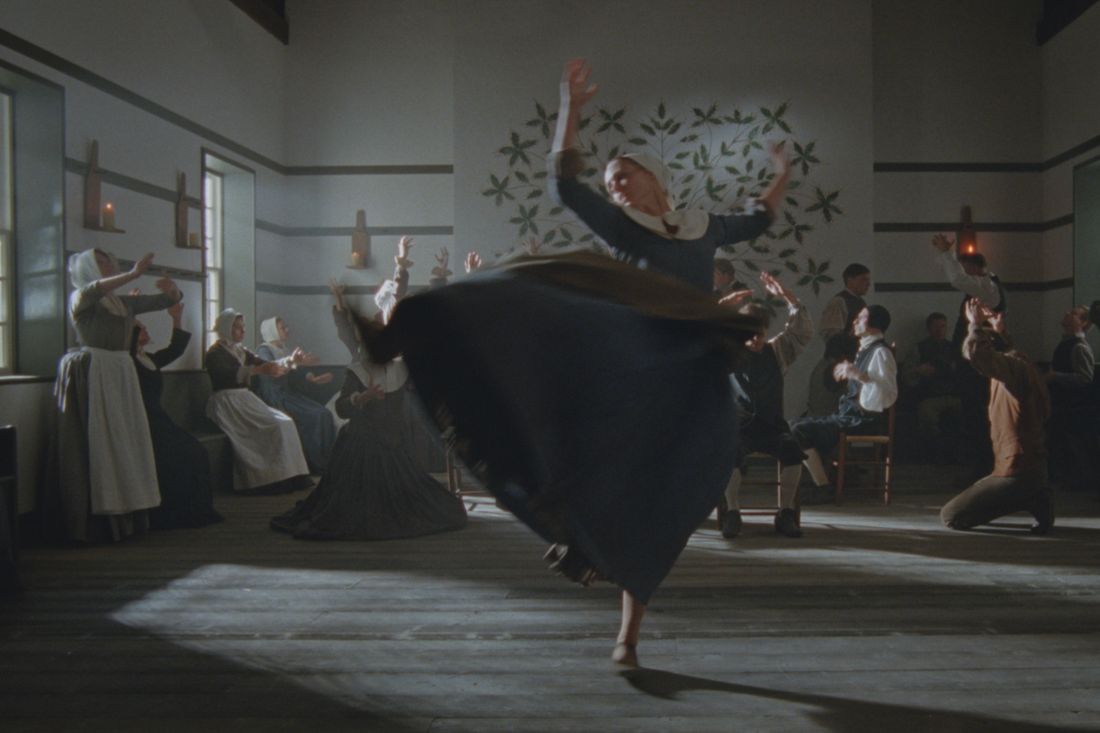
When discussing The Testament of Ann Lee, it’s impossible to ignore its unique staging. The film’s songs and dances powerfully convey both ecstatic, celebratory energy and quiet, thoughtful moments. It’s a fascinating work that feels like both a record of religious experience and the challenges faced by its followers, as well as a daring experiment in modern dance. The music and movement offer a deep insight into the lives of the Shakers. As Vulture’s Bilge Ebiri put it, the film is unlike anything he’s ever seen, and much of that originality is thanks to the choreography and performance of Celia Rowlson-Hall.
Filmmaker Mona Fastvold approached her friend, Rowlson-Hall, with a film idea about Ann Lee, the founder of the Shaker religion, and her strong beliefs in both celibacy and faith. It took seven years, but Fastvold – who co-wrote the Oscar-winning short film The Brutalist – finally had a script for The Testament of Ann Lee. Rowlson-Hall immediately agreed to work on it without even reading it. She then spent a week in May 2024 creating the film’s choreography, using demos from composer Daniel Blumberg’s original music. Her ideas were heavily influenced by historical images of the Shakers, particularly depictions of men and women moving in separate circles before joining together. As she describes it, these images felt like a completed puzzle that then came undone.
The choreography also drew inspiration from Shaker design, particularly their smooth, seamless woodworking style – the choreographer wanted the movements to feel similarly fluid and sculpted. She typically created choreography for about two songs each day, then collaborated directly with Amanda Seyfried and the rest of the cast. Each actor brought their own unique movement style, which contributed to a feeling of energy and variety. Rowlson-Hall now details the six key dance movements and how some scenes were improvised during filming. Importantly, everything was filmed on location, avoiding any studio or stage setting.
1. “The Martha”
The movie opens with the song “Clothed by the Sun” and a scene in the woods. It features Mary Partington, a follower of Lee, played by Thomasin McKenzie, leading a group of women in a prayerful, rhythmic movement – sweeping their arms and kicking their legs. Actress Rowlson-Hall described the movement as physically liberating. This scene was filmed in a forest about an hour outside of Budapest.
The foundation of this work is prayer and a sense of exchange – giving and receiving. There’s a powerful energy to it, stemming from the idea that the love we receive from a higher power exists beyond our physical selves. We visualized gathering that love, offering it with gratitude, and experiencing it as something tangible – almost like a textured, bright mist. I asked the dancers to imagine they weren’t just moving through empty air, but through a substance they could feel. Their movements are expansive, opening the chest and heart to both give and receive, with curved arms suggesting a gentle holding of this love. The kicks have a specific, slightly scooped quality, incorporating a subtle attitude. From the very beginning of the film, we wanted to establish that it includes both dancing and singing, though not in a traditional way – we’re embracing movement. I nicknamed one kick ‘the Martha’ as a nod to Martha Graham and her iconic Appalachian Spring piece. This is a modern take on dance and musical storytelling, and we’re aiming for a distinctly modern style of movement. It felt fitting to pay homage to her and her incredible artistic vision.
One part of the shoot was particularly challenging because the location was over an hour outside of Budapest, making it impossible to practice there beforehand. When we finally got to the woods, they set up a camera crane to follow the dancers. I had to completely rework the choreography on the spot with 25 performers. Despite our best efforts to prepare the ground, the dancers kept tripping over branches and slipping on leaves. It was extremely hot – a typical August day – and everyone was wearing heavy wool costumes, so they were really suffering. To make things worse, I got food poisoning and spent the whole day being sick. While I have many great memories from the set, this day was incredibly difficult. The director, Mona, really wanted a single, unbroken shot, and I wanted to deliver that for her, but when I looked at what we were capturing, I realized it wasn’t going to work. Luckily, they had another camera rolling to get a side view of Thomasin, which ended up saving the scene in post-production. It was just a tough day all around.
2. The pull down, push out
Throughout the film, the Shakers repeatedly raise their arms towards the sky, then bring them back down, sometimes as far as their waists or even slapping their chests. According to Rowlson-Hall, the key to this movement was a feeling of sincerity.
For me, the core of the film lies in how characters deal with emotional exchange. It’s about the dynamic between giving and receiving – whether it’s pain, sadness, or love. The film explores how we release difficult emotions and invite positivity into our lives, posing questions about both our struggles and our potential for healing. These explorations ultimately shape the film’s rhythm and speed.
I asked the dancers and actors to be completely honest and present. There wasn’t a specific pace or structure; I wanted them to fully experience the moment. If they needed to pause and simply receive, that was perfect – they could take as much time as they needed. Conversely, if they felt compelled to express something, they were free to move at their own speed. My goal wasn’t for anyone to focus on performing a dance step, but rather to genuinely connect with something deeper – with God, with love, or with their own inner selves. It was clear when people were just going through the motions versus truly being present; the difference in quality was striking.
3. “A chorus of angels”
Before joining the Shakers, Lee experiences the heartbreak of four miscarriages. The film sensitively portrays both the deliveries and the emotional and physical toll each loss takes on her. A song called “Beautiful Treasures,” based on a Shaker hymn, accompanies these scenes. The director worked with actors to create specific movements showing the supportive connection between Lee and the women who care for her during and after childbirth.
There was this incredibly powerful moment during filming. I remember telling Amanda and the other women they looked like they were summoning a chorus of angels. They were using both hands, almost like they were conjuring something, and it struck me that this was the dance they’d do privately, supporting her through hours of labor. It made me wonder what they could give her – strength, light, some ease. I really felt she needed all the angelic power she could get to bring a healthy baby into the world, so I just kept thinking, ‘Call on those angels!’ The way Amanda performed it was stunning – it started to feel less real, like she was entering a space that was both close and distant. I loved it because, in that whole world we created, everything felt so intense and rigid, almost aggressive. This movement was a complete release. I asked the actors to imagine light actually dancing between their fingers. It had this almost bubbly, effervescent quality, which was a beautiful contrast to all the other more forceful movements in that scene.
4. The golden cloak
While in jail after her arrest, Lee began having visions that led her to abstain from sexual relations, even with her husband, as she sought a deeper connection with God. During one particularly vivid vision, called “Hunger and Thirst,” she saw herself covered in gold fur and floating in the air. After her release, she shared these experiences and declared herself the second coming of Jesus Christ, which motivated her followers to join her in practicing the Shaker religion.
There’s a beautiful moment in “Hunger and Thirst” right before the character levitates. It made me think about how someone could actually lift off the ground. I realized she needed to shed the weight of her physical body. I asked Amanda, the performer, to imagine wrapping herself in a golden cloak. The choreography shows her tracing the shape of her body as if putting it on, and then, with a sweeping gesture, she ‘sheds’ her skin. I wanted it to feel like she was throwing off a burden, allowing her to rise. We film it very closely on her face, but you can still see that powerful movement. Amanda really connected with it, seeing it clearly as putting on the golden cloak and leaving her human form behind – a signal to take flight!
I envisioned Ann’s story as a quest filled with both intense joy and raw, primal energy. I tried to understand what it would feel like physically to experience the loss of four children – the feeling of being completely paralyzed. I was fascinated by the challenge of portraying movement, even dance, within that stillness. My goal was for Mona’s dance to enhance the story, not interrupt it, and to add another layer of emotional depth.
5. The dance circle
During the last part of the movie, Lee and her followers depart Manchester by ship for America, seeking to establish a lasting community for their Shaker faith and attract new members. Throughout their month-long voyage, they persistently pray on deck despite harsh weather – snow, rain, and wind – and their unwavering dedication eventually silences those who initially found them irritating or fanatical. This powerful scene, accompanied by the song “Worship,” was filmed on the Götheborg, a replica of an 18th-century ship docked in Sweden. The filmmakers used overhead shots to emphasize the circular patterns formed by the group as they danced and moved in unison.
What struck me most about this film was the incredibly intimate connection between the characters. They shared a familial bond, a sort of innocent physicality in their touch and embraces. I really wanted to capture that intensity – a sense of longing for connection they weren’t finding elsewhere, and finding it in these simple, passionate hugs and close moments. There’s a beautiful visual metaphor at play, too. The scene where they run together, in a circle, is particularly powerful. It’s all about unity; if one person stumbles, they all fall. Honestly, getting that scene right was surprisingly difficult – hours were spent just practicing running in sync! Beyond the visuals, it was refreshing to see prayer portrayed as a communal act, emphasizing the importance of coming together and supporting each other, something often lost in the more solitary practice of faith.
The boat dance scene turned out to be one of the best shoots we had. We were filming in Sweden, right on the deck of an actual boat, but the dancing space was incredibly small – only about four by four feet. We had to adjust the choreography on the spot. Luckily, the actors had a rehearsal day beforehand. I noticed little details – like a moment where their hands would go down and potentially get splinters from the wooden boat – and made quick changes to protect them. I had them move their arms differently so their hands could slide across the surface instead. We also had them rehearse in their period shoes because the soles were very slippery. The weather was unpredictable; we shot the dance in sunshine, wind, snow, and finally, rain. In the edit, there are close-up moments of the actors hugging and comforting each other. I hadn’t originally planned those, but ended up directing them on the day. I simply asked them to find each other, embrace, and protect each other from the weather, and it became my favorite part of the dance sequence.
We—Will, Mona, and I—had a very specific vision for how to film this scene. It was the one piece of choreography that absolutely had to be perfect, especially for Mona and me, before we could move forward. Because there’s so much going on when they’re in Manchester, any slight variation wouldn’t be noticeable. But I wanted this to feel precise, as if they’d been performing it daily for months, so ingrained in their bodies that the movements were automatic and effortless. Watching them was truly beautiful. They always sang live during filming, and hearing that song felt like a reminder of why we all make movies.
6. Let your finger lead the way
The Shakers, upon arriving in America, needed a place to establish their community, and their supporter, John Hocknell (played by David Cale), experiences a divine moment. In a memorable scene called “John’s Running Song,” Hocknell is seemingly guided by a higher power, led deep into the New York woods by an unseen force. He arrives at a secluded spot near Albany – the ideal location for the Shakers’ new settlement, Niskayuna. This scene is particularly humorous, showcasing Cale’s incredibly physical and almost trance-like performance.
As someone who really loves film, I’m always fascinated by the physical storytelling. I actually choreographed a sequence as a dance, and while they used a stunt double for a small part, I spent a lot of time with the actor, David, in the studio. We focused on a specific movement – how a hand initially trembles and then points. I wanted it to feel organic, like the gesture was controlling him, and his body simply followed. We really drilled down on the physicality – was this movement pulling him down, lifting him up, or guiding him sideways? Interestingly, when it came time to shoot, my original choreography kind of went out the window. It became more about reacting to the environment – jumping over rocks or trees, things like that. But for me, even something small – a single finger, a hand gesture – can be incredibly expressive. It can convey everything you need it to, almost like a dance in itself.
Read More
- Netflix’s Little House On The Prairie Reboot: Release Date, Cast & Everything We Know
- Off Campus Season 1 Soundtrack Guide
- YouTuber arrested after viral AI bodycam videos spark real police complaints
- Silver Rate Forecast
- Prime Video’s New R-Rated Spy Thriller Is Officially No.1 On Streaming Despite Poor Reviews
- Brent Oil Forecast
- EUR ZAR PREDICTION
- Bulgakov’s Take: Koreans Bet the Farm on Chips, Crypto, and Chaos
- Gold Rate Forecast
- Peaky Blinders: The Immortal Man’s Tommy Shelby Is a Better Father Than Michael Corleone
2025-12-26 20:57