Warning: Spoilers ahead for the plot and ending of Marty Supreme.
The movie Marty Supreme is full of unbelievable events. Throughout the film, Marty Mauser (Timothée Chalamet) gets away with outrageous things – from a relationship with actress Kay Stone (Gwyneth Paltrow) to accidentally blowing up a gas station – often just by saying “I love you” and running away. However, the most unbelievable moment comes at the very end, when Marty is suddenly overcome with emotion at the sight of his newborn baby. The film never suggests he’s capable of such a reaction, and this emotional turn feels unearned and like a convenient way to wrap up the story, much like Marty’s constant escapes.
Much of Marty Supreme feels like a commentary on the idea of American exceptionalism, and Timothée Chalamet delivers his most over-the-top performance yet. He plays Marty as someone who’s flying too close to the sun, obsessively pursuing his dream of becoming a world-class ping-pong player, even though almost no one believes in him. As Marty tries to get to the British Championship, he embodies the worst aspects of American arrogance – the belief that we can do anything we want simply because we think we’re better than everyone else. He’s selfish and reckless, stealing from family, splurging money he doesn’t have, throwing tantrums, and disrespecting officials. Like other characters in the Safdie brothers’ films, he makes terrible choices without a second thought, hurting others along the way. He’s completely unfiltered, knows no boundaries, and recovers from every setback, much like the orange ping-pong ball he tries to sell to fund his trip.
The film feels surprisingly different from how director Josh Safdie has presented Marty Supreme, which he’s described as a story about pursuing dreams. Safdie has connected with Marty’s struggle, explaining that making his previous film, Uncut Gems, felt similar: when people doubt your vision, it fuels your determination. He says that doubt creates a sense of urgency – the feeling that your dream could fail at any moment, forcing you to fight even harder to convince others to believe in it. This mirrors Marty’s journey as he relentlessly works, schemes, and compromises his dignity to reach Japan for a rematch against table-tennis champion Endo (Koto Kawaguchi). He faces constant obstacles – evading the police, being targeted by debtors, and even enduring a humiliating public punishment from Kay’s wealthy husband, Milton Rockwell (Kevin O’Leary). Each scene presents a new hurdle for Marty to overcome, and Safdie wants the audience to be impressed by the strength of his desire and the sincerity of his ambition.
The problem with Marty Supreme isn’t that its main character is flawed. It’s that the movie doesn’t give us enough moments to see Marty thinking about his actions or feelings. Without that internal reflection, it’s hard to believe he’s capable of empathy or caring about anyone but himself.
Even Rachel, Marty’s lifelong crush and neighbor, isn’t a priority for him. Marty often tells people he loves them as a quick thank you, but when Rachel says it, she truly means it. She’s been devoted to him for years, sticking by him even when he gets her pregnant and refuses to acknowledge he’s the father, and even when he suggests adoption. The film portrays Rachel as both Marty’s connection to reality and his biggest supporter, but their relationship is deeply unbalanced. She constantly defends him and is willing to do anything for him—even resorting to violence and elaborate schemes—while his affection always seems to rely on her unwavering faith in him, rather than genuine care for her. This imbalance is what makes the film’s ending feel unearned and ultimately unsatisfying, given the character we’ve seen throughout the story.
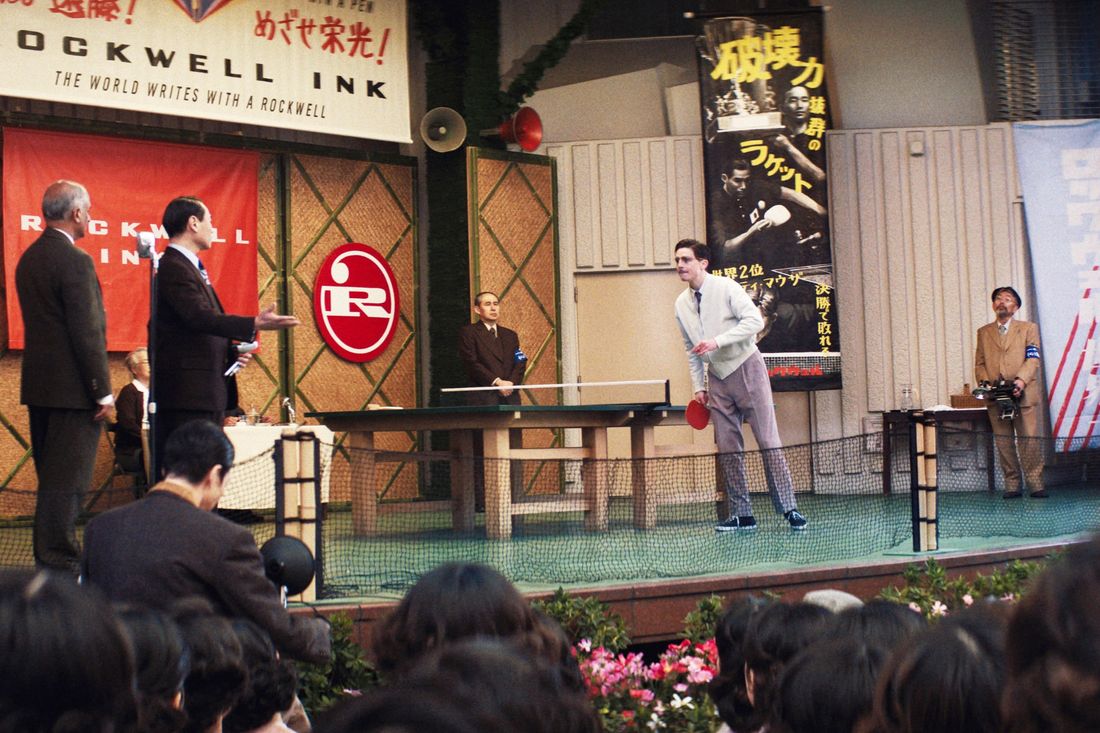
The film’s climax unfolds with Marty traveling to Japan, funded by Rockwell, to play an exhibition match against Endo. When he discovers he’s still banned from the championship, he realizes this match is his only chance to prove himself. Through a show of confidence, he challenges Endo to a serious game, which he wins, surprising the Japanese audience and cheering on the American soldiers present. Back in the U.S., Marty immediately goes to the hospital to meet his newborn baby and Rachel. He unexpectedly embraces fatherhood, a role he’d previously avoided, and vows to stay with Rachel, kissing her at her bedside before seeing the baby. The director focuses on Timothée Chalamet’s face as Marty looks at his child, and the actor immediately tears up, suggesting a moment of profound change. The camera angle, looking up at Chalamet as if from the baby’s perspective, emphasizes this supposed rebirth. The film wants us to believe Marty is finally taking responsibility and will change his ways. However, many viewers saw this as a happy ending, but the arrival of a child doesn’t necessarily fix the behavior of someone self-absorbed. It’s questionable whether Marty genuinely cares for his child or simply sees it as an extension of himself, another object of his own self-obsession.
As a critic, I’ve been noticing a pattern in the work of the Safdie brothers. It’s… frustrating, honestly. Their latest, like Marty Supreme, seems to suggest that having a child automatically absolves someone of their past failings. We saw it in their Showtime series, The Curse, where Emma Stone plays Whitney, an HGTV host building awful, gentrified homes under the guise of sustainability. She’s frankly awful to everyone, especially her husband, Asher (Nathan Fielder). And yet, the series finale hinges on her giving birth, and suddenly, poof, she’s transformed. The show lingers on her blissful expression, implying motherhood will magically fix everything. It’s the same beat as Marty Supreme, where Marty holding his baby feels like instant redemption. But for me? It feels… unearned. This idea that a baby will automatically make these flawed people better just didn’t resonate. I found myself strangely unmoved, unlike the characters on screen who seemed to find instant salvation.
Read More
- Netflix’s Little House On The Prairie Reboot: Release Date, Cast & Everything We Know
- Off Campus Season 1 Soundtrack Guide
- YouTuber arrested after viral AI bodycam videos spark real police complaints
- Silver Rate Forecast
- Prime Video’s New R-Rated Spy Thriller Is Officially No.1 On Streaming Despite Poor Reviews
- Brent Oil Forecast
- Gold Rate Forecast
- Bulgakov’s Take: Koreans Bet the Farm on Chips, Crypto, and Chaos
- EUR ZAR PREDICTION
- Peaky Blinders: The Immortal Man’s Tommy Shelby Is a Better Father Than Michael Corleone
2025-12-25 00:55