Spoilers follow for Pluribus through first-season finale “La Chico o El Mundo.”
Throughout the season, Manousos (Carlos-Manuel Vesga) warned against trusting “the Others,” and in the final episode of Pluribus, Carol (Rhea Seehorn) finally understood why. She discovered her companion and lover, Zosia (Karolina Wydra), had been working with the Others all along, intending to use Carol’s frozen eggs to turn her into one of them. This is a devastating betrayal for Carol, but Manousos feels vindicated – he believes the Others will never stop trying to convert those with immunity, and those who are immune must defend themselves.
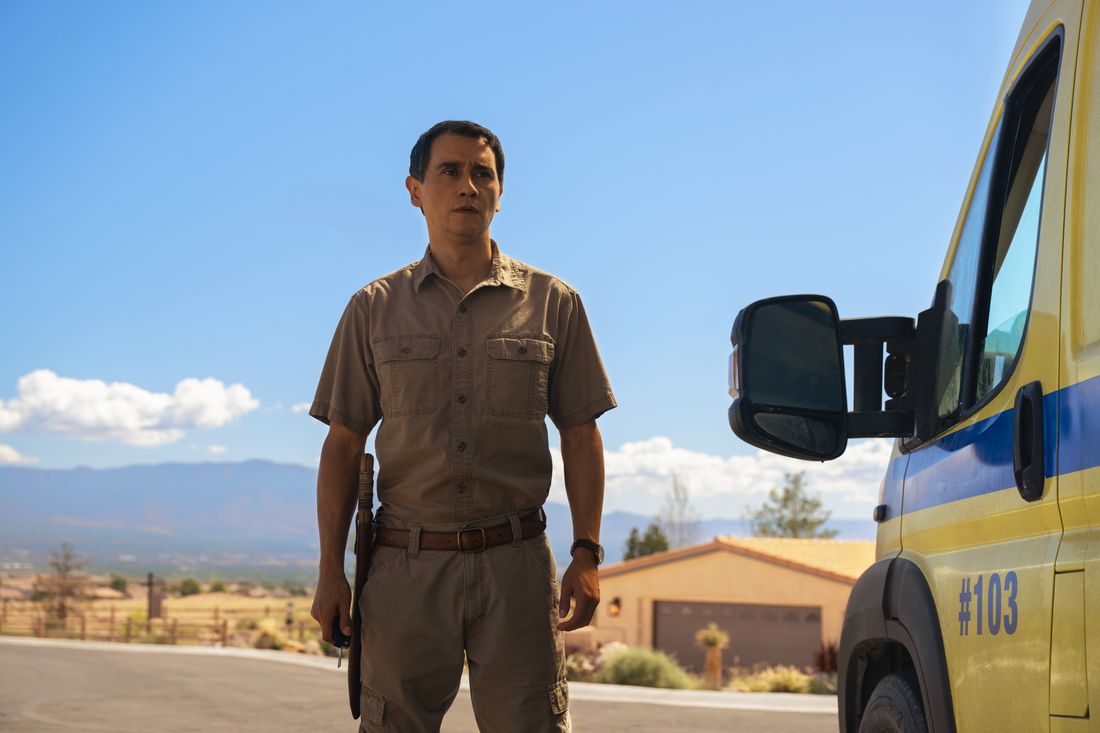
The show, called Pluribus, centers around Carol and Manousos, characters created by Vince Gilligan. Carol feels disdain for others and longs for the way things were before a group called the Others changed society. However, while Carol has begun to accept the Others, Manousos remains stubbornly resistant. This distrust is immediately apparent when Manousos, played by actor Vesga, first appears in the episode “Please, Carol.” In a lengthy scene without dialogue, Vesga portrays Manousos as rigid and unyielding, demonstrated by his actions – eating dog food, scavenging for supplies, and refusing any attempts at friendship from the Others – all conveyed through his physical presence and facial expressions.
As a film and TV fan, I found what actor Vesga said really interesting. He explained that starting to build a character completely silently, on set and alone, is almost unheard of in television, at least in his experience. Being Colombian, like Manousos, and having worked a lot in Spanish-language projects, he saw it as a really beautiful challenge. It actually allowed him to discover a new side to his acting. He feels that the key to staying grounded as a performer is remembering you’re playing a character, not becoming one – it’s about acting, not just inhabiting a role.
According to Vesga, his character, Manousos, had an incredible journey – delivering a powerful speech to the Others, surviving the dangerous Darién Gap alone, and ultimately arriving at Carol’s house in Albuquerque. Vesga approached the role using a technique inspired by Bertolt Brecht, constantly reminding himself of his fellow actors and the audience. He felt this helped him stay centered while portraying the series’ most self-controlled character. Vesga admits working with Gilligan and Seehorn exceeded his wildest expectations. He recalls driving in the Canary Islands, overwhelmed by the reality of the situation, constantly telling himself, You are here, do you realize you’re here, driving this car and working with these brilliant people? He says the experience transformed him, not just as an actor, but as a person.
I’m going to share some words the press has used to describe Manousos recently: ‘willful,’ ‘integrity,’ ‘determination,’ and ‘rebellion.’ Considering everything that happened this season, what’s your overall impression of him? His journey from Colombia to Paraguay really stands out to me. Moving to a new country always involves difficult experiences – loss, sadness, fear, pain, and hardship, but also hope. These experiences heavily influenced how he approached joining the team. He’s faced the challenges that many migrants do – starting a life in a new country, finding work, and then potentially losing it all. That’s when he decided he wouldn’t let it happen again and was determined to fight for what he needed.
The character’s past explains his unwillingness to compromise and his strong-willed nature. It’s well-written because his journey to reclaim his life requires him to migrate once more, leaving behind everything he’s established in Paraguay. He travels the same dangerous route many are currently using – the Darién Gap – which, as a Colombian, I’m deeply aware of and heartbroken by. It’s a continuing tragedy, with people risking everything for a better life, and for this character, that hope is represented by someone named Carol. That’s why I connect with descriptions of him as stubborn, dignified, and principled.
People have called Manousos’s decision to leave money for expenses while traveling to Carol ‘ridiculous,’ but it makes sense considering he wants people to return. It’s ironic because he was forced to leave his home country due to the way things were, a place where his individuality wasn’t valued. Before joining this new society, he likely felt like an unimportant person, while Carol, as someone who’s had to fight for acceptance due to her sexuality, is strong and self-assured. Manousos hasn’t experienced that same respect for his individuality. I’m curious to know what Samba Schutte thinks about Diabaté’s background, because I suspect Diabaté felt even more marginalized than Manousos, perhaps even less valued. That might explain why he now enjoys luxuries. For Manousos, it’s about righting a wrong. If I had gone through a similar experience – migrating, losing everything, and then finding a peaceful, accepting world – I’d be willing to try it. But Manousos sees it as fundamentally wrong.
I’m interested in your thoughts on the religious symbolism in Manousos’s character. His name is similar to ‘Emmanuel’ and ‘Jesus,’ and his journey includes elements like traveling alone, finding shelter in churches, resisting temptation, and ultimately being impaled. Were you conscious of these parallels, and how did you incorporate them into your performance?
I appreciate that interpretation. Catholicism is definitely a key part of who he is. The image of the Virgin Mary hanging in his car speaks volumes. He may not be constantly praying, but he was raised with that faith and still feels connected to it. Catholicism often focuses on suffering as a means of purification and achieving salvation. I was raised with a Catholic worldview that accepts hardship and struggle as inherent to life, and in a way, that makes it meaningful. I don’t think he experiences suffering the same way someone without that upbringing would. It’s a perspective where you acknowledge, ‘This is difficult, but life is difficult.’
It’s hard to say for sure, but his past experiences suggest he’s been through tough times. He may not have faced extreme hardship before, but he understands what it’s like to be hungry and to struggle with limited resources, forcing him to be resourceful. He’s been challenged, and now he’s trying to make amends for a significant mistake. There’s a hint of self-sacrifice in his character, like a martyr. The way he deals with pain – like cauterizing wounds, and even his body language – evokes imagery of religious penance, suggesting he’s willing to suffer for a greater cause, almost as if he’s a martyr for all of humanity.
I definitely agree. It’s interesting how people have interpreted the show in so many ways – focusing on themes like artificial intelligence, capitalism, or grief. Was there a particular interpretation that resonated with you most while you were working on it? For me, the story kept reminding me of Brave New World, and the idea that control isn’t always about force or fear. It’s often about convincing people they’re happy and content, even when they’re actually being manipulated. From my point of view, individuality is increasingly at risk, and I don’t think the threat comes from ideologies like communism. It’s more about the direction technology is taking us. We’re being subtly shaped into a more uniform society, often through fleeting moments of pleasure. This connects to the ‘Others’ in the show – they represent a world that gives us what we want, but not necessarily what we need. They claim they just want to make us happy, but they’re really catering to our desires, not our actual needs.
I once told Karolina that conversations with Zosia felt impersonal, like talking to a digital assistant such as Siri or ChatGPT. I worry that we’re becoming a society that seems content, but is actually becoming increasingly apathetic and disconnected. I also shared with Vince how the movie WALL-E kept coming to mind – the people in that film are constantly wearing goggles and passively lying down, and I fear we’re heading towards a similar state. This unsettling future has always felt like a real possibility.
I’m really interested in discussing a couple of scenes from the finale, starting with the first meeting between Manousos and Carol. It’s so funny and well-timed, watching them try to understand each other. Actually, that scene was my audition! During the audition, we used a real cell phone translator instead of a third actor, and I immediately thought it would be comedic. When Manousos arrives at Carol’s house, there’s a sense of urgency, but Carol isn’t as concerned as the woman who sent the video. I knew we had to find the right tone for the comedy and let it develop naturally. It felt tricky because we either needed to allow for a lot of improvisation, or meticulously plan for every potential interruption.
I was thrilled when we finally arrived on set – I’d been preparing for that scene for months! We could hear the other actor through our earpieces. It didn’t quite click at first because we were unsure when she’d interrupt. Sometimes it was in the same spot, and other times it varied. I also decided my character, Manousus, wasn’t fluent in English yet, even though he’d been studying for weeks and was picking things up. This made me occasionally react as if he understood Carol, but it took a few tries to realize it worked better if he was completely lost and truly needed the translator.
Vince reminded me that I speak English, but Manousos doesn’t, which was an important distinction. He also explained to Rhea and me that we needed to respond to any disruptions – even if we couldn’t prevent them. He said if we heard a cue in our earpiece, we should react immediately. I really liked that emphasis on improvisation; it makes the work more challenging and engaging. I see acting as a game, but one you play with complete dedication. His instructions really clarified how we should tackle the scene.
I vividly remember finishing a scene and walking to the next one with a huge grin. It wasn’t just that we nailed it, but I genuinely had fun. Working with Rhea is like playing tennis with Roger Federer – you both push each other with your best shots, not to win, but because of the sheer joy of the game. That’s what doing a scene with her feels like – a playful, enjoyable experience with a close friend.
I really enjoyed that scene. I’m also curious about the moment in the finale where Manousos uses the radio frequency he discovered on Rick, one of the Others. He’s causing Rick pain, but his intention is to help him regain control. From the beginning, we established that Manousos is a scientist – very logical and experimental. He needs to test anything he finds without any preconceived notions. He discovers the frequency with an open mind, and the resulting scene is fantastic. Initially, Manousos shows no empathy, but as he speaks to Rick, he becomes incredibly gentle, caring, and loving. The scene is complex because Manousos initially treats Rick like a test subject, similar to how the scientists treated the rats in the first episode – as if he’s simply a means to an end. But then, suddenly, that ‘specimen’ becomes Rick, a person he desperately wants to save. It’s a powerful emotional shift within that single scene.
Bringing up Catholicism makes me think of how an inquisitor might act – offering pain while claiming to be working towards someone’s salvation. It’s a twisted logic: ‘I’m going to inflict terrible pain, but it’s for your own good, and I genuinely care about you, even as I do it.’ It’s like believing that even in death, a person can reach heaven. I didn’t consciously think about that connection at the time, though. I was focused on Rick simply being a tool for Manousos’s larger plan, and how deeply affected he was by the outcome. He also felt frustrated, like he was so close to saving the person and Carol wouldn’t let him try. He believed he could have reached that person and turned things around.
Later, we see Manousos studying books about loops and circuits, giving him a new way to investigate what’s happening. I don’t have any information about season two, but it’s interesting that he understands equations, math, and physics – does that hint at something about his past? I don’t want to jump to conclusions, but that’s what’s great about the show. The writers, including Vince, have cleverly left clues for viewers to piece together. Even as an actor, I don’t know what Manousos did before in Colombia or before joining the group, but it encourages you to think and make your own connections.
Read More
- Netflix’s Little House On The Prairie Reboot: Release Date, Cast & Everything We Know
- Off Campus Season 1 Soundtrack Guide
- YouTuber arrested after viral AI bodycam videos spark real police complaints
- Silver Rate Forecast
- Prime Video’s New R-Rated Spy Thriller Is Officially No.1 On Streaming Despite Poor Reviews
- Gold Rate Forecast
- Brent Oil Forecast
- Peaky Blinders: The Immortal Man’s Tommy Shelby Is a Better Father Than Michael Corleone
- EUR ZAR PREDICTION
- Bulgakov’s Take: Koreans Bet the Farm on Chips, Crypto, and Chaos
2025-12-24 17:58