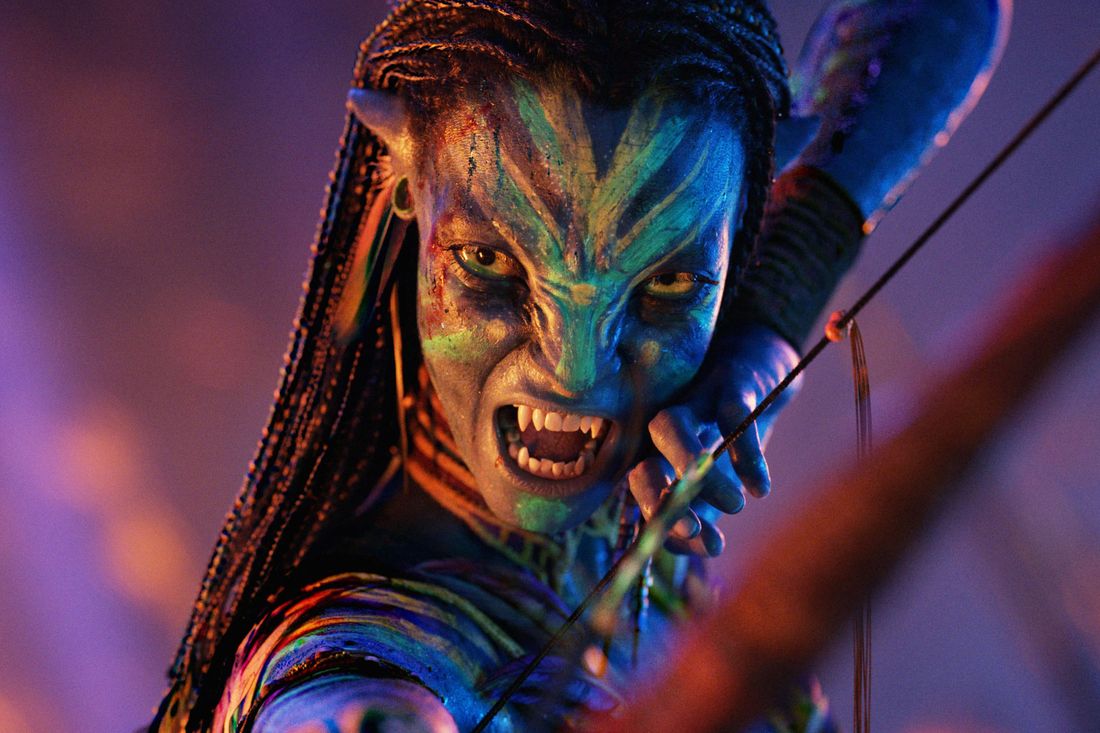
Let’s be clear: everything you see in the world of Avatar isn’t real. The blue aliens, the dragons they ride, the floating mountains, and even the massive, whale-like tulkun are all created with motion capture and digital effects. We know this, yet it’s easy to forget how convincingly real it all feels. In Avatar: The Way of Water, when young Lo’ak and his friends are joyfully running and leaping off the backs of their tulkun companions, it feels like you’re right there with them, experiencing that same sense of freedom and exhilaration. It’s filmed with such energy that it’s hard to remember it’s almost entirely created on a computer, and it seems like even the director, James Cameron, is amazed by what he’s created.
Cameron’s incredibly detailed and immersive world-building isn’t just for show. The realistic feel of Pandora actually serves as a backdrop for his own internal struggles. The conflict between the Na’vi – Pandora’s peaceful, spiritual inhabitants – and the technologically advanced human invaders mirrors the opposing forces within Cameron himself. While the 2022 film, Avatar: The Way of Water, showcased his more peaceful side, the new film brings back his more assertive, action-oriented personality, which feels strong and revitalized.
The main villain of the series, the formidable Colonel Miles Quaritch (Stephen Lang), who died in the first Avatar film but was brought back as a Na’vi in the second, now serves as a key contrast to the hero, Jake Sully (Sam Worthington). In Fire and Ash, Quaritch has an even larger role, relentlessly pursuing Jake while also trying to bring his son, Spider (Jack Champion), back to his side, leading him to make some unexpected alliances. Meanwhile, Jake is struggling with the responsibilities of his growing family and is deeply grieving the loss of his eldest son, Neteyam (Jamie Flatters). Quaritch, on the other hand, enjoys a sense of freedom and impulsiveness. A particularly compelling new character, Varang (played brilliantly by Oona Chaplin), leads a rebellious tribe of Na’vi who worship fire and embrace a nihilistic worldview. She forms a connection with Quaritch, drawn to his weaponry. Their training sessions with rifles echo a familiar theme in James Cameron’s films – a bond formed through shared expertise with powerful weapons, reminiscent of Aliens. Cameron visually portrays their connection as intensely intimate, even suggesting a romantic dynamic, to a degree that feels unusually personal and provocative. It seems Cameron identifies more with the rebellious and unrestrained Quaritch than with the burdened hero, Jake Sully.
Watching Fire and Ash, I was really struck by how much guilt everyone carries. It feels like at the beginning, pretty much everyone in Jake’s family is blaming themselves for Neteyam’s death, and it doesn’t stop there. Lo’ak is heartbroken, constantly replaying the events and believing he’s responsible. Even Neytiri is struggling, grieving the loss of her home and feeling angry with Jake. Kiri, who’s still figuring out her unique background, starts to doubt herself, and Spider, being human, is ostracized and confused about who he is. It’s not just about Neteyam, either. Jake even questions his victory from the first Avatar – riding the toruk and uniting the Na’vi. He says, “When you ride the beast, you become the beast,” and he’s decided never to do it again. All this heavy regret really highlights how different our heroes are from Quaritch and the other humans, who just refuse to admit they’re wrong, show any weakness, or even accept defeat – they don’t even seem to care about dying!
James Cameron seems genuinely passionate and uninhibited in Fire and Ash, and that enthusiasm is a testament to the immersive world he’s created. While the Avatar films aren’t entirely original – borrowing from familiar action and disaster movie tropes and featuring straightforward storytelling – the director and actors fully commit to the material, making it work. Like Way of Water before it, Fire and Ash revisits themes and ideas from Cameron’s past films, including Aliens, Terminator: Judgment Day, The Abyss, and even Titanic. Some might see this as the franchise repeating itself, but Cameron is at least borrowing from his own best work. Importantly, the film is beautifully made and expertly paced, avoiding any sense of artificiality. The moment Kiri echoes Sigourney Weaver’s iconic line from Aliens is genuinely exciting, proving Cameron can successfully revisit and reimagine his classic moments.
It’s clear there’s a wealth of story here – enough for multiple films, and some scenes feel cut short, hinting at a longer version. In fact, James Cameron originally planned for The Way of Water and Fire and Ash to be one massive movie! Despite its 197-minute runtime, the film never drags. Cameron consistently creates long movies, but he paces them quickly, constantly adding new ideas and visuals with incredible energy. What would be a central focus in most films – like a fleet of giant, purple, tentacled slugs used as airships – is just a small piece of the first act here. Even something as unusual as a space whale being put on trial feels surprisingly moving and fits seamlessly into the emotional flow. The story builds and the action sequences emphasize how comfortable Cameron is in this world – he’s free to explore any idea, character, or conflict. Fire and Ash is arguably the most sprawling of the Avatar films, but also the most immersive and rewarding, drawing you into the world and making you care about the characters. It’s a film that constantly invites you to look deeper into its stunning backgrounds, and then, just when you’re lost in it, the credits roll, reminding you it was all part of a dream.
Read More
- Netflix’s Little House On The Prairie Reboot: Release Date, Cast & Everything We Know
- Off Campus Season 1 Soundtrack Guide
- YouTuber arrested after viral AI bodycam videos spark real police complaints
- Silver Rate Forecast
- Prime Video’s New R-Rated Spy Thriller Is Officially No.1 On Streaming Despite Poor Reviews
- Gold Rate Forecast
- Brent Oil Forecast
- Bulgakov’s Take: Koreans Bet the Farm on Chips, Crypto, and Chaos
- Peaky Blinders: The Immortal Man’s Tommy Shelby Is a Better Father Than Michael Corleone
- EUR ZAR PREDICTION
2025-12-16 16:55