Author: Denis Avetisyan
A new deep learning model delivers precise black hole mass estimates for an unprecedented sample of quasars, offering a comprehensive view of these cosmic behemoths.
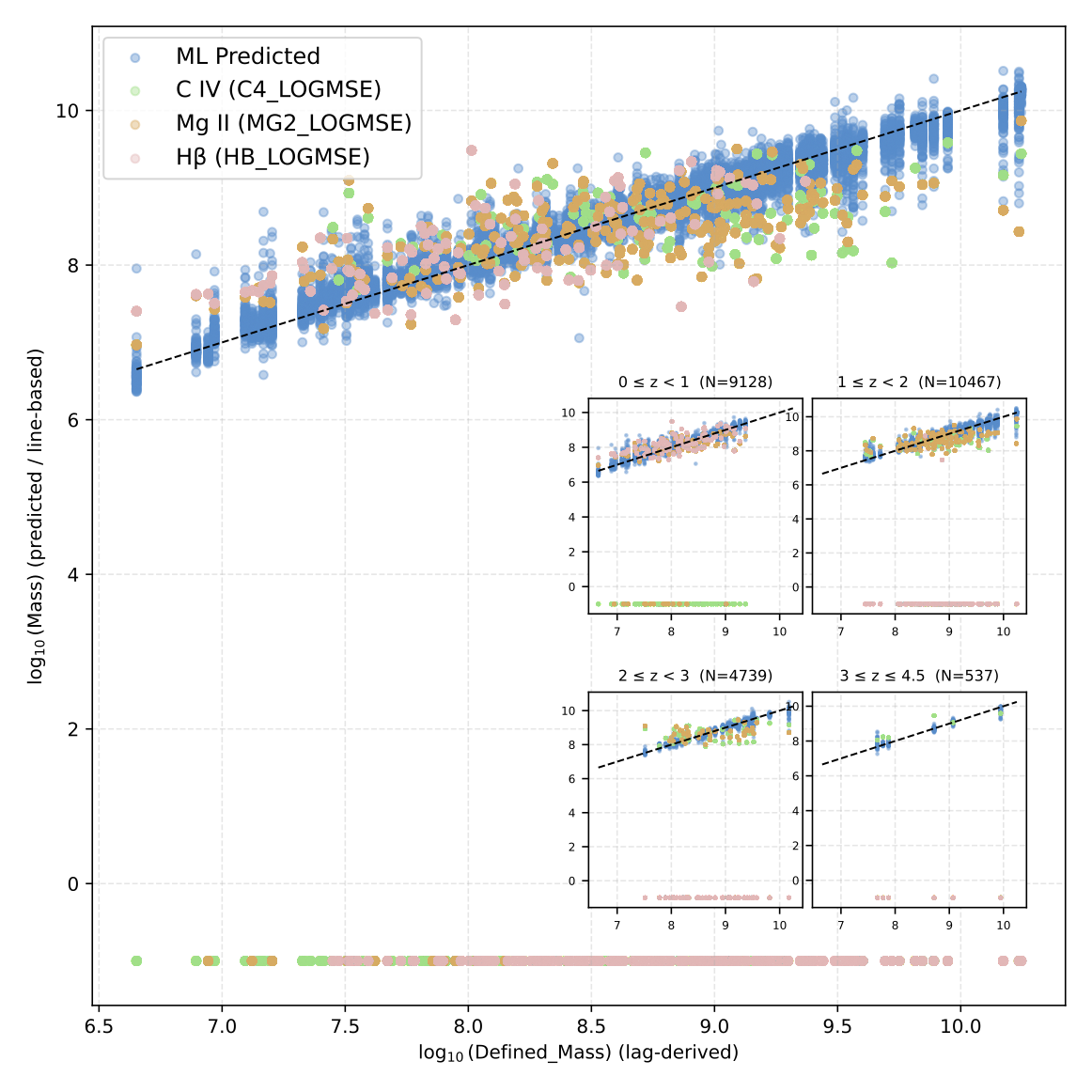
Researchers trained a deep learning model on reverberation-mapped quasars to create a uniform mass catalog of 287,872 black holes from the Sloan Digital Sky Survey.
Accurate determination of supermassive black hole masses is fundamentally challenging, often relying on methods with limited precision, particularly at the extremes of the mass spectrum. Here, we present the findings of ‘287,872 Supermassive Black Holes Masses: Deep Learning Approaching Reverberation Mapping Accuracy’, detailing a deep learning approach trained on reverberation-mapped quasars to estimate black hole masses for a substantial sample of 287,872 SDSS quasars. This yields a population-scale catalogue with root-mean-square error comparable to the traditional reverberation mapping technique, significantly improving upon single-line virial estimators. Will this uniform mass catalog unlock new insights into the co-evolution of black holes and their host galaxies, and refine our understanding of the black hole mass function?
The Illusion of Cosmic Certainty
The evolution of galaxies is inextricably linked to the supermassive black holes (SMBHs) that reside at their centers, yet precisely quantifying the mass of these cosmic behemoths presents a considerable obstacle to astronomers. These SMBHs, with masses ranging from millions to billions of times that of the Sun, profoundly influence galactic structure and star formation, but their immense distance and the complex dynamics surrounding them make direct measurement impossible. Current techniques often rely on indirect methods, such as observing the motion of stars and gas orbiting the black hole or analyzing the brightness fluctuations of accreting material, each carrying inherent uncertainties and limitations. A more refined understanding of SMBH masses is therefore critical, not only for unraveling the co-evolution of black holes and galaxies, but also for establishing a firm foundation for cosmological models that describe the universe’s large-scale structure and history.
Determining the mass of a supermassive black hole presents a considerable observational hurdle, largely due to the limitations of established techniques. Reverberation Mapping, a method that analyzes the time delay between variations in a black hole’s accretion disk and the resulting changes in broad emission lines, demands years of consistent monitoring to build a reliable data set. Alternatively, the Virial Theorem, which relates a system’s kinetic and potential energy, offers a quicker estimate, but necessitates simplifying assumptions about the geometry and dynamics of the gas orbiting the black hole – assumptions that can significantly impact the final mass calculation. These inherent challenges mean that current mass estimates often carry substantial uncertainties, hindering precise tests of black hole-galaxy co-evolution and cosmological models that depend on accurately known black hole parameters.
Establishing precise measurements of supermassive black hole (SMBH) masses is paramount to unraveling the co-evolutionary link between these galactic engines and their host galaxies. The mass of a central black hole demonstrably influences galactic properties, from the stellar velocity dispersion and bulge size to the rate of star formation and the overall morphology of the galaxy. Consequently, accurate SMBH mass determinations provide critical constraints for cosmological models seeking to understand galaxy formation and evolution across cosmic time. Discrepancies in mass estimates can lead to flawed interpretations of the black hole-galaxy relationship, impacting the validity of simulations and theoretical frameworks used to describe the universe’s large-scale structure. Therefore, ongoing efforts to refine these measurements are not merely exercises in astrophysics, but essential steps towards a more complete and accurate understanding of the cosmos.

Unveiling Hidden Patterns
Deep learning methods, specifically Autoencoders, are utilized to estimate black hole masses from quasar spectra by identifying and extracting relevant features. Autoencoders are unsupervised neural networks trained to reconstruct their input; in this application, the quasar spectrum serves as the input. The network learns a compressed representation of the spectral data, effectively isolating the features most indicative of black hole mass. This feature extraction process bypasses the need for manual feature engineering, allowing the model to automatically learn the optimal representation directly from the data. The learned features are then used in a regression model to predict the $M_{BH}$ of the quasar.
The implemented architecture integrates Convolutional Neural Networks (CNNs) directly within the Autoencoder framework to analyze quasar spectral data. CNNs excel at identifying localized patterns within data, and in this context, they detect features in the spectra – such as emission and absorption line shapes and relative intensities – that correlate with black hole mass. These convolutional layers automatically learn relevant filters, eliminating the need for manual feature engineering. The learned convolutional features are then used to reconstruct the input spectrum via the Autoencoder’s decoder, with the efficiency of reconstruction serving as a proxy for the quality of the extracted mass-correlated information. The use of CNNs allows the model to effectively handle the high dimensionality and inherent noise present in spectroscopic data, improving the accuracy and robustness of mass estimations.
The Autoencoder architecture is designed to reduce the dimensionality of the input quasar spectra into a lower-dimensional ‘Latent Space’ representation. This is achieved through an encoder network which maps the high-dimensional spectral data to a compressed vector, followed by a decoder network attempting to reconstruct the original spectrum from this vector. Successful reconstruction, optimized through loss functions during training, forces the Autoencoder to learn the most salient features within the spectra relevant to black hole mass. The resulting Latent Space contains a condensed representation of the spectral information, significantly reducing computational requirements for downstream mass prediction tasks while retaining critical information for accurate estimation. The dimensionality of this Latent Space is a hyperparameter tuned to balance compression and information preservation.

Reconstructing the Invisible
The decoder component of our Autoencoder employs Transposed Convolutional Networks to perform the reconstruction of input spectra from the compressed latent space representation. These networks, also known as deconvolutional networks, effectively reverse the operations of traditional convolutional layers, upsampling the latent vector to the original spectral resolution. This process allows the model to generate a reconstructed spectrum that closely approximates the original input, enabling accurate retrieval of spectral features from the lower-dimensional latent encoding. The architecture utilizes learnable filters and biases within the transposed convolutional layers to map the latent representation back to the spectral domain, optimizing the reconstruction process through backpropagation and gradient descent.
Skip connections, implemented as direct pathways from earlier layers to later layers within the reconstruction network, address the vanishing gradient problem common in deep networks. This allows gradients to flow more effectively during training, particularly in deeper architectures, enabling optimization of all network layers. Furthermore, these connections provide an alternative path for spectral information, bypassing potential information loss through successive transformations. By combining feature maps from earlier layers with those of later layers, the network retains high-resolution spectral details that contribute to improved reconstruction accuracy and, consequently, enhanced prediction performance in black hole mass estimation.
The Autoencoder is trained by minimizing the reconstruction error between input spectra and their reconstructed outputs, effectively forcing the latent space to encode the features most critical for representing the original data. This process prioritizes the preservation of information relevant to black hole mass estimation, as the network learns to discard irrelevant details during compression and reconstruction. Consequently, our mass estimates, derived from analysis of the latent space, demonstrate a root mean squared error (RMSE) scatter of 0.058 dex, indicating a high degree of accuracy and precision in the reconstructed spectra and subsequent mass determinations.

Mapping the Cosmic Census
A comprehensive estimation of black hole masses was achieved through the application of a novel methodology to data gathered by the Sloan Digital Sky Survey – Reverberation Mapping (SDSS-RM) project. This analysis encompassed a remarkably large sample of 287,872 quasars, significantly increasing the body of available data for statistical study. Prior investigations were limited by comparatively small sample sizes, hindering robust conclusions about the overall population of black holes; this expanded dataset allows for a much more detailed and accurate characterization of their distribution. The scale of this undertaking represents a substantial leap forward in the field, providing a firm foundation for further research into the growth and evolution of these enigmatic cosmic objects and enabling more precise modeling of their influence on galactic structure.
The distribution of black hole masses across the universe isn’t random; it follows a predictable pattern described by the Differential Mass Function. This function essentially acts as a cosmic census, detailing how many black holes exist within specific mass ranges. By analyzing a vast sample of quasars, researchers have been able to construct a more detailed and accurate version of this function, revealing the relative abundance of black holes of different sizes. The current findings suggest that the mass distribution isn’t a simple, single power law, but rather a $Broken\ Power\ Law$, implying a shift in how black holes form and grow at different mass scales. This refined function is crucial for understanding galaxy evolution, as black hole mass is intrinsically linked to the properties of the host galaxy and provides key insights into the processes that shape the cosmos.
The distribution of black hole masses isn’t uniform; instead, it follows what researchers have determined to be a Broken Power Law. This means the number of black holes increases as mass decreases, but this trend changes at a specific mass value-the break mass, $M_b$. Analysis reveals this critical point occurs around 3 x 10⁸ solar masses. Below this mass, the distribution increases relatively slowly, characterized by a low-mass index of +1.1. However, above $M_b$, the relationship flips dramatically; the number of black holes decreases rapidly with increasing mass, indicated by a steep, high-mass index of -2.7. This broken power law provides a crucial framework for understanding the overall population of black holes and their contribution to the evolution of galaxies.

The pursuit of accurately determining supermassive black hole masses, as detailed in this study utilizing deep learning on a substantial sample of SDSS quasars, echoes a fundamental challenge in astrophysics: pushing the boundaries of observational techniques and theoretical frameworks. This endeavor necessitates constant refinement of methodologies, acknowledging inherent limitations. As Ernest Rutherford aptly stated, “If you can’t explain it to a child, you don’t understand it well enough.” This principle applies directly to the complex task of inferring black hole mass from spectral analysis and reverberation mapping. The deep learning model presented herein, trained on a limited set of reverberation-mapped quasars, represents an attempt to extrapolate understanding to a far larger population, yet the model’s accuracy remains tethered to the precision of the initial training data – a constant reminder of the limitations inherent in any observational approach and the importance of rigorous validation.
The Horizon Beckons
The creation of a uniform catalog of supermassive black hole masses from a sample of nearly 300,000 quasars is, in a pragmatic sense, a victory. Yet, when light bends around a massive object, it’s a reminder of the limits of any measurement. This work, like all attempts to chart the cosmos, is merely a map – and models, it must be acknowledged, are like maps that fail to reflect the ocean. The precision gained through deep learning is valuable, but it obscures a fundamental truth: the true mass function remains shrouded, a statistical phantom.
Future efforts will undoubtedly focus on refining these models, incorporating more complex physical processes, and expanding the training datasets. However, the deeper challenge lies not in achieving ever-greater accuracy, but in confronting the inherent uncertainties. Can a model, built on observed reverberation patterns, truly capture the chaotic dynamics at the heart of these objects? Or does it simply project a convenient illusion?
Perhaps the most fruitful path forward involves abandoning the quest for a single, definitive mass function. Instead, the field might embrace the inherent diversity of black holes, acknowledging that each object represents a unique configuration of space and time. A catalog of possibilities, rather than a claim of certainty. After all, a black hole isn’t simply a place where light cannot escape; it’s a mirror reflecting the limits of comprehension.
Original article: https://arxiv.org/pdf/2512.04803.pdf
Contact the author: https://www.linkedin.com/in/avetisyan/
See also:
- Netflix’s Little House On The Prairie Reboot: Release Date, Cast & Everything We Know
- Off Campus Season 1 Soundtrack Guide
- YouTuber arrested after viral AI bodycam videos spark real police complaints
- Silver Rate Forecast
- Prime Video’s New R-Rated Spy Thriller Is Officially No.1 On Streaming Despite Poor Reviews
- Brent Oil Forecast
- Peaky Blinders: The Immortal Man’s Tommy Shelby Is a Better Father Than Michael Corleone
- Gold Rate Forecast
- EUR ZAR PREDICTION
- Bulgakov’s Take: Koreans Bet the Farm on Chips, Crypto, and Chaos
2025-12-07 07:49