
Starting a game with a long-running story can be overwhelming, like jumping into the last episode of a show you’ve never watched. Whether you’re new to a game like Diablo or returning to a big online world, all that backstory can be hard to grasp. That’s where AI summarization tools come in handy. They can break down complex stories, characters, and events into a clear and concise summary. It’s like getting a helpful recap so you can understand what’s happening and fully enjoy the game.
Key Takeaways
- Get the essential intel, faster: Use AI summarization to turn massive patch notes, complex guides, and deep lore into scannable highlights. This lets you spend less time reading and more time mastering the game.
- Choose the right tool for the job: Different content requires different tactics. Use quick, extractive summaries for patch notes, visual mind maps to untangle complex skill trees, and question-based methods to filter game reviews for the info you actually care about.
- You are the final filter: AI can miss crucial details like specific stats, gamer slang, and sarcastic community feedback. Always treat AI-generated summaries as a first draft and give them a quick review to confirm accuracy before trusting them with your build or strategy.
What is Text Summarization and Why Should Gamers Care?
It’s easy to get lost in the sheer amount of text surrounding video games. From detailed wikis and lengthy update notes to endless online discussions, you can end up spending more time reading about a game than actually playing it. That’s where text summarization helps. It’s like having an AI assistant that quickly condenses large amounts of text into a short, clear, and easy-to-understand summary – essentially, the core information you need.
This tool is a huge benefit for gamers. Instead of spending a lot of time figuring out every detail in game updates – like changes to weapons in Warzone – you can quickly see what’s most important. Similarly, instead of wading through complicated game wikis to learn about characters in Diablo 4, you can get a short and simple backstory. It’s designed to give you the key info you need quickly, so you can spend more time enjoying the game – whether that’s winning matches or getting lost in the game’s story. This technology helps you skip the unnecessary details and focus on having fun.
Cut Through the Gaming Noise
As a gamer, I’m constantly overwhelmed by how much info is out there! It feels like trying to drink from a firehose. That’s where text summarization comes in – it’s like having a filter to grab the important stuff without you having to wade through everything. For example, if I’m trying to get good with a new character in Honkai: Star Rail, instead of reading a ton of long guides, I can use a summarizer to quickly find the best builds and strategies everyone’s using. It really helps me understand things better and actually remember what to do when I’m in the heat of battle. It’s all about being efficient and improving my gameplay without spending hours just reading!
Two Main Types: Extractive vs. Abstractive
Summarization tools generally work in one of two ways: by pulling out key sentences (extractive summarization) or by rewriting the text in a new way (abstractive summarization). Knowing the difference between these methods will help you choose the best one for your specific task.
Extractive summarization works by pinpointing the most crucial sentences or phrases within a text and directly copying them to create a summary. It’s best used when you need precise information, such as specific numbers or a direct quote.
Abstractive summarization works like asking a friend to explain something to you. Instead of just pulling out key sentences, the AI actually understands the text and then rewrites it in a new and original way. This approach uses natural language generation to create a fresh summary, making it especially helpful for grasping complicated stories or rules.
How AI Summarizes Gaming Content
Ever wonder how an AI can read a 5,000-word game review and spit out a perfect three-sentence summary in seconds? It’s not some high-level magic spell—it’s a combination of some seriously cool tech working behind the scenes. At its core, AI summarization relies on teaching computers to understand language the way we do, but on a massive scale. It breaks down walls of text, identifies the most critical points, and pieces them back together into something short and sweet. Think of it as your personal quest helper, sorting through all the lore dumps and heated forum arguments to give you just the intel you need. To really get how it works, we need to look at the two main power-ups the AI uses: Natural Language Processing and Machine Learning.
The Basics of Natural Language Processing
AI summarizers rely on a technology called Natural Language Processing, or NLP. NLP lets computers understand and interpret human language. When you give an AI a long article – like one about how fans reacted to a new trailer – NLP helps it pinpoint important details such as character names, game titles, and key plot points. Think of it as teaching the AI to distinguish between crucial information and minor details. This understanding of context and importance is the first step in creating a helpful summary.
Putting Machine Learning to Work
After an AI processes language, Machine Learning (ML) helps it learn how to use that information. ML is like the AI’s training process – it studies massive amounts of text, such as articles and reviews, to identify important patterns. For instance, by examining many guides for the game Warzone, it figures out that weapon details, attachments, and perk choices are key elements for a useful summary. This training allows the AI to decide what information is essential and what can be left out, resulting in summaries that are concise, helpful, and focused on what gamers need.
The Best AI Summarization Tools for Gamers
There are a lot of AI tools available, and choosing the best one can be overwhelming – it’s like picking a character in a video game! Each tool is good at different things and designed for specific tasks. Do you just need a quick summary of new information, or are you doing detailed research for a project like a video? The right tool depends on what you’re trying to accomplish. Let’s explore some of the top options to help you find the perfect one for your needs.
Jasper AI: For In-Depth Content
Okay, so as a gamer who loves making content, I’ve found Jasper AI to be a total lifesaver. It’s basically the best tool I’ve used for writing longer pieces. We actually did a guide on it, and it really shines when you need to quickly create awesome content. I use it all the time to break down huge game wikis into neat character backstories, or to turn those long developer streams into really detailed articles. Seriously, it makes sure you don’t miss any of the important stuff that makes a game’s story or strategy so engaging. It’s a game changer!
Writesonic: Get the Gist in Seconds
Need the quick version? Writesonic can help. It’s a fast and efficient tool, ideal for keeping up with the constant stream of gaming news and updates. Research shows tools like this are great at creating short summaries, letting gamers quickly understand important details about game changes, updates, and what people are talking about online. Whether you want to know why players are upset about a weapon adjustment or what’s new in an event, Writesonic gives you the core information without unnecessary details.
Anyword: For Clear and Concise Breakdowns
Ever struggle to explain something complicated, like a tricky part of a video game, to a friend? Anyword is built to solve that problem. It takes confusing information and turns it into clear, simple summaries. It’s perfect for understanding things like new crafting systems in games like Palworld or complicated boss battles. In fact, research on game review summaries shows Anyword excels at being clear and concise, making it ideal for gamers who want to quickly grasp complex game mechanics and strategies. It strips away the confusing language and gives you the essential information you need to improve your gameplay.
Paraphraser: Perfect for Research and Guides
For the dedicated guide-writers and theory-crafters, a good paraphrasing tool is essential. These tools are built to help you synthesize information from multiple sources into a single, cohesive summary. A comprehensive survey on automatic text summarization highlights their value, explaining that they are “essential for gamers looking to condense extensive research or guides into manageable summaries, ensuring they retain the most critical information without losing context.” Whether you’re compiling the ultimate Warzone loadout guide or researching the most efficient farming routes in Honkai: Star Rail, a paraphraser helps you consolidate your findings into a clear and original piece of content.
Choose the Right Summary Method for Your Game
Gaming content varies greatly, so one-size-fits-all summaries don’t work well. The best way to summarize depends on the content itself. Long lists of updates need a different approach than in-depth reviews or detailed story explanations. Think of summarization techniques as tools – you wouldn’t use the wrong tool for the job. Just like you wouldn’t use a sniper rifle in close combat, you shouldn’t use a lengthy, story-driven summary when you simply need to know about gameplay changes.
Choosing the best way to gather information can help you quickly understand what you need and give you a significant advantage. Whether you’re keeping up with changes in a game like Warzone or deciding if a new video game is worth your time, having a good technique is key. We’ll explore three useful methods: the BRIEF method for summarizing information quickly, mind mapping for breaking down complicated topics, and a question-based approach to filter through reviews and news. Learning these techniques will help you spend less time researching and more time enjoying what you’re learning about or playing.
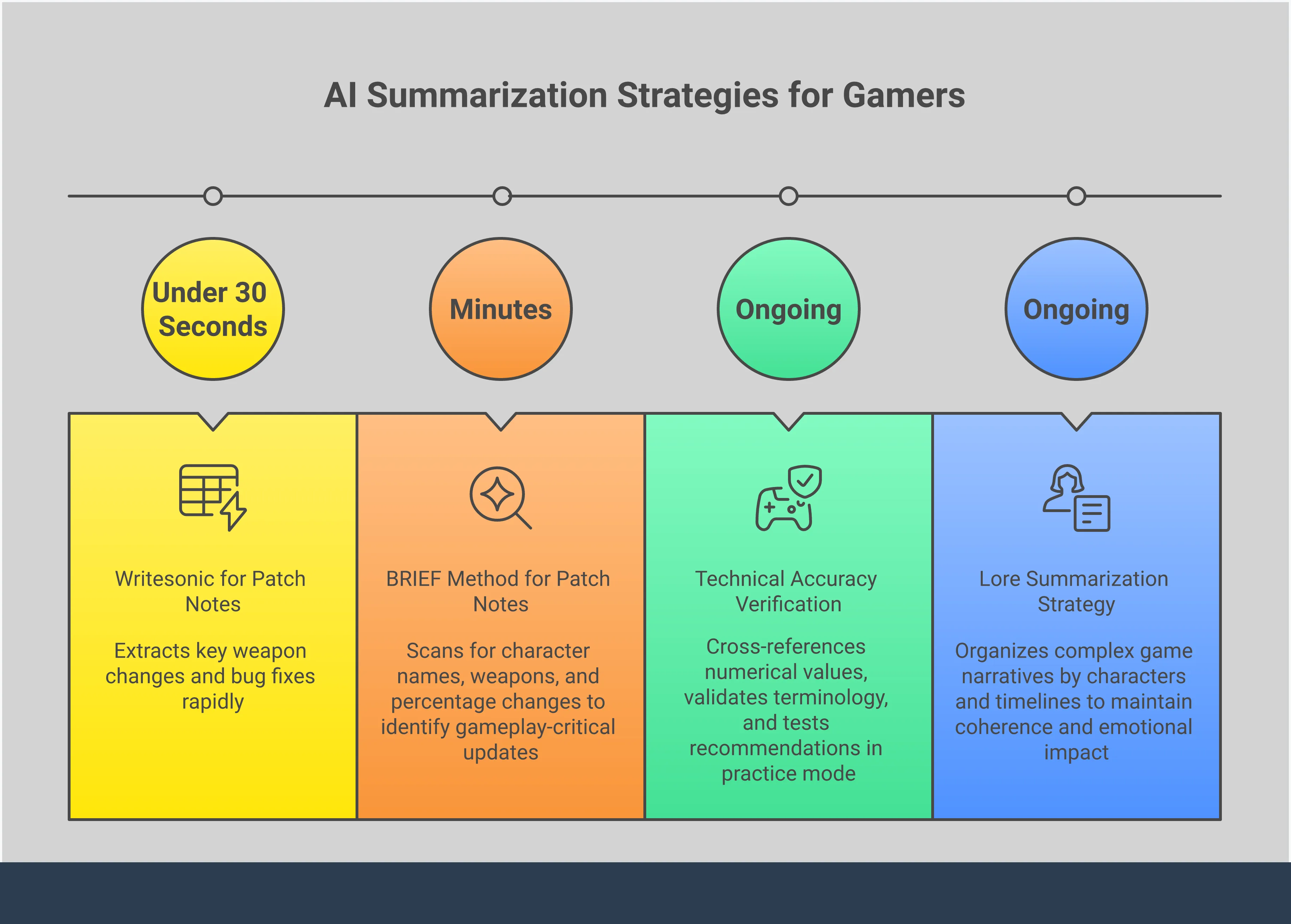
The BRIEF Method for Game Reports
As a gamer, I’m always excited when developers share updates, but those huge patch notes can be overwhelming! That’s where something called the BRIEF method comes in handy. It’s a really effective way to quickly figure out what actually matters for my gameplay, without having to read through tons of technical details. It’s all about getting the key changes fast and efficiently, so I can jump back into the game!
Imagine quickly pinpointing the most important changes in a long update – like a focused scan instead of reading everything. You’re looking for key details about your character, weapons, or how the game works, specifically major improvements, significant weaknesses, and important bug fixes. This lets you understand the critical updates quickly and adjust your game plan before your next play session.
Mind Mapping for Complex Game Mechanics
Certain games have systems that are too complex to explain with just a list. For example, games like Diablo 4 with its detailed skill trees, or Genshin Impact with its elemental combinations, require a more visual method. That’s where mind mapping is helpful. It’s a great way to see how different parts of a game work together, making complicated systems easier to understand and remember.
Instead of simply listing what your character can do, a mind map can reveal how abilities work together – for example, how a support skill boosts an attack, or how combining effects creates something even stronger. This is a great way to really understand a game’s inner workings, allowing you to create unique strategies and see why certain popular approaches are effective.
The Question Method for News and Reviews
Whenever a new game comes out, the internet quickly fills with opinions. To decide if it’s right for you, you need to filter out the noise and find information that actually matters. That’s where the Question Method comes in. It helps you pinpoint the most important parts of a game and what people are saying about them. Before reading any reviews, think about what you want to know – things like how well the combat works, if the story is engaging, or how smoothly it runs on your computer.
I love how reading about games makes me really focus on what I want to know. It’s like I’m actively searching for the things that matter to me, which helps me figure out if a game is actually good – or not – based on my own tastes. It’s also brilliant for sorting through all the hype and opinions online, like after a new trailer drops. I can quickly see if the game is something I’d really enjoy and if it’s worth spending my money on.
How to Summarize Epic Game Lore and Storylines
Starting a game with a rich history, like Final Fantasy XIV or The Elder Scrolls, can be overwhelming – it’s like jumping into the last episode of a long TV series! Whether you’re new to the game or returning after time away, learning all the backstory, characters, and important events feels like a huge challenge. That’s where AI summarization tools can help. They act like personal story experts, quickly breaking down large amounts of information so you can focus on enjoying the game. A good summary doesn’t just make the story shorter, it captures the most important parts in a clear and understandable way.
Condense Complex Narratives
Games with rich backstories often feature complex narratives that stretch across vast worlds and time periods, making them hard to follow. AI summarizers can help by quickly identifying the most important parts of the story – key plot points, themes, and events – from long texts or conversations. This lets you understand the main story without getting stuck on minor details. It’s like getting a perfect recap, ensuring you’re prepared for what happens next, just like the preview shown in the Vessel of Hatred trailer.
Preserve Character Arcs
Stories truly come alive through their characters, and simply recounting events doesn’t capture the emotional impact of their experiences. Great summaries go beyond just what happened, focusing instead on how characters change and the important connections they form. A helpful AI can follow a character’s growth – from a beginner to a legend – and preserve the feelings that make the story engaging. This lets you understand not only the plot, but why your favorite characters do what they do. It’s this connection to characters that creates the passionate communities you see around games like Honkai: Star Rail.
Maintain a Coherent Plot
Have you ever read a summary that just seemed like a list of disconnected facts? That usually means it lacks coherence. A strong summary should read smoothly, with events connected in a way that makes sense. Today’s AI summarizers use Natural Language Processing (NLP) to grasp the overall structure and meaning of a story. This technology ensures the summary tells a complete and logical story from start to finish. It doesn’t just pull out important words – it reconstructs the story, keeping the main plot intact while removing unnecessary details. Maintaining this clear narrative is crucial for creating an engaging experience, just as important as the game’s visuals or music.
Create the Perfect Summary for Guides and Walkthroughs
Let’s face it, many game guides are way too long. When you’re trying to optimize a character in Diablo 4 or learn a new raid, you don’t want to wade through tons of background information and complex strategies. You just need clear, quick instructions. That’s where AI summarization tools come in handy. They’re like creating personalized cheat sheets that give you exactly the information you’re looking for.
Instead of wading through long articles, you can use a summarizer to quickly find the most important information. Need help with a difficult game task, a quick explanation of new features, or just the key changes in an update? These tools help you get straight to what matters. It’s about being efficient – spending less time reading and more time actually playing. This is especially helpful in large, complex games where guides can be overwhelming. Summarizers give you the essential strategies without unnecessary details, making your gaming experience smoother and more enjoyable.
Simplify Lengthy Strategy Guides
We’ve all faced this: you’re battling a difficult boss, search for help online, and find a massive, overwhelming guide. Instead of desperately trying to read it while in the game, just copy and paste it into a summarizer. This tool can shorten long guides to a few important bullet points, giving you the main strategy without all the extra details. It helps you quickly understand what you need to do and get back to playing. It’s especially useful for complicated strategies with lots of steps, letting you focus on doing them instead of trying to figure them out.
Get the TL;DR on Patch Notes
Patch notes are often difficult to understand because they’re packed with technical details. Most players simply want to know how updates will impact their gameplay – like if a weapon has been weakened or a frustrating bug has been resolved. An AI summarizer can quickly provide a short, easy-to-understand overview. Just provide the link to the patch notes, and it will highlight the most important changes. This is especially helpful for games that are constantly updated, such as Apex Legends, and for understanding how those updates will affect your preferred strategies and equipment in games like Warzone.
Highlight Essential Gameplay Mechanics
If you’re starting a new game or coming back to one after a while, you might need a quick reminder of how certain things work – like making items, adding magical effects, or how your character gets stronger. Instead of reading a long guide, you can use a tool to quickly explain just those specific parts of the game. This helps you focus on what’s important without getting overwhelmed by details you already know. It’s a fast way to learn or remember how a game works, so you can jump right in without having to relearn everything.
How to Maintain Accuracy with Technical Gaming Content
When you’re breaking down complicated instructions or updates – like for a game – getting the details right is crucial. Even a small mistake can mean the difference between success and wasted effort. AI summarizers are great for a quick overview, but they don’t always handle technical information perfectly. Think of them as a helpful first step, not the complete answer.
Just like you wouldn’t blindly trust a teammate’s directions without checking your own map, you need to verify what the AI tells you. It’s important to guide the AI and confirm its summaries are both concise and accurate. Getting this right allows you to quickly understand important details – like the best Warzone equipment or complex boss strategies – without losing the accuracy you need to win. Essentially, you’re making the AI a helpful tool, ensuring you always get trustworthy information.
Keep Technical Details Intact
Effective summaries simplify complex information without losing important details. This is especially true when discussing game rules – every number and term is crucial. Instead of saying something like “improve your critical hit chance,” a helpful summary would state exactly how to do it, such as “wearing the ‘Gloves of Precision’ will give you a +15% critical hit chance against frozen enemies.” The latter provides a clear, usable instruction, while the former is too general. Always double-check your summaries against the original source to ensure you’ve included specific numbers, item names, and any conditions that apply. Remember, the point is to understand the strategy better, not just shorten the text.
Handle Gamer Jargon and Terminology
Gamers often use unique terms like “nerf,” “proc,” and “DPS” with specific meanings that standard AI might not understand. A simple summarization tool could easily misinterpret this slang or gaming-specific language, leading to inaccurate or confusing results. For example, an AI might not get the humor in a gaming community’s inside jokes, like those surrounding the ‘F.A.R.M.’ team in Honkai: Star Rail. When selecting a summarization tool, it’s important to choose one designed to handle specialized vocabulary. Always double-check that the tool correctly understands and keeps the meaning of gaming terms. The fact that researchers are actively working on improving AI’s ability to summarize gaming content highlights how crucial understanding context is.
Balance Brevity with Completeness
Summaries are meant to be quick and efficient, but they’re useless if they leave out important details. The key is finding the right balance – a summary should be short enough to save you time, but thorough enough to be helpful. For example, when looking at game patch notes, you need to know about even small changes to important abilities. A great way to get a good summary is to give the AI specific instructions. Instead of just asking for a general summary, tell it exactly what you want, like “Summarize the changes to the Druid’s Spirit Boons in this article.” This helps the AI focus on the most important information, giving you a summary that’s both concise and complete.
Common Challenges in Gaming Summarization
Summarizing video game content is more challenging than it seems. Games are full of complicated rules, rich backstories, and unique terms. While AI is improving, it still struggles to understand all of this. The biggest problems are figuring out how players feel from their comments, accurately capturing important technical details, and understanding the slang used by gaming communities.
Imagine trying to quickly understand a lively discussion on Reddit about a new Diablo 4 update. A basic summary like “Players are talking about the update” doesn’t capture the real story – the anger over a weakened ability, the enthusiasm for a cool new item, or the funny memes that show how everyone is feeling. A good summary needs to understand not just what people are saying, but how they’re saying it and why. That’s where simple AI often struggles, and why having a good understanding of the game yourself is still valuable. It’s helpful to be aware of the common mistakes AI makes before relying on its summaries.
Getting the Context Right
A major hurdle for artificial intelligence is accurately understanding what players really mean in their opinions. While AI can identify keywords in reviews, it often struggles with things like sarcasm, jokes only gamers would get, or hidden praise within criticism. For instance, if someone writes, “Wow, another fetch quest, just what I wanted,” an AI might think that’s a positive comment, when it’s actually sarcastic. To truly understand feedback, AI needs to grasp the gaming community’s culture. That’s why simply asking an AI if a game is “good” or “bad” isn’t enough—it’s the subtle details in player feedback that reveal the full picture and help improve the game.
Maintaining Technical Accuracy
When you’re researching things like the best weapon setups for Warzone or character builds, even small details are important. A great setup can differ from a good one by just one attachment or skill choice. While AI summarizers try to be brief, they sometimes remove crucial technical information, making the guide less helpful. For example, it might suggest a weapon without mentioning the important attachments you need. This can result in a shorter summary that isn’t actually useful when you’re playing the game. It’s difficult for AI to create summaries that are both concise and completely accurate, and many haven’t quite figured it out yet.
Dealing with Community Slang
Gaming communities develop their own unique slang. Words like “nerf” and “buff” are common for players, but an AI unfamiliar with gaming terms might not understand them at all – it could even get them completely wrong. It’s like trying to explain a funny inside joke, such as the F.A.R.M. Team memes from Honkai: Star Rail, to someone who doesn’t play the game. An AI struggles with this too, because it doesn’t share the same experiences to understand what these terms really mean. That’s why it’s still important to have people check the AI’s work – we can make sure the slang is understood correctly and the original meaning isn’t lost.
Find Your Perfect Summarization Strategy
There’s no single ‘best’ way to summarize gaming content. Instead, focus on creating a collection of tools and methods that suit your needs. Just like you wouldn’t use the same item for every situation in a game, the best approach depends on what you’re trying to do. Do you need a quick update on recent changes, or are you looking for a detailed exploration of a game’s story?
The best way to stay on top of gaming information is to use a variety of resources and methods, choosing the right one for each situation. Being adaptable is key – sometimes you need a quick overview, and other times a thorough analysis. Ultimately, you want to simplify your gaming experience, not make it more complicated. Let’s explore how to customize your approach so you can spend less time researching and more time enjoying the game.
Weighing Speed vs. Accuracy
Gamers are used to making choices between different strengths and weaknesses – like choosing between a powerful but fragile character or a slower, tougher one. The same idea applies when getting information. Sometimes you need answers right now. If you’re about to start a raid and need a quick overview of how a boss works, speed is the most important thing. In those moments, a fast AI summary that highlights the key points can be incredibly helpful. You’re happy to get the basic idea quickly, even if it means missing some of the finer details.
However, when you want to fully grasp a complex game story like that of Diablo 4, getting the details right is crucial. You need a summary that accurately reflects the characters’ reasons for acting, surprising plot turns, and the game’s overall themes – without making it too simple. In these cases, it’s best to take your time, use a more sophisticated summarization method, or even create a summary yourself to be sure you don’t miss anything important. The key is to know when to speed things up and when to slow down.
Match the Tool to the Content
As a gamer, I know you wouldn’t approach Warzone and Palworld the same way – different games need different strategies, right? Well, it’s the same with summarizing content! What I’ve learned is that the type of thing you’re summarizing really changes which tool works best. If I’m checking out player reviews, I want something that can really understand how people are feeling – a sentiment analysis tool is perfect for that. But if I’m trying to quickly understand a guide about the best Warzone weapons, I need a summarizer that won’t get confused by all the gaming terms and specific stats. It needs to be able to handle that kind of detail accurately!
Just because a tool is fancy and high-tech doesn’t mean it’s the best choice. Often, a straightforward method that pulls out the most important sentences works better and is less prone to errors, especially when dealing with technical information. Trying to be clever with AI can sometimes lead to inaccuracies. It’s best to test different tools – like those for patch notes, wikis, guides, or forums – to find what works most reliably for what you’re trying to do.
Find What Fits Your Workflow
The most effective way to get summaries is to choose a method you’ll actually stick with – it should easily fit into how you already play games. For example, if you lead a guild and need to share info with your team, an AI summarizer can quickly turn long forum posts or developer updates into short, useful reports. If you’re a solo player who wants to stay current on game strategies, a browser extension that summarizes articles as you read them could be incredibly helpful.
What frustrates you most about gaming? Do you waste time searching for help online, or struggle to recall details from older games? Pinpoint these issues and find a solution – whether it’s a tool or a new approach – that directly addresses them. The idea is to build a system that feels effortless, freeing up your mental energy so you can concentrate on enjoying the game.
Frequently Asked Questions
The easiest way to think about the difference between extractive and abstractive summaries is this: an extractive summary works like a highlighter – it simply picks out the most important sentences from the original text. An abstractive summary, on the other hand, is like having a friend explain something to you. They understand the information and then retell it in their own words, creating a new, simplified explanation.
It’s smart to be concerned about getting accurate information, especially with technical guides. AI summaries are a good starting point, but don’t rely on them completely. Use the summary to understand the overall plan, then double-check important details – like numbers, item names, and skill choices – against the original guide. Think of the AI as a helpful assistant that organizes things for you, but you’re still the one who needs to verify everything.
There are a lot of options, so which one should you start with? The best tool depends on what you’re trying to do. If you just need a quick summary of something like game updates or news, Writesonic is a good choice because it’s fast. If you’re trying to understand complicated game rules, Anyword is better at making things clear. The best approach is to think about what you read most often that feels overwhelming, and then choose the tool that seems best suited to help with that specific problem.
Do these tools actually understand gaming terms like “nerf” or “meta”? They’re improving, but it’s still tricky for them. Most AI tools learn from tons of online text, so they usually recognize popular terms like “nerf” and “buff.” However, they can struggle with slang or memes that are specific to certain gaming communities. If a summary doesn’t seem to understand a key term, it’s a good idea to go back to the original source to make sure you understand the context.
This tool isn’t just for competitive games! It’s really helpful for single-player RPGs too, especially those with complex stories and histories. You can quickly understand a character’s background by summarizing information from wikis, or simplify long guides into easy-to-follow checklists for quests. It’s also great if you’re picking up a game after not playing it for a while and need a refresher on the story.
Read More
- United Airlines can now kick passengers off flights and ban them for not using headphones
- Crimson Desert: Disconnected Truth Puzzle Guide
- All 9 Coalition Heroes In Invincible Season 4 & Their Powers
- Mewgenics vinyl limited editions now available to pre-order
- Viral Letterboxd keychain lets cinephiles show off their favorite movies on the go
- Assassin’s Creed Shadows will get upgraded PSSR support on PS5 Pro with Title Update 1.1.9 launching April 7
- Grey’s Anatomy Season 23 Confirmed for 2026-2027 Broadcast Season
- How to Get to the Undercoast in Esoteric Ebb
- All Golden Ball Locations in Yakuza Kiwami 3 & Dark Ties
- Does Mark survive Invincible vs Conquest 2? Comics reveal fate after S4E5
2025-12-03 17:21