Post-apocalyptic films often show us worlds brought to a standstill, filled with the ruins of what once was. The 28 Days Later series started with this idea – an abandoned London frozen in time during a zombie outbreak. The recent 28 Years Later revisited this world, focusing on how survivors rebuilt their lives and formed new, often strange, communities. Now, 28 Years Later: The Bone Temple takes a different approach. Instead of a physical standstill, it explores a psychological one, showing characters haunted by the past – even those who didn’t live through the original disaster.
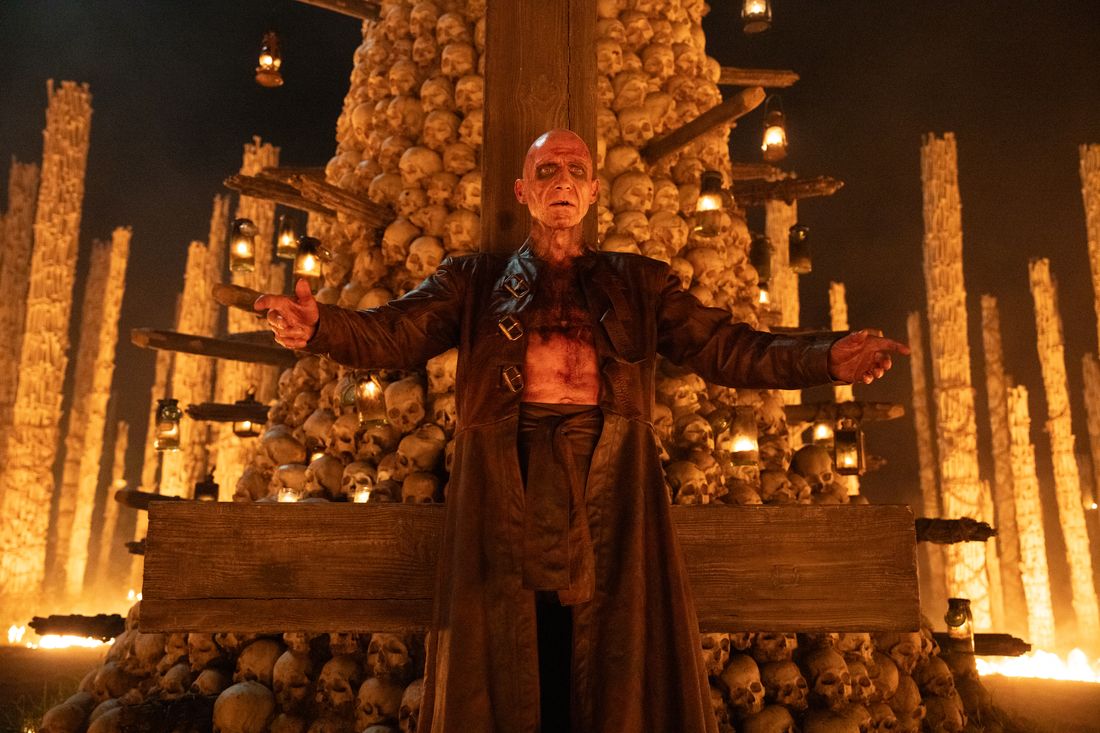
Compared to 28 Years Later, The Bone Temple feels more straightforward – director DaCosta wisely avoids repeating the original’s fast-paced editing and unusual visual style. However, it delves deeper into the characters’ minds. The previous film ended with a strange scene involving a group of eccentric zombie killers led by someone named Jimmy. The Bone Temple explores the origins of this group and the disturbing cult surrounding their leader, Jimmy Crystal (Jack O’Connell). Crystal’s appearance and persona seem to be based on Jimmy Savile, a famous British DJ whose horrific crimes were revealed after his death. The film imagines a world where Savile would have remained a popular figure, and his image is now exploited by the villain, who we briefly saw as a troubled child in the first film, growing up amidst both religion and pop culture like the Teletubbies. These early influences have warped together in his mind, creating the monstrous figure he is today.
This movie really shifts from the shaky, travelogue feel of the first one to a much smoother way of telling the story. I found myself really drawn into what’s happening with Dr. Kelson, who we met before as that eccentric guy living alone. He’s still trying to understand the zombies, but now he’s experimenting with morphine on this huge, powerful one named Samson, hoping to calm him down and maybe even bring back some of the person he used to be. Kelson’s built this incredible, unsettling temple covered in bones as a way to honor everyone who’s died, even the zombies themselves. He used to talk about how important it is to hold onto your humanity and remember that everyone faces death, but he had to become pretty hardened to survive. Now, he’s hoping his morphine might actually reverse the infection, wondering if it destroys the mind or just covers it up. He doesn’t have enough to make a real cure, though, and it feels like he’s mostly just lonely and wants a connection. There’s this incredibly strange, beautiful scene where he and the sedated Samson sit under the moonlight, looking at the stars, and they even… dance. It’s a really odd movie, but it’s stuck with me.
It’s not surprising that the large zombie in the film begins to display more human qualities than Jimmy Crystal, who appears to be a normal person. Genre films often explore the idea that humans can be the true monsters, and this series has hinted at that before. What makes The Bone Temple stand out is how these glimpses into the characters’ feelings come together to reveal a disturbing view of human cruelty. We see a flashback of Samson as a happy child on a train – likely when he was infected. In another scene, we experience an attack through Samson’s eyes, and it feels like he’s fighting his own inner self, trying to destroy what he’s become. This contrasts sharply with Jimmy Crystal’s wish to mold the children he collects into twisted versions of himself. Both characters, unable to see others as individuals, unleash terrible violence.
What makes DaCosta’s film so good is how seamlessly it weaves in deeper ideas, despite The Bone Temple being a rather over-the-top movie. It’s wonderfully wacky, filled with moments like Kelson’s impromptu dance parties (fueled by his vintage records), the strange behavior of the Jimmys, and a truly epic, high-energy climax that got the whole theater excited. Even these wild scenes feel connected to the film’s theme: a society trapped in the past, where people seem stuck at the moment everything fell apart. The film suggests that the only way to cope with and survive a world ending is to embrace who you are and let go.
Read More
- United Airlines can now kick passengers off flights and ban them for not using headphones
- Crimson Desert: Disconnected Truth Puzzle Guide
- All 9 Coalition Heroes In Invincible Season 4 & Their Powers
- The Boys Season 5 Spoilers: Every Major Character Death If the Show Follows the Comics
- Mewgenics vinyl limited editions now available to pre-order
- Invincible Season 4 Episode 6 Release Date, Time, Where to Watch
- Grok’s ‘Ask’ feature no longer free as X moves it behind paywall
- Assassin’s Creed Shadows will get upgraded PSSR support on PS5 Pro with Title Update 1.1.9 launching April 7
- ‘Timur’ Trailer Sees Martial Arts Action Collide With a Real-Life War Rescue
- Crimson Desert Guide – How to Pay Fines, Bounties & Debt
2026-01-15 18:55