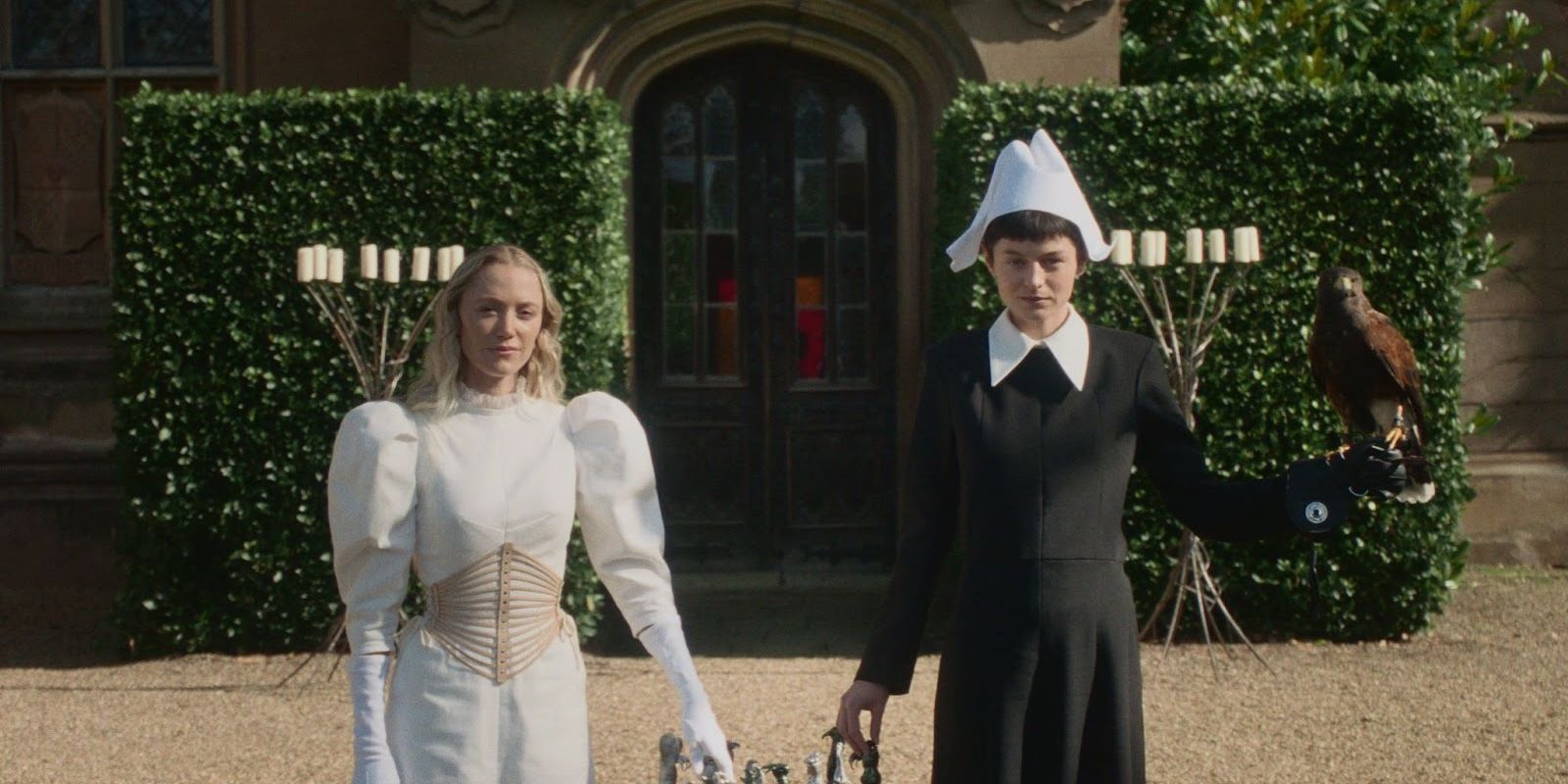
Julia Jackman’s film views storytelling as a powerful act of feminism. Inspired by Isabel Greenberg’s graphic novel, which itself draws from the Middle Eastern tale One Hundred and One Nights, it’s a queer fairy tale with a straightforward message. While the production design by Sofia Sacomani creates a visually appealing, somewhat fantastical medieval setting, the film relies on this style a bit too heavily. Emma Corrin delivers a captivating performance as Hero, bringing strength and beauty to the role, but even with their best efforts, the film remains superficial and doesn’t explore its themes in enough depth.
Unfortunately, this film doesn’t offer much that hasn’t already been done better in similar movies. It’s heavily influenced by the styles of filmmakers like Wes Anderson, Sofia Coppola’s Marie Antoinette, and Emerald Fennell’s Saltburn, using unusual visuals and outdated fashion to try and convey deeper themes, but without much success. The electronic score by Oliver Coates is particularly jarring and unpleasant.
100 Nights of Hero Fails to Distinguish Itself From Other Anachronistic, Queer Tales
I’m a little confused by this film, honestly. It feels like it can’t quite decide what it’s about, which is ironic considering the whole point seems to be about the power of sharing your own story. The title made me think we’d get a bunch of different stories, but really, it focuses on just one: the story of three sisters, led by Rosa, who get into trouble simply because they can read and write. It’s a powerful idea, but the film feels a bit unfocused getting there.
The story mainly follows Cherry (Maika Monroe), a quiet housewife whose husband, Jerome (Amir El-Masry), seems more interested in men. The world they live in was originally created by a young child named Kiddo (Safia Oakley-Green), but Birdman (Richard E. Grant) took over and doesn’t like the freedom Kiddo built in. As a result, he’s established strict, controlling rules where everyone worships him, dresses like birds, and women are expected to be submissive. To make matters worse, Cherry faces a deadly ultimatum: she must become pregnant within 100 days, or she will be put to death.
Because the movie focuses almost entirely on White characters, with actors of color relegated to minor or background roles, it’s difficult to see it as offering a fresh or groundbreaking perspective on the problems caused by traditional male dominance.
Hugh Jackman’s character is furious about a double standard: men are given freedom while women are restricted and then blamed for the consequences of men’s behavior. This sets the stage for the introduction of Manfred, an old friend of his, who makes a risky bet: he’ll seduce his wife while her husband is away. The stakes are high – if Manfred succeeds, he’ll gain control of the husband’s property. However, the husband secretly hopes Manfred will achieve another goal: impregnate his wife, thus ending local gossip and providing him with an heir.
While acting as Cherry’s servant, Hero shares news of Rosa’s liberation and troubles with both Cherry and Manfred. Although the movie is promoted as a steamy love triangle, that aspect doesn’t develop until much later. The first half of the film relies heavily on repetitive scenes that make the timeline and setting confusing. Marilyn Monroe’s Cherry spends most of the movie appearing fragile and distressed, then abruptly changes in the final scenes. Galitzine’s Manfred is attractive and likable, but lacks depth.
I was really drawn in by Corrin’s performance – when the movie let them shine, that’s when it truly worked. The visuals were lovely too, though maybe a bit too precious at times. Honestly, though, the story itself felt flat. It tried to tackle some interesting ideas, but it just didn’t have the depth or beauty of Shakespeare. And the romantic connection between the characters? It was pretty obvious from the beginning and stayed that way throughout – not subtle at all, just repeatedly stated.
What really bothered me about this film was that it talked about revolution, but we never actually saw it. There’s this offhand mention of an uprising happening elsewhere, but it feels like a missed opportunity. And honestly, given how the story focuses almost entirely on white characters, while people of color are relegated to the sidelines or just used as background, it’s hard to feel like the film is offering any fresh or even interesting insights into the dangers of the patriarchy. It just feels…empty, considering the themes it tries to address.
Despite the challenges, Jackman delivers a truly impressive performance. There’s a real emotional impact to seeing a dark world transformed by the strength of a hopeful story. Even though that concept might feel old-fashioned in today’s world, it’s still deeply touching. If reality feels unsteady, we can always find solace and escape through the power of imagination.
Read More
- United Airlines can now kick passengers off flights and ban them for not using headphones
- Crimson Desert: Disconnected Truth Puzzle Guide
- All 9 Coalition Heroes In Invincible Season 4 & Their Powers
- Grey’s Anatomy Season 23 Confirmed for 2026-2027 Broadcast Season
- Mewgenics vinyl limited editions now available to pre-order
- Viral Letterboxd keychain lets cinephiles show off their favorite movies on the go
- All Golden Ball Locations in Yakuza Kiwami 3 & Dark Ties
- Assassin’s Creed Shadows will get upgraded PSSR support on PS5 Pro with Title Update 1.1.9 launching April 7
- Does Mark survive Invincible vs Conquest 2? Comics reveal fate after S4E5
- The Boys Season 5 Spoilers: Every Major Character Death If the Show Follows the Comics
2025-12-03 02:58