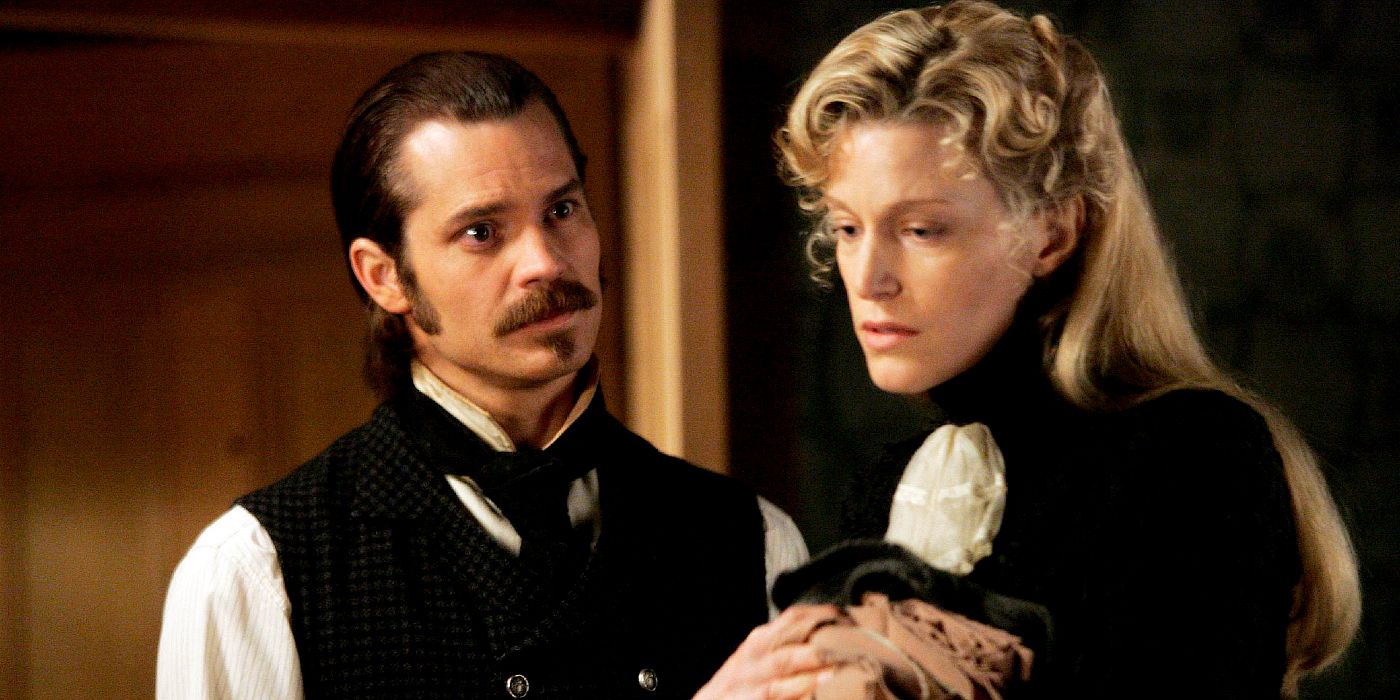
If you ask a serious TV fan about shows they wish hadn’t been canceled, HBO’s “Deadwood” is likely to come up. Created by David Milch, this incredibly well-made Western originally aired for three seasons, each with twelve episodes, starting in 2004. It was truly unique – a gritty and realistic portrayal of life in a lawless 1870s North Dakota camp, where a group of people struggled to survive and build a life, facing constant danger. It was completely captivating.
Choosing just 10 episodes of Deadwood as masterpieces is tough, because the show consistently delivered high quality – honestly, most of its 36 episodes could make a strong argument for inclusion. Deadwood didn’t really have bad episodes; each one built the story, explored the show’s themes, and included scenes that people still talk about fondly. But if forced to choose, here are 10 that have truly stood the test of time and deserve the title of masterpiece.
“Requiem For a Gleet” Underlined How Vital Al Swearengen Is to the Deadwood Camp
When Deadwood moved from its first to second season, Al Swearengen, played by Ian McShane, clearly became the show’s most compelling character. Creator David Milch realized this, and many would have expected him to give Swearengen even more screen time.
It was a risky move, but one that paid off in spades.
For many fans, the kidney stone storyline in Deadwood perfectly captures what made the show so unique, which is why the episode “Requiem For a Gleet” has become a classic. It was a fantastic hour of television that allowed Ian McShane to portray a more sensitive side of Swearengen, gave the supporting cast a chance to excel, and offered a realistically painful depiction of medicine in the 1870s.
Over the past two decades, the character has proven to be one of HBO’s all-time greats – a man whose sheer determination was so powerful, it seemed even death couldn’t overcome him.
“Amalgamation and Capital” Has One of the Most Shocking Endings in TV History
If you’re someone who really pays attention to what’s going on, you probably started feeling uneasy right from the beginning of season two’s “Amalgamation and Capital.” I know I did! I’d been watching him try to connect with Martha and William – his late brother’s wife and son – ever since they came to Deadwood, and it was clear things weren’t going to be easy. It just felt… tense from the start.
This week, Bullock finally acknowledged William, hinting at a possible father-son bond. But, as often happens on TV, just when things were looking up, a new crisis emerged, reminding them that life can be cruel.
Unfortunately, the episode unfolds exactly as you might expect, despite initially leading viewers to believe something different. The majority of the time is spent showing various things happening at the camp, leaving you wondering if they’ll all come together or stay separate. A particularly heartwarming moment arrives when William rides a unicycle that Tom Nuttall, the bar owner, bought – it’s one of the show’s most genuine displays of simple happiness.
Honestly, just when you start to feel good about things, disaster strikes. Arnette Hostetler’s horse bolts – completely out of the blue – and races right through the camp, tragically trampling William. It’s such a shocking turn of events, even though, looking back, there was this underlying sense of dread. It remains one of the most startling and unforgettable endings I’ve ever seen.
“The Whores Can Come” Is an Incredibly Sad, Yet Profound, Episode
“The Whores Can Come” isn’t usually mentioned among a fan’s favorite episodes, likely because it’s a very somber story. It centers on the funeral of a young boy, William Bullock, who died after an accident involving a horse, and the event causes everyone in the camp to reflect on how fragile life can be.
Characters like Trixie, Sol Star, Calamity Jane, Joanie Stubbs, and even Al Swearengen’s closest associates – Dan Dority, Silas Adams, and Johnny Burns – are all deeply affected by the death of a child. They interrupt their lives to attend William’s funeral.
This episode is unique because it’s one of the few times everyone at the camp is united. What makes it even more interesting is that they come together not because of the usual problems – like threats from Yankton or George Hearst’s plans – but due to a sudden, heartbreaking event. This makes the episode feel unusually realistic and grounded.
Interestingly, Swearengen is the only one who skips the service, yet he lets everyone who works for him – including the prostitutes – attend. The story suggests he couldn’t bring himself to look at William’s body, as the boy’s death reminded him of his own difficult childhood. This moment made Swearengen, who usually seems cold and calculating, feel more human and understandable.
“Mister Wu” Boasted Swearengen at His Most Ruthless
Calling a single episode of Deadwood a showcase for Ian McShane doesn’t quite fit. Almost every episode includes at least one or two scenes where he delivers a captivating—and often intimidating—speech filled with incredibly inventive cursing.
These shows are all fantastic examples of how well the actors embody their characters – truly one of the best pairings in television history. But the tenth episode of the first season, “Mister Wu,” has become a classic for two main reasons.
The story’s pace suffers because it spends too much time on Swearengen’s relentless pursuit of the thieves who stole drugs from Wu, a Chinese business owner, as those drugs were meant for the Gem Saloon’s owner. Swearengen always gets what he wants, and when he discovers who committed the theft, he brutally drowns one of his own men in a bathtub to prevent a conflict with Cy Tolliver.
This episode also showcases the beginning of a wonderfully funny dynamic between Wu and Swearengen. Despite the fact that they don’t share a language—Wu doesn’t speak English and Swearengen doesn’t speak Chinese—they begin to connect through gestures and colorful language. This initial, difficult interaction lays the foundation for a lasting bond throughout the series. “Heng dai!”
In “A Two-Headed Beast,” Dan Dority Went to War
While Deadwood featured moments of action, it wasn’t primarily known for typical Western gunfights. Though the show spanned three seasons, action sequences weren’t central to its storytelling. However, it did showcase a couple of particularly intense fights, notably a fierce brawl between Swearengen and Bullock early in the second season.
The second fight was legendary. It was a brutal clash between Dan Dority, the man always at Wyatt’s side, and Captain Joe Turner, a key figure working for George Hearst.
The intense fight happened during the fifth episode of season three, right in the middle of camp with everyone watching. It was a shockingly brutal display – something the onlookers would never forget. Dority and Turner, both large and powerful men, repeatedly punched each other, wrestled in the mud trying to gain the upper hand, and even tried to hold each other’s heads underwater in the shallow puddles.
But Milch was a skilled writer, and the fight wasn’t just meaningless violence. By the time Dority won by brutally injuring and killing Turner, the show had drawn the audience into the conflict, making them feel responsible for the brutality. Afterwards, viewers had to watch Dority grapple with the trauma of both experiencing and inflicting such violence for many episodes.
“E.B. Was Left Out” Became a Showcase For One of Deadwood’s Funniest Characters
The character of E.B. Farnum, the slippery owner of the Grand Central Hotel, was consistently funny. William Sanderson played him perfectly as someone always eager to join any plan, even if he didn’t really help much.
Farnum was a slippery and overly polite man who thought he deserved more than he had, and everyone in Deadwood knew he wasn’t to be trusted. So, it wasn’t surprising when he was appointed town Mayor – a role with no actual authority, but one that allowed Farnum to feel important.
In this episode, Farnum becomes furious watching a meeting at the Gem from Grand Central. Actor Sanderson delivers an amazing performance, portraying a character who is both funny and heartbreaking. This scene perfectly captures Farnum’s core flaw: he’s consistently underestimated, but fails to recognize it’s because people see through his dishonest schemes, making his manipulations painfully obvious.
In another standout moment, Swearengen shares a powerful lesson with A.W. Merrick: true endings only come with death, not with suffering. Until then, he advises, don’t hesitate to inflict pain on those who deserve it.
“Deadwood” Welcomed Audiences to a Whole New (Profane) World
The first episode of Deadwood starts with Seth Bullock, acting as sheriff in Montana, facing a difficult situation: a prisoner is desperately trying to bargain for his life to avoid a lynch mob heading to the jail. Viewers naturally assume that Bullock, a man known for his strong principles, will refuse the deal and protect the prisoner from the approaching vigilantes.
Instead, Bullock publicly hangs the man, shocking those who were determined to take revenge themselves. This unexpected act was a defining moment for Deadwood, immediately setting it apart from other shows.
After that moment, the pilot consistently showed viewers it was unlike anything else in the genre. The dialogue, initially shocking and difficult to follow, ultimately proved to be brilliantly clever and thought-provoking once you allowed yourself to get immersed in it.
The show also featured a remarkable cast of unique and memorable characters, many of whom quickly became beloved by fans over the next three seasons. It’s rare to find a show with so many characters who leave a lasting impression – but then again, Deadwood was never ordinary.
“True Colors” Gave Us Hearst at His Most Intimidating
When Deadwood first started, viewers might have expected a simple story of a good guy, Bullock, facing off against a clear villain, Swearengen. However, as the show progressed, it became apparent that the characters were more complex. Bullock wasn’t a traditional hero, and Swearengen wasn’t simply a villain – he was a much more ambiguous figure.
You know, as a big fan of Deadwood, I always felt like the show was building to something huge, and when George Hearst finally showed up at the end of Season 2, it delivered. Milch really gave us the show’s ultimate bad guy with him. That season finale and the first episode of Season 3 were fantastic showcases for Hearst, but there’s one scene in ‘True Colors’ that really stuck with me – it’s the moment I knew he was a truly terrifying presence. It just cemented him as the villain you love to hate.
Hearst and Alma Garrett meet to talk about Hearst buying Garrett’s gold claim. Alma feels surprisingly good about her ability to negotiate. However, it quickly becomes clear that she misjudged Hearst, even though her husband, Whitney Ellsworth, had warned her he was a difficult man.
Gerald McRaney is truly frightening as Hearst in this scene, immediately establishing himself as the most menacing character in the show. The moment his gaze locks onto Garrett, it’s like watching a predator size up its target – the tension becomes instantly palpable and incredibly gripping. This scene is a perfect illustration of a classic villain and reveals everything we need to understand about his enduring evil.
“Sold Under Sin” Ends With a Genuinely Heartwarming Moment
Over time, Deadwood became known as a deeply intense, challenging, and meaningful show – and it absolutely lived up to that reputation. But it was also surprisingly hilarious, often funnier than many traditional comedies, and sometimes even genuinely touching. These lighter, more enjoyable sides of the show deserve just as much recognition as its darker, more dramatic elements.
Let’s give some credit to “Sold Under Sin.” The episode concludes with a heartwarming scene that’s sure to brighten anyone’s day.
Throughout the first season, viewers saw Jewel, the Gem Saloon’s cleaner and cook, in brief scenes. It gradually became apparent that Swearengen, despite being annoyed by her limp, had a strange fondness for her. In the episode “Jewel’s Boot Was Made For Walking,” she asked Doc Cochrane to build her a brace to help with the limp, and he reluctantly agreed. Cochrane’s concern for Jewel was heartwarming, as he was clearly worried about making her condition worse.
The final scene showed Swearengen looking down from the Gem Saloon’s balcony as Jewel and Cochrane danced. It was a deeply moving moment that brought tears to many viewers’ eyes.
“Here Was a Man” Helped the Show Solidified Itself as Something Special
The first three episodes of Deadwood suggested a truly exceptional show, but the fourth episode confirmed it. This outstanding hour of television opens with Keith Carradine’s character, once again, heavily drinking and playing poker.
But trouble starts brewing when he insults Jack McCall (Garret Dillahunt). By now, viewers had come to expect Wild Bill Hickok to be a central figure, so they’d never imagine a minor character could simply kill him. Shockingly, that’s precisely what happens.
McCall shooting Hickok, seemingly over a personal insult, felt like a statement from the show’s creator, David Milch, that no character was safe. While viewers familiar with the historical events surrounding Hickok’s death likely suspected McCall from the start, the moment still came as a shock to those unfamiliar with the story.
Looking back, that episode really stuck with me as the show went on – it almost feels like a hidden gem now! It’s because of Titus Welliver, who played Francis Walcott, the geologist we all loved to hate. He came back in season two as Walcott, and then popped up as a completely different character later on! It got a lot of us thinking – could the spirit of the man McCall killed be cursed to wander around Deadwood, taking on different forms? It’s probably a bit of a stretch when you really think about it, but it’s a really fun idea to consider, and it adds another layer to the show for me.
Read More
- United Airlines can now kick passengers off flights and ban them for not using headphones
- Crimson Desert: Disconnected Truth Puzzle Guide
- Katanire’s Yae Miko Cosplay: Genshin Impact Masterpiece
- How to Get to the Undercoast in Esoteric Ebb
- All Golden Ball Locations in Yakuza Kiwami 3 & Dark Ties
- All 9 Coalition Heroes In Invincible Season 4 & Their Powers
- All Itzaland Animal Locations in Infinity Nikki
- HBO’s Harry Potter Is Already Breaking My Heart
- Gold Rate Forecast
- Zendaya’s 4 Big 2026 Movies Could Beat Brie Larson’s Box 2019 Office Record
2025-12-12 22:18